
Stop Guessing PCB Types: The 3 Main Categories Every Engineer Needs To Nail First

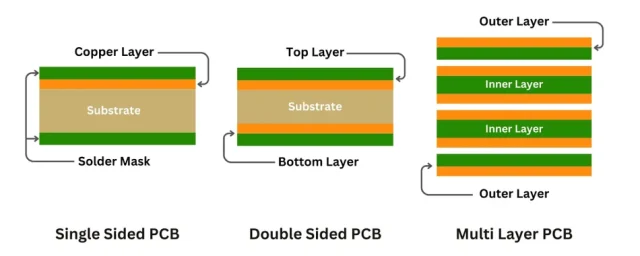
What are the three main types of PCBs? They are single-sided, double-sided, and multilayer PCBs. Single-sided boards fit ultra-low-cost simple projects, double-sided boards balance cost and capability for most mid-tier designs, and multilayer boards handle high-speed, high-complexity electronics.
Last year, a startup building smart home Bluetooth sensors came to us in a panic. Their first prototype used a 6-layer board, pushing their BOM cost 42% higher than their direct competitors, and they couldn’t hit their target retail price. I opened their design files, and found a basic low-power temperature and humidity sensor that could have been built perfectly on a double-sided board. This is the first pitfall 90% of hardware teams fall into: they overcomplicate their design before they even understand the three core PCB categories that define every project.

Why This 3-Type Framework Is The Foundation Of Every Good Design

The PCB industry has dozens of niche board types: rigid-flex, high-frequency, metal-core, you name it. But every single one of them traces back to these three core categories. Skip this step, and you’ll either blow your budget on overkill, or end up with a board that can’t deliver the performance you need.
Before we dive into the details of each type, if you’re confused about which substrate pairs best with your design, we broke down every critical detail in [What is the most common PCB material?].

The Side-By-Side Breakdown No Datasheet Will Give You

Core PCB Type Base Structure Real-World Capabilities Ideal Use Cases Relative Unit Cost Standard Manufacturing Lead Time
Single-Sided PCBs Single layer of copper foil bonded to one side of a rigid insulating substrate, with all traces and components on the same face Simplest circuit routing, no via drilling required, minimal design constraints TV remotes, basic LED lighting, low-cost power adapters, simple sensor modules, disposable consumer electronics Lowest (up to 70% cheaper than double-sided boards for high-volume runs) 1–3 days
Double-Sided PCBs Two layers of copper foil (top and bottom) on a rigid substrate, connected by plated through-holes (PTH) More compact routing, support for higher component density, moderate circuit complexity, basic grounding and noise reduction Industrial control boards, automotive auxiliary electronics, smart home devices, audio amplifiers, power supply units Moderate (2–3x single-sided boards, but exponentially cheaper than multilayer for most designs) 2–5 days
Multilayer PCBs 4+ alternating layers of copper foil and insulating substrate, laminated into a single rigid board, connected via blind, buried, or micro-vias Ultra-high density interconnect (HDI), high-speed signal integrity, advanced EMI shielding, extreme miniaturization, complex power distribution AI server motherboards, 5G communication equipment, automotive ADAS systems, smartphones, aerospace electronics High (cost rises exponentially with layer count; 4-layer boards are 4–6x double-sided, 16-layer boards can be 20x+ more) 5–15 days

What The Spec Sheets Skip: Real-World Truths From The Factory Floor

Single-Sided PCBs: Not Just For Hobby Projects
Many new engineers turn their noses up at single-sided boards, writing them off as “amateur level”. But here’s the hard number: in 2025, single and double-sided rigid boards still made up over 40% of global PCB production volume for cost-sensitive, high-volume applications.
A client of ours manufacturing disposable medical temperature sensors switched from a double-sided to a single-sided design last year, dropping their per-unit PCB cost from $0.28 to $0.11. For a 12 million unit annual run, that’s $2.04 million in direct savings. No performance loss, no reliability issues. Just a smarter choice.
I’ve seen too many teams overcomplicate a $0.50 product with a multi-layer board, just to feel like they’re doing “serious engineering”. It’s a waste of time and money.
Diagram-showing-single-double-and-multi-layer-PCBs-640x256

Double-Sided PCBs: The Unsung Workhorse Of The Industry

If you’re working on a general-purpose electronic design that doesn’t need multi-gigabit signal speeds, 9 times out of 10, a double-sided board is the right call. It’s the sweet spot between cost, design flexibility, and manufacturing speed.
Per 2025 IPC data, double-sided boards hold a steady 32% share of the global industrial PCB market, and that number isn’t dropping any time soon. They’re the default for a reason.
The only time I see double-sided boards fail is when a designer tries to cram a server-level design onto them. Match the tool to the job.

Multilayer PCBs: The Power Tool You Shouldn’t Use For Every Job

Multilayer boards are incredible. They let you pack 1000+ components into a space the size of a credit card, run 56 GHz signals without loss, and build electronics that would have been impossible 20 years ago. But they’re not for every project.
Last quarter, a startup building EV charging accessories came to us with an 8-layer board design that kept failing EMC testing. We reviewed it, and realized they only needed 4 layers — the extra layers were poorly designed, creating grounding loops and signal interference that didn’t exist in a simpler stackup. We reworked the design to a 4-layer board, cut their cost by 58%, and they passed EMC on the first try.
There’s a weird myth in hardware circles that more layers = better design. That’s like using a sledgehammer to hang a picture frame. It works, but you’re going to make a mess and spend way more money than you need to.

2026 Shifts That Are Rewriting PCB Type Selection

Based on the latest 2026 global PCB market forecasts, the industry will hit a $100.64 billion valuation this year, with clear shifts in how each core PCB type is being adopted. Standard multilayer boards will expand their market share to 34% of global output in 2026, driven by explosive 42% year-over-year growth in 8–16 layer high-speed boards for AI servers and automotive ADAS systems. At the same time, single-sided PCB demand is rebounding 18% in the low-power IoT sensor space, as manufacturers prioritize extreme cost efficiency for battery-powered, disposable devices. Double-sided PCBs will remain the dominant choice for general industrial and white goods applications, holding a steady 32% of the industrial PCB market through 2026, with no signs of decline.

Real Questions From Real Designers (No Fluff, No Corporate Speak)

Q: If multilayer PCBs are so advanced, why would anyone ever use a single-sided or double-sided board?

A: It all comes down to cost and necessity. If your design can run reliably on a single-sided board, using a multilayer board is just throwing money away. Multilayer boards come with exponentially higher manufacturing costs, longer lead times, and far less room for design tweaks mid-prototype. For a simple circuit with a handful of components, a single or double-sided board will be more reliable, cheaper, and faster to produce. I’ve seen more prototypes fail from over-engineered multilayer designs than from under-engineered double-sided ones.

Q: Can I just upgrade from a double-sided to a 4-layer board mid-prototype without redoing my entire design?

A: No. A 4-layer board isn’t just a double-sided board with two extra layers tacked on. The entire layer stackup, impedance control, via design, and grounding strategy have to be rebuilt from the ground up. Trying to shoehorn a double-sided design into a 4-layer board will almost always create signal integrity issues, grounding loops, and manufacturing defects that are harder to fix than just reworking the design properly. Save yourself the headache, and pick the right board type before you lay down your first trace.

At the end of the day, picking the right PCB type isn’t about picking the most advanced option. It’s about picking the one that fits your design, your budget, and your production timeline.

Whether you’re figuring out the right board type for your first prototype, or scaling a design to high-volume mass production, our team has 10 years of industry experience delivering high-quality, cost-optimized PCBs for every use case. Send us an inquiry today, and we’ll give you a free, no-obligation design review and custom quote within 24 hours.

About US

Founded in 2012, JKRGLO strives to build a one-stop platform for the electronic industry chain. By integrating PCB manufacturing, component procurement and PCB assembly services, we enable digital PCBA processing. With increasing investment in innovation and digital systems, we have achieved rapid growth and emerged as a leading PCB and PCBA manufacturer in the industry, capable of rapidly producing high-reliability and cost-effective products.
 

Table of Contents

滚动至顶部