63/37 vs 60/40 Solder: The Practical Difference, Side by Side
Introducción inicial
Respuesta rápida:63/37 and 60/40 are both tin-lead solders that melt around 183°C, but they behave differently on the iron. 63/37 is eutectic, so it flips from solid to liquid at a single temperature with no in-between “mushy” stage — easier to hand-solder and far less likely to throw a cold joint. 60/40 has a ~7°C plastic range (183–190°C), so a joint can shift and crack while it sets. For hand soldering and rework, grab 63/37; 60/40 is fine for general work and costs a little less. One thing both share: neither is RoHS-compliant — they’re both lead-based.
If you’ve stood in the solder aisle wondering whether the extra tin in 63/37 is worth the few cents, you’re not alone. The two alloys look identical on the spool and the specs overlap just enough to be confusing. They’re not the same thing, though, and the difference shows up the moment you touch the iron.
What "eutectic" actually means
This is the whole ballgame, so it’s worth getting right.
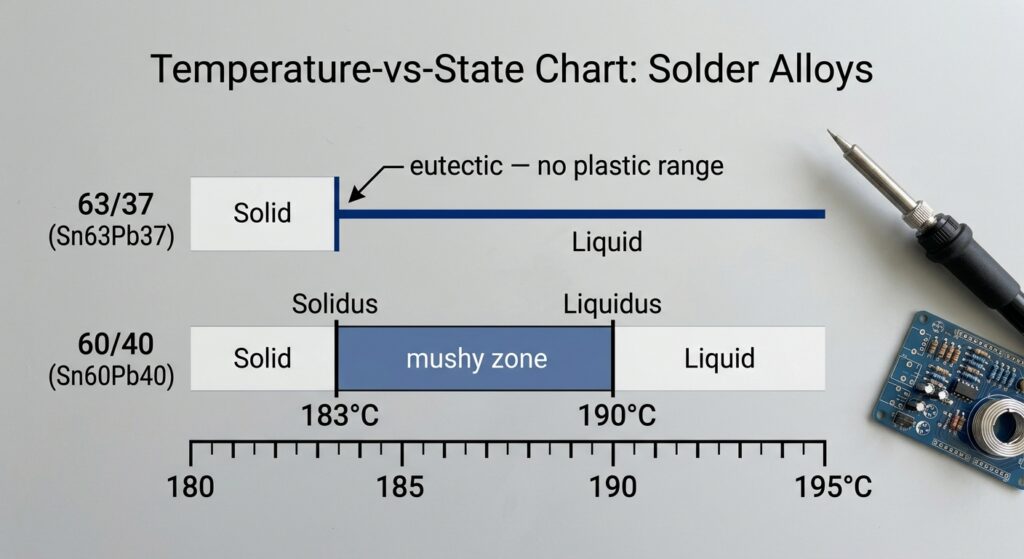
A pure metal melts at one exact temperature. Mix two metals and you usually get a range: the alloy starts softening at the solidus temperature and only becomes fully liquid at the liquidus temperature. In between, it’s a paste — part solid, part liquid. That in-between zone is called the plastic (or “mushy”) range, and it’s where joints get disturbed.
A eutectic alloy is the exception: it has a single, sharp melting point with no plastic range. Real eutectic tin-lead is 61.9% Sn / 38.1% Pb at exactly 183°C. Commercial 63/37 sits close enough that it behaves as eutectic in practice — it goes solid→liquid in one clean step.
60/40 is not eutectic. Its solidus is 183°C and its liquidus is ~190°C, leaving a ~7°C window where it’s half-melted.
63/37 vs 60/40 at a glance
| Property | 60/40 (Sn60Pb40) | 63/37 (Sn63Pb37) |
|---|---|---|
| Tin / lead | 60% / 40% | 63% / 37% |
| Eutectic? | No | Yes (effectively) |
| Melting point | 183–190°C (range) | 183°C (sharp) |
| Plastic range | ~7°C (mushy) | None |
| Fluidity on the iron | Good | Better / wets faster |
| Cold-joint risk | Slightly higher | Lower |
| Relative cost | Lower | Slightly higher (more tin) |
| Best for | General / through-hole / dip | Hand soldering, rework, precision |
| RoHS-compliant? | No (contains lead) | No (contains lead) |
Where they're the same
People mix these up for a reason — they share the basics:
- Both are lead-based soft solders. Neither is RoHS-compliant, full stop. If you need lead-free, you’re looking at SAC305 (Sn96.5/Ag3.0/Cu0.5) or similar, not either of these.
- Both start melting at 183°C, so your iron temperature and technique carry over between them.
- Both take rosin-core or acid-core, work in wave soldering and reflow, and form strong, conductive joints when done right.
- Both are easy to find and cheap enough that solder cost is rarely the deciding factor in a project.
Where they actually differ
The mushy zone is the big one. With 60/40, if a part moves, the board flexes, or you pull the iron a beat too early while the joint is still in that 183–190°C paste, you get a disturbed or cold joint — grainy, dull, unreliable. 63/37 skips that stage entirely, so the window for screwing it up is smaller.
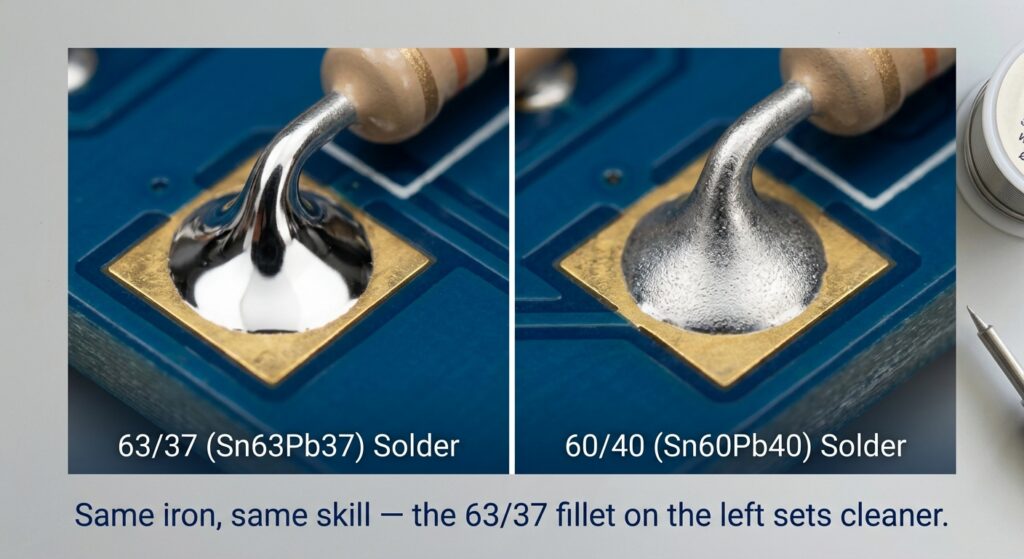
Fluidity. Because 63/37 hits liquid cleanly, it wets and flows a touch faster, which means fewer solder bridges between tight pins and a neater fillet.
Finish. 63/37 joints tend to look bright and smooth as they set; 60/40 can look slightly duller or grainier because of that partial-solidification texture.
Price. 63/37 carries more tin, so it’s usually a hair more expensive per spool. For most hobbyists the gap is meaningless; for high-volume production it adds up.
Which should you actually use?
If you only keep one spool on the bench, make it 63/37. The eutectic behavior is more forgiving, especially for hand soldering, through-hole rework, and any work where you’re holding the joint while it cools. It’s the alloy most pro bench techs reach for by default.
Reach for 60/40 when:
- You’re doing high-volume dip or wave soldering and the plastic range is actually useful for the process.
- You’re cost-sensitive on a large run and the joints aren’t precision-critical.
- It’s simply what’s in the drawer and the job is straightforward.
Either way, the mechanical strength difference is small enough that it rarely decides a real-world failure. The win with 63/37 is consistency and fewer do-overs.
The RoHS myth (most guides get this wrong)
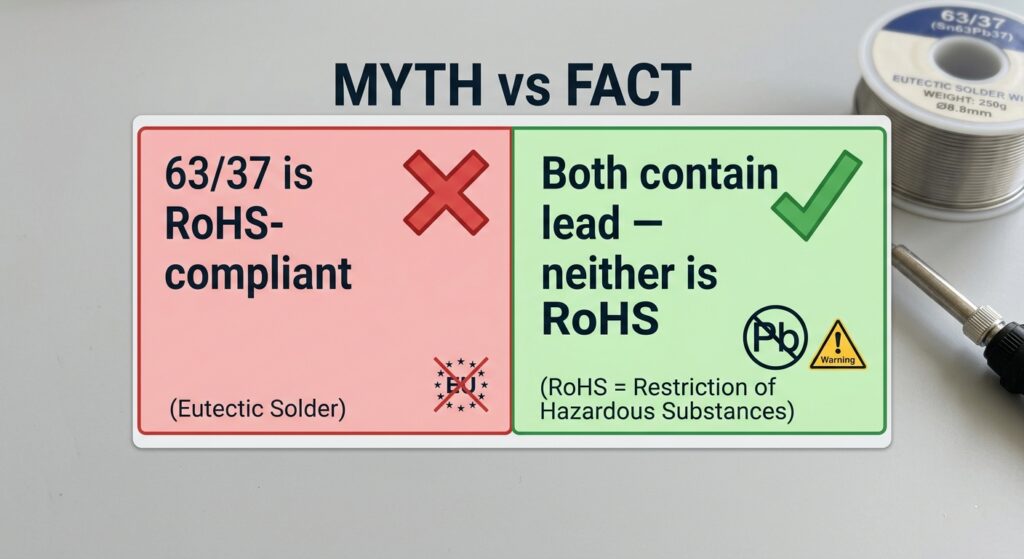
You’ll see articles claim 63/37 is “closer to RoHS-compliant” or safer on regulations. That’s false. RoHS restricts lead outright; an alloy that’s 37% lead is nowhere near compliant. The “safer” move isn’t picking 63/37 over 60/40 — it’s going lead-free (SAC305 and friends) when the product must meet RoHS. 63/37’s only real edge on the regulation front is that it uses slightly less lead, which changes nothing for compliance.
Preguntas frecuentes (FAQ)
R:Is 63/37 solder better than 60/40?
For hand soldering and rework, yes — its eutectic, single-point melt makes cleaner joints with less risk of cold spots. For bulk automated soldering, 60/40 is a common, cost-effective choice. Neither is “stronger” in a way that usually matters.
R:Can I use 60/40 and 63/37 interchangeably?
On the same iron and temperature, yes — both melt near 183°C and form reliable joints. Just expect 60/40 to need a steadier hand during cool-down because of its mushy range. Don’t mix the two alloys in the same joint if you can avoid it.
R:Is 63/37 solder RoHS compliant?
No. It’s roughly 37% lead, and RoHS bans lead in most electronics. For RoHS you need a lead-free alloy like SAC305. 63/37 is easier to work with than 60/40, but it is not the compliant option.
Quiénes somos
Quizá también te interese…

Acerca del autor
Andrew Zhan – Ingeniero de I+D en JKRGLO.com
Con más de 14 años de experiencia en ingeniería de I+D en el sector de las placas de circuito impreso (PCB), Andrew Zhan aporta una amplia experiencia en la optimización del diseño de circuitos y la implementación de prácticas de fabricación (DFM). Se centra en convertir requisitos de diseño complejos en soluciones listas para la producción, impulsando la innovación técnica tanto para la fabricación de prototipos como para la producción en serie.
En estrecha colaboración con equipos multidisciplinares y con los clientes, garantiza una rigurosa validación de la calidad y una comunicación técnica fluida a lo largo de todo el ciclo de vida del proyecto. Andrew se compromete a ofrecer soluciones de placas de circuito impreso (PCB) fiables y de alto rendimiento que superen constantemente las expectativas de los clientes.
Índice
¿Aún necesitas ayuda? Ponte en contacto con nosotros:
¿Necesitas un presupuesto para una placa de circuito impreso (PCB) o un conjunto de placa de circuito impreso (PCBA)?
Etiqueta:
63-37
PCBA
63 37 solder
PCB