
Stop Guessing PCB Types: The 3 Main Categories Every Engineer Needs To Nail First
Why This 3-Type Framework Is The Foundation Of Every Good Design
The Side-By-Side Breakdown No Datasheet Will Give You
| Core PCB Type | Base Structure | Real-World Capabilities | Ideal Use Cases | Relative Unit Cost | Standard Manufacturing Lead Time |
|---|---|---|---|---|---|
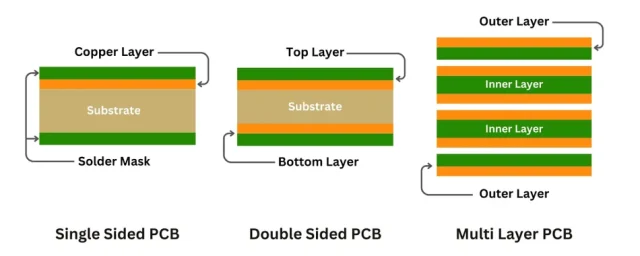
| Single-Sided PCBs | Single layer of copper foil bonded to one side of a rigid insulating substrate, with all traces and components on the same face | Simplest circuit routing, no via drilling required, minimal design constraints | TV remotes, basic LED lighting, low-cost power adapters, simple sensor modules, disposable consumer electronics | Lowest (up to 70% cheaper than double-sided boards for high-volume runs) | 1–3 days |
| Double-Sided PCBs | Two layers of copper foil (top and bottom) on a rigid substrate, connected by plated through-holes (PTH) | More compact routing, support for higher component density, moderate circuit complexity, basic grounding and noise reduction | Industrial control boards, automotive auxiliary electronics, smart home devices, audio amplifiers, power supply units | Moderate (2–3x single-sided boards, but exponentially cheaper than multilayer for most designs) | 2–5 days |
| Multilayer PCBs | 4+ alternating layers of copper foil and insulating substrate, laminated into a single rigid board, connected via blind, buried, or micro-vias | Ultra-high density interconnect (HDI), high-speed signal integrity, advanced EMI shielding, extreme miniaturization, complex power distribution | AI server motherboards, 5G communication equipment, automotive ADAS systems, smartphones, aerospace electronics | High (cost rises exponentially with layer count; 4-layer boards are 4–6x double-sided, 16-layer boards can be 20x+ more) | 5–15 days |
What The Spec Sheets Skip: Real-World Truths From The Factory Floor
Single-Sided PCBs: Not Just For Hobby Projects
Double-Sided PCBs: The Unsung Workhorse Of The Industry
Multilayer PCBs: The Power Tool You Shouldn’t Use For Every Job
2026 Shifts That Are Rewriting PCB Type Selection
Real Questions From Real Designers (No Fluff, No Corporate Speak)
Q: If multilayer PCBs are so advanced, why would anyone ever use a single-sided or double-sided board?
A: It all comes down to cost and necessity. If your design can run reliably on a single-sided board, using a multilayer board is just throwing money away. Multilayer boards come with exponentially higher manufacturing costs, longer lead times, and far less room for design tweaks mid-prototype. For a simple circuit with a handful of components, a single or double-sided board will be more reliable, cheaper, and faster to produce. I’ve seen more prototypes fail from over-engineered multilayer designs than from under-engineered double-sided ones.
Q: Can I just upgrade from a double-sided to a 4-layer board mid-prototype without redoing my entire design?
A: No. A 4-layer board isn’t just a double-sided board with two extra layers tacked on. The entire layer stackup, impedance control, via design, and grounding strategy have to be rebuilt from the ground up. Trying to shoehorn a double-sided design into a 4-layer board will almost always create signal integrity issues, grounding loops, and manufacturing defects that are harder to fix than just reworking the design properly. Save yourself the headache, and pick the right board type before you lay down your first trace.
At the end of the day, picking the right PCB type isn’t about picking the most advanced option. It’s about picking the one that fits your design, your budget, and your production timeline.