
2026년 PCB 제조 관세: 중국산 기판에 적용되는 실제 관세 누적액
서론
간단한 답변
2026년 9월 현재, 중국산 인쇄회로기판에는 12.5% 또는 37.5%의 미국 수입 관세가 부과되며, 결정적인 요인은 해당 기판이 2층 및 4층 경질 FR4 회로 기판에 대한 제301조 면제 대상에 해당하는지 여부입니다. 자격을 갖춘 기판은 25% 제301조 제품 관세를 면제받으며, 2026년 7월 24일에 도입된 12.5% 강제노동 등급 관세만 납부합니다. 그 외 모든 제품(6층 이상, 플렉스 및 리지드-플렉스, 비-FR4 기판, 그리고 대부분의 조립 기판)은 일 년 내내 37.5%를 납부해 왔습니다. 이 면제 조치는 2026년 11월 9일 오후 11시 59분(미국 동부 표준시)에 만료되며, 이는 현재 PCB 구매자들에게 가장 중요한 날짜입니다. 2025년을 지배했던 IEEPA 관세는 2026년 2월 20일 대법원에 의해 무효화되었으며, 4월 이후 약 $165억에 달하는 징수된 관세가 수입업체들에게 환급되고 있습니다.
2026년에 관세 논의의 양상이 달라졌다. 작년에는 ‘145%’, ‘30%’와 같은 숫자가 헤드라인을 장식했고, 그 주 뉴스에서 다루는 내용이 무엇이든 그에 따라 화제가 바뀌곤 했다. 하지만 올해는 제외 품목 수, 관세 분류, 그리고 11월의 단일 마감 기한에 대한 기술적인 논의가 주를 이루고 있다. 기판을 구매하는 분들에게 이러한 변화는 중요합니다. 서류 처리 방식과 레이어 수에 따라 동일한 기판이라도 두 번의 선적 시 관세율이 25%포인트나 차이가 날 수 있기 때문입니다.
저희는 매주 미국 구매자들을 위해 기판을 제작하고 견적을 내기 때문에, 이러한 규정이 실제 구매 주문서에 어떻게 반영되는지 직접 확인하고 있습니다. 아래는 2026년 9월 기준 USTR, CBP 및 법원 제출 자료를 대조하여 확인한 실제 관세 부과 내역과, 저희 공장에서 직접 확인한 내용입니다.
1. 현재 중국산 PCB의 가격은 얼마인가요?
“중국산 PCB에 적용되는 관세는 얼마인가”라는 질문에 대한 단 하나의 정답은 없습니다. 현재 관세는 두 가지 변수, 즉 기판의 층 수와 구조, 그리고 해당 제품에 적용되는 특정 면제 조항이 여전히 유효한지에 따라 결정되기 때문입니다. 다음은 2026년 9월 기준 중국산 제품에 대한 전체적인 현황입니다.
| 보드 종류 (중국산) | 제301조 대상 제품에 대한 관세 | 강제 노동 등급 (2026년 7월 24일부터) | 실효 관세 |
|---|---|---|---|
| 2층 경질 FR4, 제외 대상 (HTS 8534.00.0040) | 0% (제외됨) | 12.5% | 12.5% |
| 4층 경질 FR4, 제외 대상 (HTS 8534.00.0020) | 0% (제외됨) | 12.5% | 12.5% |
| 6층 이상, HDI, 플렉스, 리지드-플렉스, 비-FR4 기판 | 25% | 12.5% | 37.5% |
| 조립된 기판(PCBA) — 일반적으로 기판 제외 대상에서 제외됨 | 25% (분류에 따라 다름) | 12.5% | ~37.5% |
| 중국산 IC 및 반도체 (8541 / 8542) | 50% | 12.5% | 62.5% |
관세는 물품의 관세 평가액에 적용되며, 위의 수치에는 운임, 상품 처리 수수료 및 중개 수수료가 제외되어 있습니다. 두 가지 주목할 점이 있습니다. 첫째, 같은 공장에서 생산되어 같은 주에 출하된 2층 기판과 6층 기판의 관세에는 25포인트의 차이가 발생할 수 있습니다. 이는 가격이나 품질 때문이 아니라, 어떤 관세 품목과 어떤 면제 조항에 해당하느냐에 따른 것입니다. 둘째, 12.5% 등급은 PCB에 한정된 조치가 아닙니다. 이는 중국산 상품 전반에 적용됩니다.
2. 2026 스택이 어떻게 재구축되었는가
2026년 첫 7개월 동안의 규칙 변경은 지난 3년 동안의 변경을 모두 합친 것보다 더 많았습니다. 그중 다섯 가지 사건이 가장 큰 변화를 가져왔습니다.
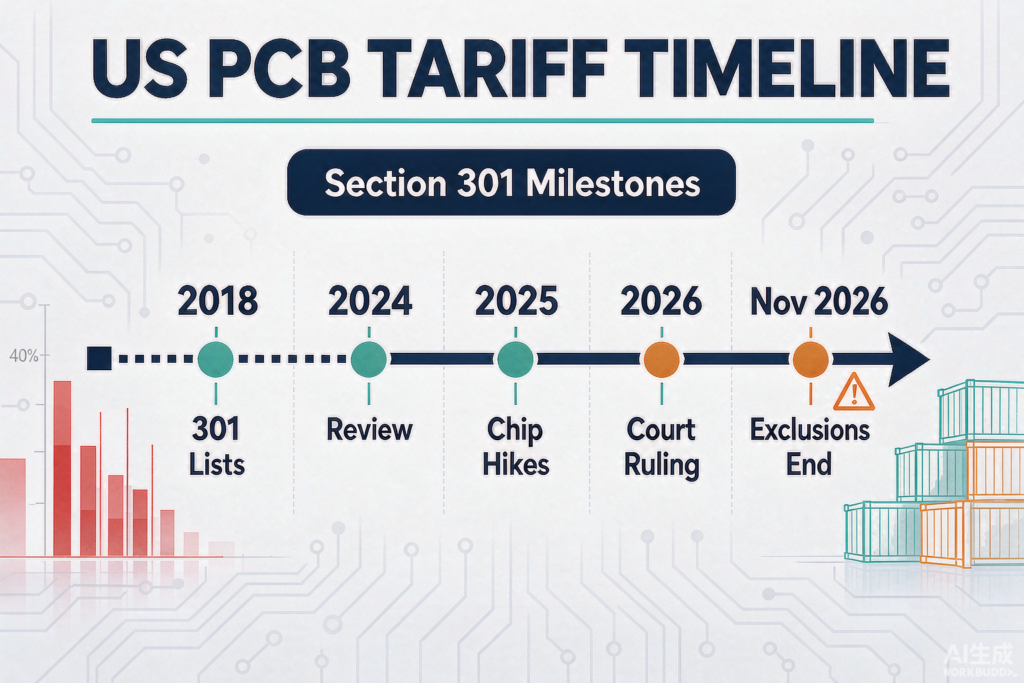
| 날짜 | 무슨 일이 있었나요? | PCB 구매자에게 이는 무엇을 의미하는가 |
|---|---|---|
| 2026년 2월 20일 | 대법원은 6대 3의 판결로 IEEPA가 대통령에게 관세를 부과할 권한을 부여하지 않는다고 판단하여, 펜타닐 및 상응 관세를 무효화했다. | 귀하의 신고 내역에 IEEPA 관련 항목이 없으며, 환급을 청구할 수 있게 되었습니다. |
| 2026년 2월 24일~25일 | 1974년 무역법 제122조에 따른 10% 임시 추가 관세가 전 세계적으로 발효되었으며, 적용 기간은 최대 150일로 제한된다. | 무효화된 관세 대신 10%라는 단일 규정이 적용되었으며, 동시에 지속 가능한 메커니즘이 마련되었다. |
| 2026년 3월 4일부터 4월 20일까지 | 국제무역법원은 환급을 명령했고, CBP는 CAPE 포털을 개설하여 환급금 지급을 시작했습니다. | 약 33만 명의 수입업자에게 $166억이 미지급된 상태이며, 8월까지 $100억에 가까운 금액이 환급될 예정이다. |
| 2026년 6월 24일 | ‘데 미니미스’ 조치는 중국뿐만 아니라 모든 원산지에 대해 일시 중단되었다. | 시제품, 예비 부품 및 소량 주문의 경우 이제 통관 신고를 하고 관세를 납부해야 합니다. |
| 2026년 7월 24일 | 제122조는 법정 유효기간이 만료되었으며, 같은 날 2단계로 구성된 제301조 강제노동 관세가 발효되었다. | 중국은 12.5% 등급으로 이동했으며, 약 45개의 다른 국가 및 지역은 10% 등급에 머물러 있다. |
| 2026년 11월 9일, 오후 11시 59분 (미국 동부 표준시) | 178 301조 면제 조항이 만료되며, 여기에는 2층 및 4층 경질 기판을 포함하는 조항도 포함됩니다. | 미국 무역대표부(USTR)가 기한을 연장하지 않는 한, 중국의 2층 및 4층 기판에 대한 관세율이 12.5%에서 37.5%로 인상된다. |
| 2026년 11월 27일 | 중국이 미국에 대한 갈륨 및 게르마늄 수출 통제 조치의 유예 기간이 만료되었다 | 업무 변경이라기보다는 부품 조달 위험에 가깝지만, 동일한 프로그램들에 영향을 미치고 있다 |
한 가지 패턴을 명심해 둘 필요가 있습니다. 관세 제도가 무효화되거나 만료될 때마다, 그 대체 조치는 몇 달이 아니라 단 몇 시간 만에 등장해 왔습니다. 관세가 없는 기간을 염두에 둔 계획은 2년 연속으로 실패로 돌아갔습니다.
3. 당신의 임무를 결정하는 다섯 가지 요소
PCB 제조 관세는 무조립 보드나 조립된 보드가 국경을 통과할 때 구매자가 납부하는 수입 관세로, 구매 주문서에 명시된 총액이 아닌 상품의 관세 평가액을 기준으로 산정됩니다. 이러한 가치 중심의 논리 때문에 운임과 보험료가 관세 내역에 포함되지 않으며, 동일한 판자라도 신고 방식에 따라 구매자마다 가격이 달라질 수 있는 것입니다.
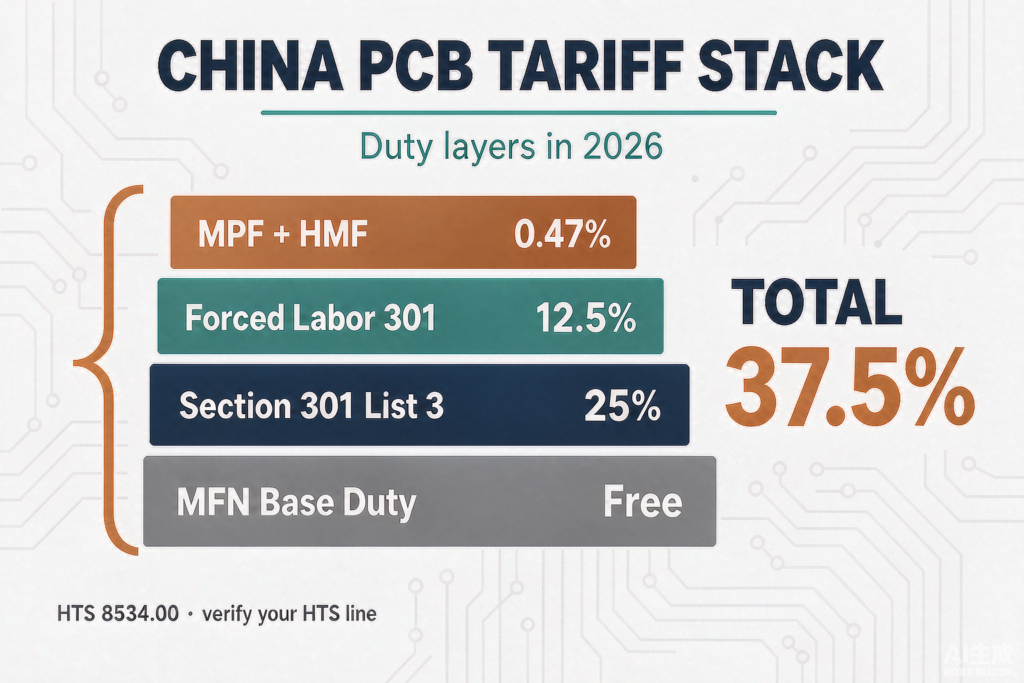
| 레이어 | 요율 | 적용 대상 및 적용 범위 |
|---|---|---|
| 최혜국 대우 관세 | HTS 8534.00에 대해서는 면세 | 모든 원산지. 기준 세율이 0%라고 해서 최종 세율이 0%가 되는 것은 아닙니다. 그 외의 모든 과세 단계는 여전히 적용됩니다. |
| 제301조 대상 제품에 대한 관세 | 25% | 중국 및 홍콩산 PCB의 경우, 해당 제품이 공표된 제외 대상에 포함되지 않는 한 |
| 제301조 강제노동 등급 | 12.5% 중국, 10% ~45개 기타 국가·지역 | 2026년 7월 24일부터 약 60개 경제권에서 제122조 추가 요금을 대체하여 시행됩니다. |
| 상품 처리 수수료 (MPF) | 입력된 값의 0.3464%, 법정 최저 한도 적용 | 정식 수입 신고. 소량 화물의 경우 최소 수량이 비율을 좌우한다. |
| 항만 유지 관리비 (HMF) | 0.125% | 해상 운송만 해당되므로, 항공 및 해상 운송 견적에 약간의 차이가 발생합니다. |
제301조 면제란 연방관보에 게재된 제품별 면제 조치로, 일반적으로 정해진 기간 동안, 게재된 설명과 정확히 일치하는 상품에 한해 목록에 등재된 품목을 제301조 관세 적용 대상에서 제외하는 것을 말합니다. 일부 이사회에서는 적용 제외 조항 때문에 실효 세율이 다른 이사회에 비해 3분의 1 수준에 그치는 것입니다.
4. 2단계 및 4단계 배제 조치, 그리고 11월 9일에 일어날 일
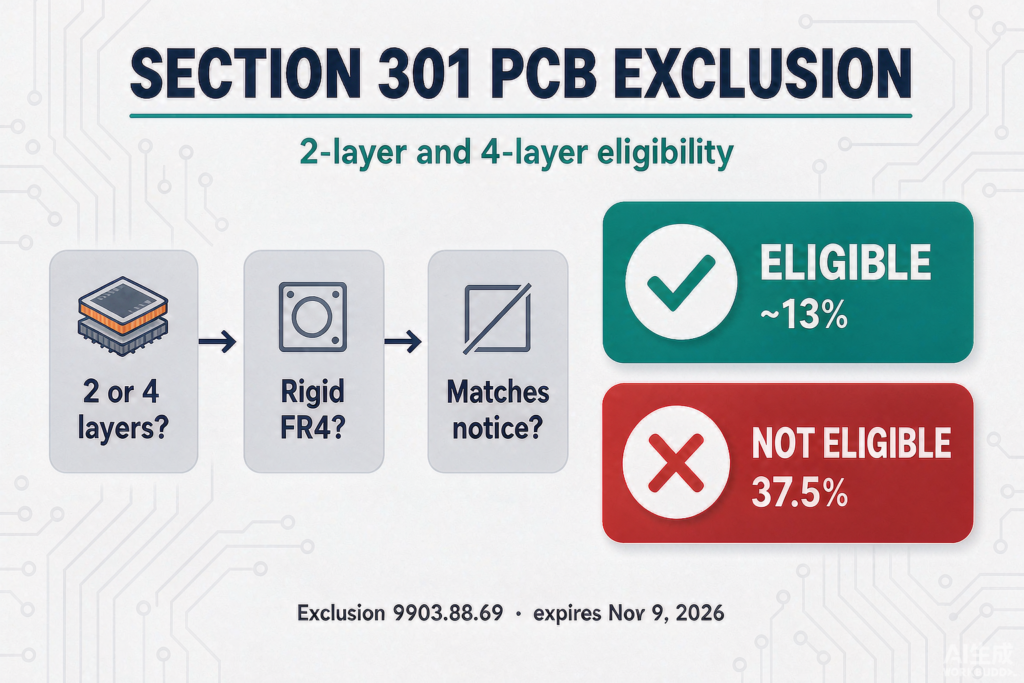
대부분의 단순 기판을 저렴한 가격에 공급할 수 있게 해주는 이 예외 조항은 HTS 9903.88.69에 명시되어 있습니다. 이 조항은 일반적인 “인쇄 회로 기판”을 포괄하지 않으며, 매우 좁은 범위의 설명만을 다루고 있습니다. 따라서 해당 설명의 어느 부분이라도 충족하지 못하는 기판들은 구매자들이 이를 반드시 인지하지 못한 채로 일 년 내내 37.5%의 관세를 전액 납부해 왔습니다.
| 오늘 자격 요건을 충족합니다 | 자격 요건을 충족하지 않습니다 |
|---|---|
| 단단한 보드만 | 플렉스, 리지드-플렉스 및 모든 유연한 구조 |
| 유리 강화 기판(표준 FR-4) 위에 구리층 2개, 또는 동일한 기판 위에 구리층 4개 | 6층 이상, HDI, 그리고 4층을 초과하는 모든 수 |
| 비어 있고 부품이 없는 기판 | 부품이 실장된 조립 보드 |
| 유리 섬유 강화 기판 | 메탈코어, 알루미늄, 세라믹 및 기타 특수 기판 |
HTS 8534.00은 부품이 장착되지 않은 인쇄회로기판(베어 PCB)에 적용되는 미국 관세 품목 번호이며, 이 품목 번호 자체에는 기본 관세가 부과되지 않습니다. 구매자가 실제로 지불하는 금액은 여기에 추가로 적용되는 무역 구제 조치에 따른 관세에서 비롯됩니다.
이 면제 조치는 2026년 11월 9일 동부 표준시 기준 오후 11시 59분에 만료됩니다. 미국 무역대표부(USTR)가 이를 연장하지 않는 한, 11월 10일에 최초로 제출된 신고 건부터는 전액 관세가 부과됩니다. FOB $3.00 조건으로 4층 기판 1,000개를 주문할 경우, 관세액 차이는 $375와 $1,125가 됩니다.
| 현재 (제외 조항 적용 중) | 2026년 11월 10일부터 | |
|---|---|---|
| 실질 관세율 | 12.5% | 37.5% |
| $3,000 화물에 대한 관세 | $375 | $1,125 |
| 운임 제외 보드당 비용 | $3.38 | $4.13 |
| 변경 | — | 보드당 +22% |
5. HTS 분류: 대부분의 구매자가 절대 확인하지 않는 항목
분류에 따라 어떤 레이어가 적용될지가 결정됩니다. 또한 이는 구매자가 공급업체를 변경하지 않고도 실질적인 비용 절감 효과를 얻거나, 반대로 실질적인 부담을 초래할 수 있는 유일한 변수이기도 합니다.
| 제목 | 다루는 내용 | 실무 참고 사항 |
|---|---|---|
| 8534.00 | 무부품 인쇄회로기판 — 리지드, 플렉스, 리지드-플렉스, 무부품 | MFN은 무료이며, 실제로 지불하는 금액은 25% 및 12.5% 계층에 해당합니다. |
| 8473.30 | 컴퓨터 및 데이터 처리 기기의 구성 요소인 어셈블리 | 대부분의 수입업자들이 생각하는 것보다 범위가 좁으며, 다른 기능을 수행하는 보드들은 포함되지 않습니다. |
| 8517.62 및 8517.79 | 통신 장치용 어셈블리 | 2026년 강제노동 관련 조치의 부속서에서 도출된 것으로, 양측 모두에게 뜻밖의 결과를 초래한다 |
| 8537.10 | Boards fitted with switching or control apparatus, under 1,000 V | Common for industrial controllers and machine panels |
| 8542.31 and 8542.39 | Integrated circuits, including some modules that function as ICs | China-origin parts here carry the 50% semiconductor rate |
USMCA rules of origin determine whether goods assembled in Mexico or Canada enter the United States duty-free, and they rest on where the qualifying manufacturing processes happen rather than simply where the last assembly step took place. Classification and origin are the two places where documentation, not negotiation, sets your rate.
Two habits pay for themselves. First, classify by function and write the reasoning down before the first shipment, so the answer does not change with whoever is filling out the paperwork that month. Second, if the value is meaningful or the heading is arguable, request a binding ruling through CBP’s eRulings system. It is free, it takes about a month, and it converts a judgment call into a document you can hand an auditor years later. Reclassification after the fact does not just cost the duty — it can cost interest and penalties, and it applies retroactively to every entry you filed the same way.
6. Landed cost: four scenarios on the same order
Landed cost is the total a buyer pays to get goods into a warehouse — unit price plus freight, insurance, duty, customs fees, and inland delivery — and it is the only number worth comparing between suppliers in different countries. Here is an illustrative 1,000-piece, four-layer order across four sourcing routes. Freight, MPF, and brokerage are excluded so the duty effect is visible on its own.
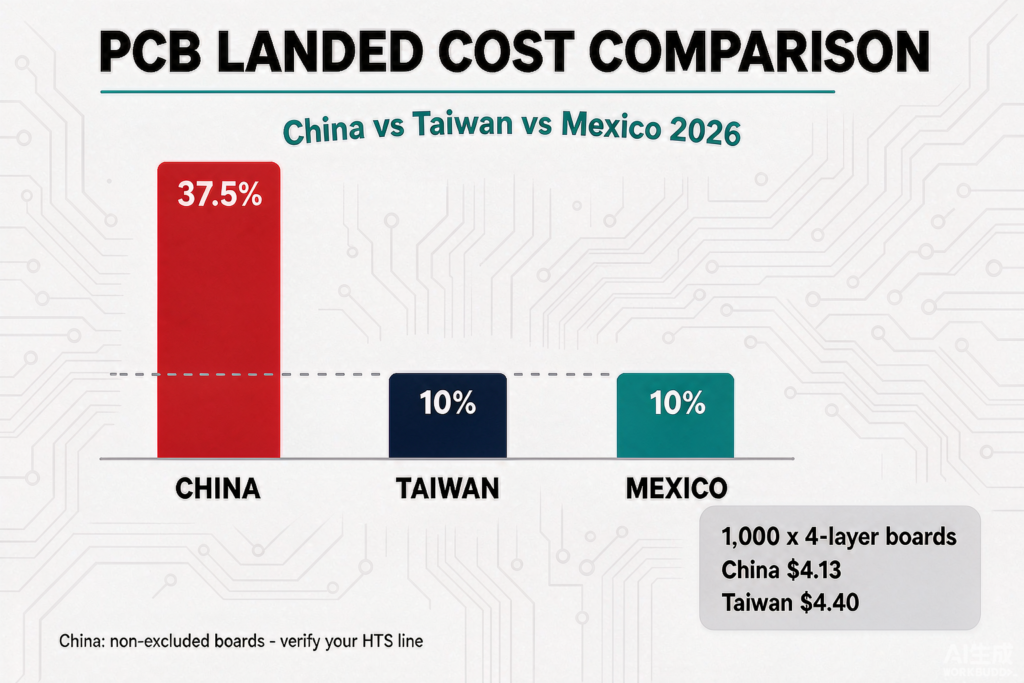
| Source | Unit FOB | Duty rate | Duty per board | Cost per board |
|---|---|---|---|---|
| China, exclusion claimed, before November 9 | $3.00 | 12.5% | $0.38 | $3.38 |
| China, after November 9 if the exclusion lapses | $3.00 | 37.5% | $1.13 | $4.13 |
| Malaysia | $4.20 | 10% | $0.42 | $4.62 |
| Taiwan | $4.50 | 10% | $0.45 | $4.95 |
| Mexico, USMCA-qualifying | $5.50 | 0% | $0.00 | $5.50 |
Read the first two rows together and the November deadline stops being an abstraction. The China board stays the cheapest option on this order either way, but the cushion against Malaysia shrinks from $1.24 per board to $0.49. For a program with thin margins, that is the difference between a comfortable decision and a hard conversation.
Now run the same math on a six-layer board, where China pays 37.5% no matter what. A $6.00 board lands at $8.25. The same board quoted at $6.80 from Taiwan lands at $7.48 — cheaper, even though the unit price is higher. That is the case where duty genuinely changes a sourcing decision, and it is the case that gets missed when buyers compare quotes on unit price alone.
7. Samples and prototypes after the de minimis change
De minimis was the rule that let commercial shipments valued at $800 or less enter the United States without duty; it has been suspended for all origins since June 24, 2026, so every commercial shipment now needs a customs entry. China-origin goods lost the exemption earlier, which is why some teams already adjusted and others are about to.
The change hits engineering budgets harder than it hits production, because fixed costs do not scale down. A $200 sample box now needs a classified entry, the MPF minimum, and either a broker or in-house filing capability. Add a broker fee in the usual $35 to $75 range and the effective rate on that sample can exceed the duty rate on a full container.
Three things make it manageable. Consolidate: a single shipment covering multiple suppliers costs one entry instead of five. Document: prototype goods with no commercial value may qualify for duty-free entry under 19 CFR 10.151, but only with proper documentation, and labeling a commercial order as a sample is how importers earn penalties. And ask your supplier for paperwork in advance — invoices that state the HTS code, the value, and the origin correctly save a week of back and forth with a broker.
8. Seven mitigation moves that hold up under audit
None of these require an aggressive position on the rules, which is the point. Strategies that depend on a creative reading of a Federal Register notice tend to survive until the first audit.
- Classify by function and document it. Write the HTS code, the reasoning, and the date into the part file before the first shipment. When a new buyer or broker takes over the account, the answer stays the same.
- Verify every exclusion against the published description. Layer count, rigidity, base material, and whether components are mounted all matter. A supplier saying “our boards are covered” is not verification.
- Do the pre-November stockpiling math. If you build in volume on two-layer and four-layer FR4, compare the cost of carrying inventory for a few months against a 25-point duty increase. Inventory carrying cost is usually the cheaper side of that trade — but only for volumes you are confident about.
- Consolidate shipments. Fixed entry costs do not care about shipment size. Five small shipments cost roughly five times what one consolidated shipment costs.
- Use duty drawback if you re-export. If goods you import are later exported, or destroyed under supervision, drawback can recover the large majority of the duty paid. It is the single most underused mechanism among mid-size importers.
- Consider a Foreign Trade Zone for inverted-tariff situations. When the finished product carries a lower duty rate than its imported inputs, an FTZ lets you pay the finished rate instead of the component rate. It is real, legal, and requires setup work.
- Treat USMCA qualification as a manufacturing question, not a shipping question. Origin rules follow the product-specific rule for the classification, and recent rulings have focused on where the substantive processes happen. A final assembly step does not automatically create origin, and Mexico’s own 2026 tariff reform raised costs on non-FTA inputs, so the arithmetic needs to be run rather than assumed.
One thing to skip: relabeling a product to land in a better tariff line without changing the product. That is not tariff engineering, and the penalty exposure runs well past the duty saved.
9. What we see from the factory floor
Tariff analysis is usually written from the buyer’s side of the ocean. Since we sit on the manufacturing side, here is what has actually changed in the orders coming across our desks — the practical version of everything above.
- Buyers ask for tariff documentation upfront. HTS codes on invoices, layer counts confirmed in writing, and explicit statements about base material have gone from occasional to routine. Teams that got burned by a reclassification are asking before the order instead of after.
- Layer count is now a supply chain decision. Where a design could reasonably be built on four layers or six, the tariff difference sometimes decides it. That conversation did not exist two years ago.
- Orders concentrated before the deadline. Programs that know they depend on the 2-layer and 4-layer exclusion are moving volume earlier rather than betting on an extension.
- Sourcing split by board type rather than by supplier loyalty. Complex multilayer and flex work still comes to China in large numbers because the process depth is here, while simple high-volume boards are the volume most likely to be diverted.
- Quoting got longer. A useful quote now includes the classification assumption, the exclusion position, and the date the rate was checked. A quote that only shows a unit price is not answering the question buyers are asking in 2026.
FAQ
What is the tariff rate on PCBs from China in 2026?
It depends on the board. Two-layer and four-layer rigid FR4 bare boards that qualify under Section 301 exclusion 9903.88.69 pay 12.5%, the forced-labor tier that took effect on July 24, 2026. Boards with six or more layers, flex and rigid-flex circuits, non-FR4 substrates, and most assembled boards pay 37.5% — 25% Section 301 plus the 12.5% tier.
What happens on November 9, 2026?
178 Section 301 exclusions expire at 11:59 p.m. Eastern, including the exclusion covering two-layer and four-layer rigid boards. Unless USTR extends them, entries filed from November 10 pay 37.5% instead of 12.5% on those boards.
Do bare PCBs and assembled PCBAs pay the same duty?
No. The 2-layer and 4-layer exclusion applies to bare, unpopulated boards with a glass-reinforced base. Once components are mounted, the assembly normally falls under a different classification and does not benefit from the board exclusion, so PCBAs generally sit at the full 37.5% for China-origin product unless another exemption applies.
Can I still import a prototype duty-free under the $800 rule?
Not as a commercial shipment. De minimis has been suspended for all origins since June 24, 2026, so even a small sample order needs a customs entry, an HTS classification, and payment of applicable duty and fees. Goods with no commercial value may qualify for duty-free entry under 19 CFR 10.151, but that requires documentation and cannot be used for orders destined for resale.
Is it cheaper to assemble boards in Mexico to avoid the tariffs?
Only if the finished goods actually qualify under USMCA rules of origin. Qualification follows the product-specific rule for the classification, and it looks at where the substantive manufacturing processes happen rather than the last assembly step. Mexico also raised duties on many non-FTA inputs in its 2026 reform, so a Mexico route has to be costed with real rules-of-origin work rather than assumed at zero duty.
Should we still source PCBs from China in 2026?
For complex multilayer, HDI, and flex work, usually yes — the process depth and turnaround are difficult to match, and duty is only one line in the landed cost. For simple two-layer and four-layer FR4, run the arithmetic per part number: China remains competitive on price before November 9, and the margin narrows afterward. The honest answer is that the right decision differs by board type, which is why per-part-number comparisons beat per-supplier comparisons.
The practical takeaway: know your board’s classification, know which exclusion it sits under, and put a date on the rate you were quoted. Buyers who do those three things are the ones who are not surprised on November 10. If you need a quote that states the classification assumption, the exclusion position, and the date the rate was verified, our engineering team will put it in writing with the quotation.
Rates and deadlines in this article were verified against USTR, CBP, and USITC sources as of September 2026 and can change with subsequent trade actions. This is general information, not customs or legal advice — confirm the rate for your specific HTS code with a licensed customs broker or CBP before you commit to an order.
회사 소개
다음 내용도 참고해 보세요…

저자 소개
앤드류 잔 – JKRGLO.com 연구개발(R&D) 엔지니어
앤드류 잔(Andrew Zhan)은 PCB 업계에서 14년 이상의 연구개발(R&D) 엔지니어링 경력을 쌓아왔으며, 회로 설계 최적화 및 DFM 구현 분야에서 깊은 전문성을 보유하고 있습니다. 그는 복잡한 설계 요구 사항을 양산 가능한 솔루션으로 전환하는 데 주력하며, 시제품 제작과 양산 모두에서 기술 혁신을 주도하고 있습니다.
그는 여러 부서의 팀 및 고객과 긴밀히 협력하며, 프로젝트의 전체 수명 주기 동안 철저한 품질 검증과 원활한 기술적 소통을 보장합니다. 앤드류는 고객의 기대를 꾸준히 뛰어넘는, 신뢰할 수 있고 고성능의 PCB 솔루션을 제공하는 데 전념하고 있습니다.
목차
그래도 도움이 필요하신가요? 문의하기:
PCB 또는 PCBA 견적이 필요하신가요?
태그:
최고의 PCB 제조업체
PCBA
PCB