
PCB Solder Mask Color: What Changes, What Does Not, and How to Choose
簡単な回答
Choose a PCB solder mask color by the job the board must do. Use the manufacturer’s well-qualified standard option when appearance and optical behavior do not matter. Consider a qualified white material for LED reflectance, and black or a brand color when the exposed assembly has a defined cosmetic requirement. Confirm material identity, feature limits, inspection, price and availability before release.
PCB solder mask color is the visible color of the permanent protective coating patterned over much of a circuit board’s outer copper. The color name does not identify the laminate, copper weight, surface finish または quality grade.
A color change is not automatically an equivalent-material change. Different inks can differ in processing, optical behavior and qualified properties. Compare the actual formulations rather than assuming that all green, black or white materials behave alike.
A black board can be well made. A green board can be poorly made. The color tells you very little about either result. What it does change is the surface that people, cameras and sometimes the optical system have to work with.
The purchasing mistake is to ask for a color and leave the rest implied. One factory may understand white as its ordinary stock ink; another may quote a lighting-grade formulation. Both can deliver a white board, but the two proposals do not necessarily meet the same requirement.
This guide separates appearance from material performance and turns the color choice into a manufacturing specification. The point is not to make every order complicated. It is to make the few requirements that matter explicit before a prototype becomes the reference for production.
What Gives a PCB Its Color?
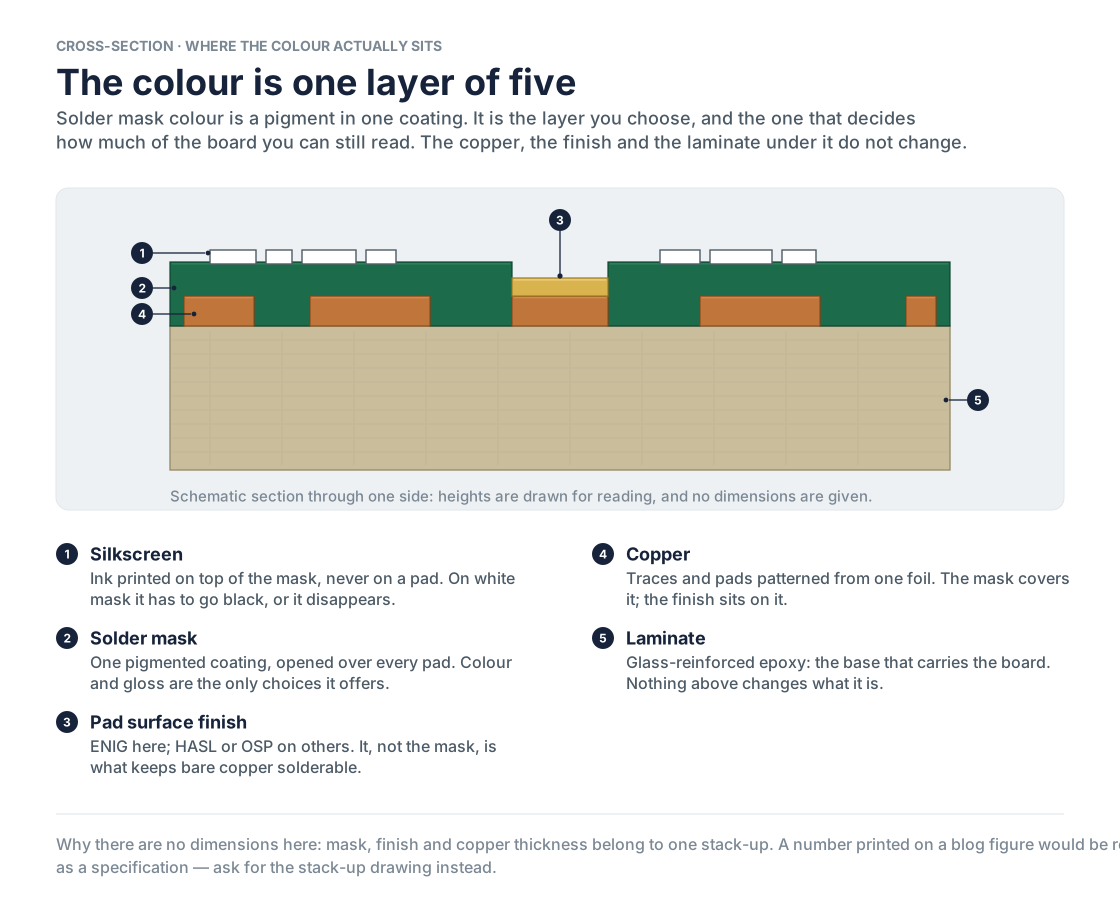
ソルダーマスク is a permanent patterned coating that covers selected copper features while leaving defined openings for soldering, contact or testing.
On a conventional assembled rigid board, the color people notice is usually the solder mask. Under it are copper features and the board construction; above or beside it may be a printed legend, exposed metal finish and component bodies. These are separate parts of the manufacturing description.
| Visible feature | What it normally represents | What the color does not establish |
|---|---|---|
| Green, black, blue or another coating | Solder mask formulation, pigment, thickness and appearance | Laminate grade, copper weight or product reliability |
| Gold-colored exposed pads | A specified surface finish or contact system | That the whole board uses a premium laminate |
| White or black text | Legend / silkscreen marking ink | The electrical function of the marked net |
| Bare substrate at an edge | Laminate or other base construction | The identity of the solder mask |
| Amber flexible areas | A flexible construction, often with a coverlay system | That a rigid-board mask process is suitable for bending |
A rendering can make these layers look interchangeable. The production files cannot. Keep solder mask artwork separate from paste and legend data, and state the requested coating on the fabrication drawing or order specification. The surface finish on exposed pads needs its own callout.
Transparent or lightly pigmented coatings can make underlying copper more visible. An opaque material can obscure it. Neither behavior reveals whether an internal layer is correctly connected, and a photograph is not a substitute for a netlist test or a fabrication inspection.
Start with the construction when a project is unusual. A flexible tail, exposed contact area or optical window may need a different coating arrangement rather than a different shade of rigid-board ink. Our PCB material selection guide covers the wider material decision; color comes after that baseline, not in place of it.
PCB Solder Mask Colors: A Practical Comparison
A solder mask color comparison is a selection aid for appearance, visibility and material availability; it is not a universal ranking of electrical or thermal performance.
Use the table as a starting point for questions, not as permission to change a released design. Green is often the simplest default because many fabricators support a mature stock process. A supplier with an established black or blue line may handle those options just as routinely for an appropriate board.
| Color / appearance | A sensible reason to choose it | What to check | Do not assume |
|---|---|---|---|
| Green | General-purpose production and familiar visual review | Exact qualified material and feature capability | Every green material has identical properties |
| Black / matte black | Visible consumer or industrial design | Low-contrast features, legend, finish and cosmetic sample | Premium electrical performance or improved cooling |
| White | LED optics or a defined white appearance | Spectral reflectance, color retention and post-assembly appearance | All white inks are lighting-grade |
| Blue | Branding or clear visual differentiation | Legend contrast, stock availability and inspection setup | A particular industry or reliability class |
| Red | Branding, demonstration hardware or secondary identification | Readable labels and approved hue | Higher power capability |
| Purple | Product identity or an established brand look | Material continuity and physical sample | It is always a special-order material |
| Yellow / orange | A specified visual design or identification aid | Available ink, contrast and appearance after processing | Higher thermal safety or flame resistance |
The useful distinction is a required benefit versus a preferred look. An LED optical surface may need measured reflectance. A hidden control board usually does not. A visible premium product may legitimately require matte black, but that requirement should be described as appearance, with matching acceptance evidence.
Do not turn the table into an industry color code. Blue does not certify medical suitability, yellow does not establish flame resistance, and black is not a qualification for high power. Applicable approvals and product requirements must be checked on the actual material and construction.
Likewise, avoid a fixed surcharge column. Common colors may be included in a supplier’s standard offering, while a less common formulation, special finish or controlled color match may change cost and schedule. The distinction is supplier-specific and order-specific, not a rule attached permanently to a color name.
Why Green Is Often the Easiest Starting Point
A qualified standard color is a solder mask option already supported by a manufacturer’s approved materials, process settings and inspection methods for a stated board construction.
Green is widely associated with that default. Operators are familiar with its appearance, suppliers commonly maintain it, and a factory may have its broadest process history with a green ink. Those are practical reasons to begin there when the product has no other requirement.
They are not proof that green is intrinsically more reliable than every alternative. The supplier still needs to use the correct material, prepare the copper, apply and cure the coating correctly, and verify the finished features. A familiar color does not excuse poor registration or inadequate adhesion.
Ask a narrow question: which color and material combination is best established for this board’s smallest features and assembly route? The answer can be green, but it should come from the proposed process, not a generic statement that all other colors are difficult.
For early development, visibility may matter more than the finished product’s appearance. Probe access, readable reference designators and clear photographs can save debugging effort. If a later cosmetic change is planned, record it as a pending material/process review instead of treating the prototype as full qualification of the final finish.
Green also does not have to remain the default forever. A repeat product can move to an approved alternate once the new formulation, inspection conditions and customer-facing appearance are reviewed. That is a controlled change, not a marketing upgrade.
A helpful procurement note is to request the supplier’s recommended qualified option, together with any difference in fine-feature capability, inspection or availability for the preferred color. That produces a usable comparison without forcing an unnecessary custom material onto a standard board.
Black and Matte Black: Specify the Look, Then Check the Process
Black solder mask is a colored protective coating; matte black additionally specifies an appearance characteristic and should not be confused with the exposed-pad metal finish.
Black can be the right choice when a board remains visible through a housing, behind a panel or inside a serviceable premium product. Appearance is a valid requirement. The mistake is using that appearance as evidence of better signal integrity, thermal conductivity or workmanship.
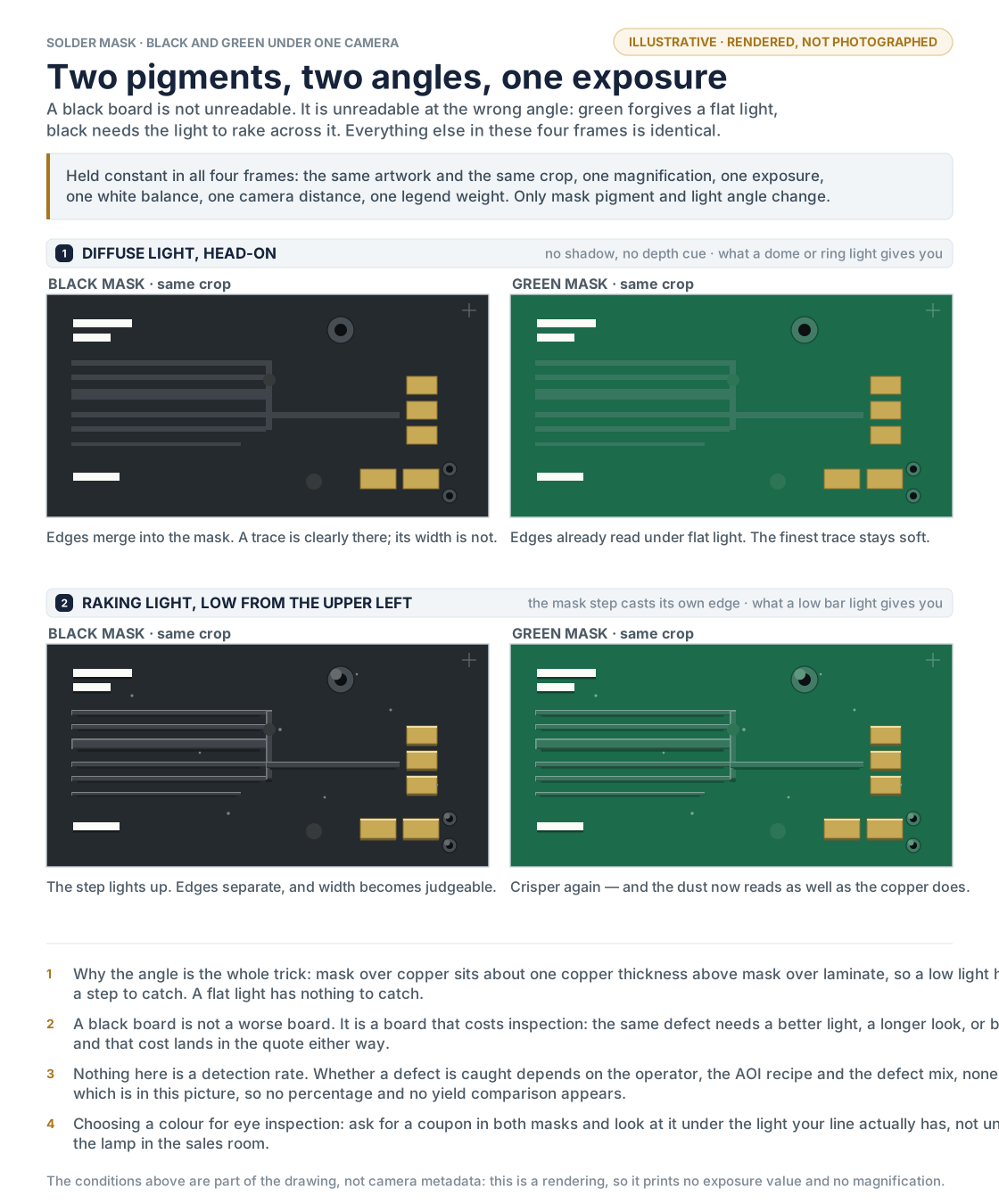
A dark, opaque coating can make some underlying copper features and surface marks harder to distinguish in a particular viewing setup. Gloss can also produce reflections. Ask the factory to review your actual features under its inspection conditions rather than declaring black universally incompatible with AOI.
A camera recipe, lighting direction, exposure and available views all affect a useful image. Inspectors may need to distinguish a mask defect, a metal pad, a component body and contamination in different ways. The result is not captured by a single claim that black lowers detection by a fixed percentage.
| Question for a black board | Evidence worth seeing | Decision it supports |
|---|---|---|
| Is the chosen material available in matte? | Named product and a production-representative sample | The requested appearance can actually be supplied |
| Are fine features acceptable? | Color-specific mask artwork review and finished examples | The selected process can maintain the necessary openings/webs |
| Can the important features be inspected? | Representative images and reviewed calls under the intended setup | Inspection remains effective for the job |
| Will the shipped surface look right? | Sample after assembly, cleaning and normal handling | Cosmetic requirements survive the actual route |
Keep the meaning of surface finish clear in the order. In PCB purchasing, that term often means the metal coating on exposed pads. If you write matte finish without saying solder mask appearance, the supplier may need to guess which requirement you meant. State both separately.
Do not ask black material to conceal unacceptable damage. Cosmetic acceptance, coating integrity and electrical acceptance are different matters. A darker surface may make a mark less noticeable, but it does not make exposed copper, contamination or loss of adhesion acceptable.
White Solder Mask for LEDs: Buy Optical Behavior, Not Just White Ink
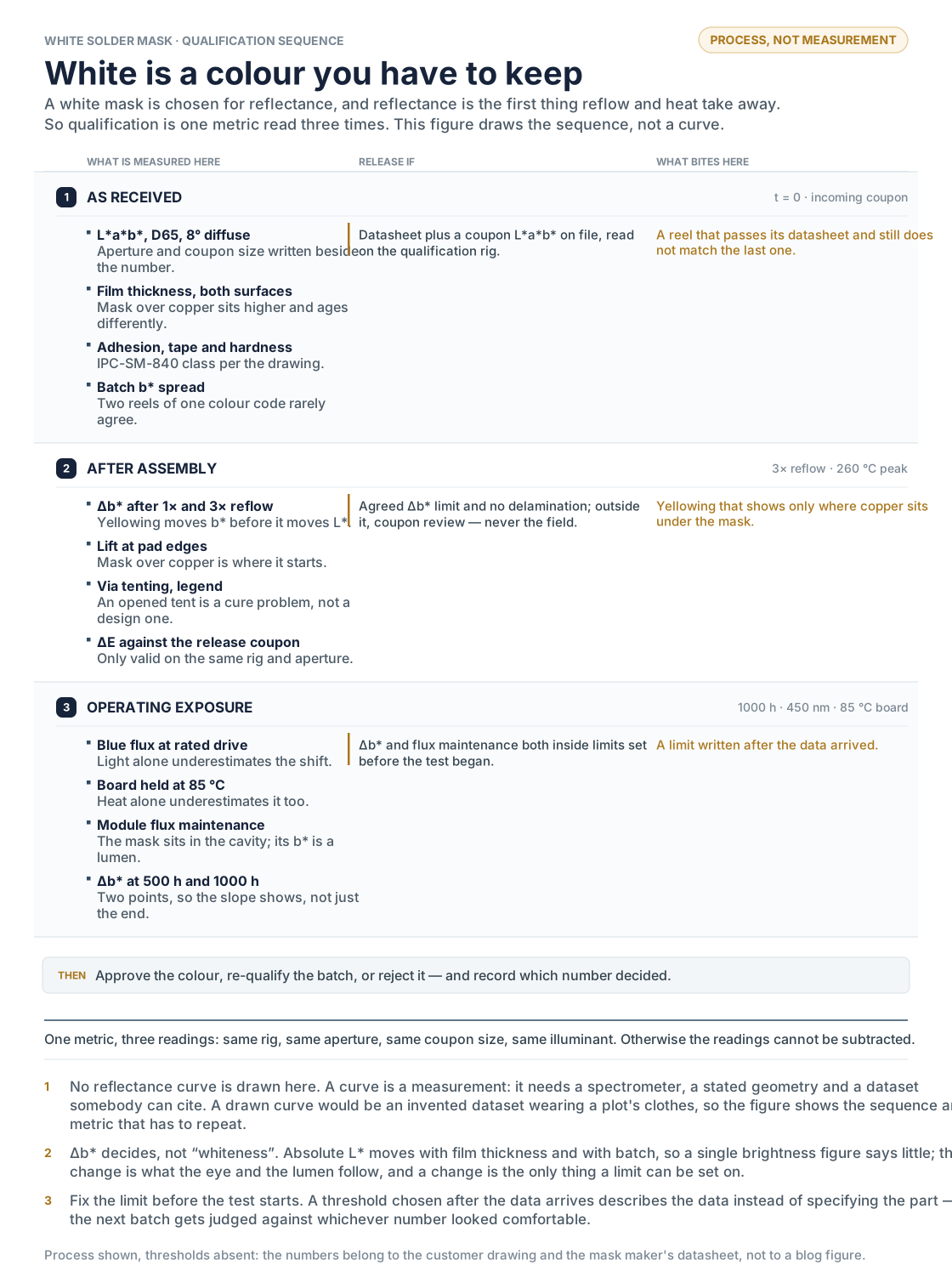
Spectral reflectance is the fraction of incident light reflected by a surface as a function of wavelength; a white appearance alone does not specify that reflectance curve.
White is a meaningful functional choice when light interacts with the board. In an LED assembly, the exposed surface can return light into the optical path, and the coating’s behavior can affect the appearance of the complete module. A general-purpose white material is not automatically interchangeable with one designed for LED applications.
Taiyo’s public product descriptions identify white LED materials with light-reflectance and assembly color-retention features. That supports specifying the correct product family. It does not support assigning one reflectance percentage, guaranteed light-output gain or service life to every white PCB.
| Requirement | Specify or request | Why it matters |
|---|---|---|
| Optical response | Relevant wavelength range, measurement method and material data | A single visual white reference misses spectral behavior |
| Assembly stability | Appearance / reflectance after the intended soldering and cleaning route | An attractive bare board may change during processing |
| Operating exposure | Relevant temperature, light/UV and environment with acceptance conditions | Initial whiteness is not an aging qualification |
| Actual board construction | Thickness/coverage conditions, underlying surface and production process | Sample conditions can differ from the delivered product |
| Supply continuity | Exact formulation and alternate approval rules | A replacement white ink may not give the same optical result |
Define the time point at which the sample is accepted. An LED optical requirement may need the assembled and processed board, not just a pristine panel before soldering. Ask whether the same surface treatment and rework exposure were used when the material data was generated.
A white surface can make flux residue, particles or handling marks conspicuous. Visibility is not the same as harmful contamination: determine what the residue is, whether the process permits it and whether it violates the cosmetic or optical requirement. Do not demand aggressive cleaning merely to remove every visible trace without checking material compatibility.
If the light engine has a performance target, validate the complete optical assembly. LED binning, package optics, diffuser, geometry and operating conditions also influence the measured result. A solder mask selection is one input to that system, not a guaranteed percentage improvement in lumens.
For thermal performance, return to the stackup, dielectric path, metal backing where applicable, component attachment and cooling arrangement. A white mask does not turn an ordinary construction into a thermally engineered LED board. The PCB fabrication specification should identify the construction as well as the coating.
Blue, Red, Purple and Yellow: Keep Branding Separate From Qualification
Color coding is a supplementary visual identification method; a board’s controlled part number and revision must remain identifiable without relying on color alone.
A colored board can help distinguish modules during a demonstration or make a product recognizable in photographs. It can also support an existing brand language. These uses do not require a claim that the color improves the circuit.
If color helps an operator select a module, keep the permanent identifier readable as well. Two revisions can be built in the same color, and two factories can supply different shades under the same name. Lighting, contamination, wear and differences in color perception also make a color-only instruction fragile.
Specify the actual ink and appearance when consistency matters. Purple at one factory may be routine stock; yellow at another may require a separate procurement run. Ask before promising a launch date or treating a color as a non-standard cost item.
Do not describe blue as a medical grade or red as a high-performance grade. Industry suitability depends on the product requirements, qualified construction and process controls. The same applies to flame behavior: yellow pigment does not establish a flammability rating or prove that decomposition products are harmless.
When the PCB is hidden for its entire life, ask whether a branded color earns its control burden. The answer may still be yes for an identified service module, but the reason should be explicit. A readable label is often more useful than a perfectly matched hue on a surface nobody sees.
For customer-facing hardware, approve the assembled product under the intended lighting rather than a cropped web photograph. Nearby components, exposed metals and the housing change the visual result. A color that looks right alone may not match the product once those surfaces are present.
Inspection, Legend Contrast and Repair Access
Inspection contrast is the distinguishability of relevant features under a defined viewing or imaging setup, including illumination, exposure, geometry and the surrounding materials.
Separate bare-board inspection from assembly inspection. Inspecting copper patterns, mask registration and coating defects is not the same task as checking fitted components or solder joints. Some fabrication checks also occur before solder mask is present. Avoid transferring a color claim from one stage to every inspection station.
| Task | What color / appearance may affect | What must be verified instead of assumed |
|---|---|---|
| Manual visual review | Visibility of coating edges, traces, residue and marks | Lighting, magnification and reference examples |
| Assembly AOI | Contrast between bodies, pads, solder and background | Recipe suitability and detection of relevant defects |
| Legend reading | Reference designators, polarity and orientation visibility | Ink contrast, stroke/size and placement |
| Debug and rework | Locating pads and following visible features | Accessible test points, controlled drawings and correct revision |
| Outgoing cosmetic check | Hue, gloss, exposed surface and contamination appearance | Defined zones and approved sample at the correct process stage |
White text on a dark background can be readable, but color contrast does not fix text that is too small, covered by a connector or clipped by a mask opening. On white material, a contrasting legend may be more appropriate. Review the PCB silkscreen and marking requirements together with the mask.
Show the inspector the actual decision. If a camera must detect a polarity mark next to a black package, provide a representative populated assembly. A bare coupon with generous spacing will not demonstrate that task. If a technician must locate a probe point, review the label and access after the enclosure is fitted.
A color change can justify an inspection review without requiring entirely new equipment. The supplier should decide what recipe, light or threshold adjustment is needed and validate relevant calls. There is no credible universal conversion from a color name to a defect escape rate.
For repair, drawings and revision control still matter more than seeing a trace through the coating. Cutting or exposing copper is an intervention governed by the repair process, not a normal advantage to be assumed for every translucent board. Plan test access and service information while designing the assembly.
Fine-Pitch DFM: Ask for the Material-Specific Mask Rules
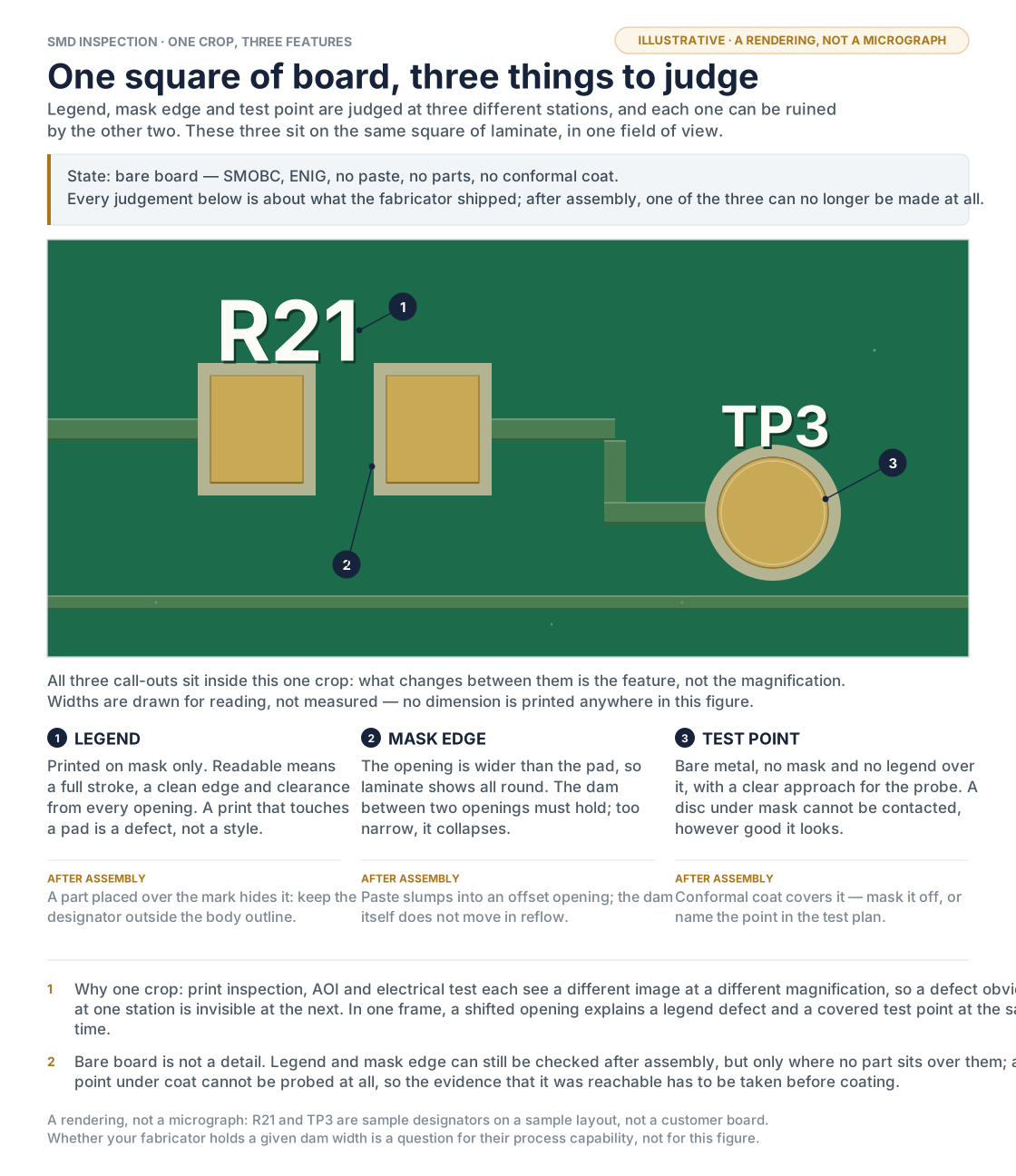
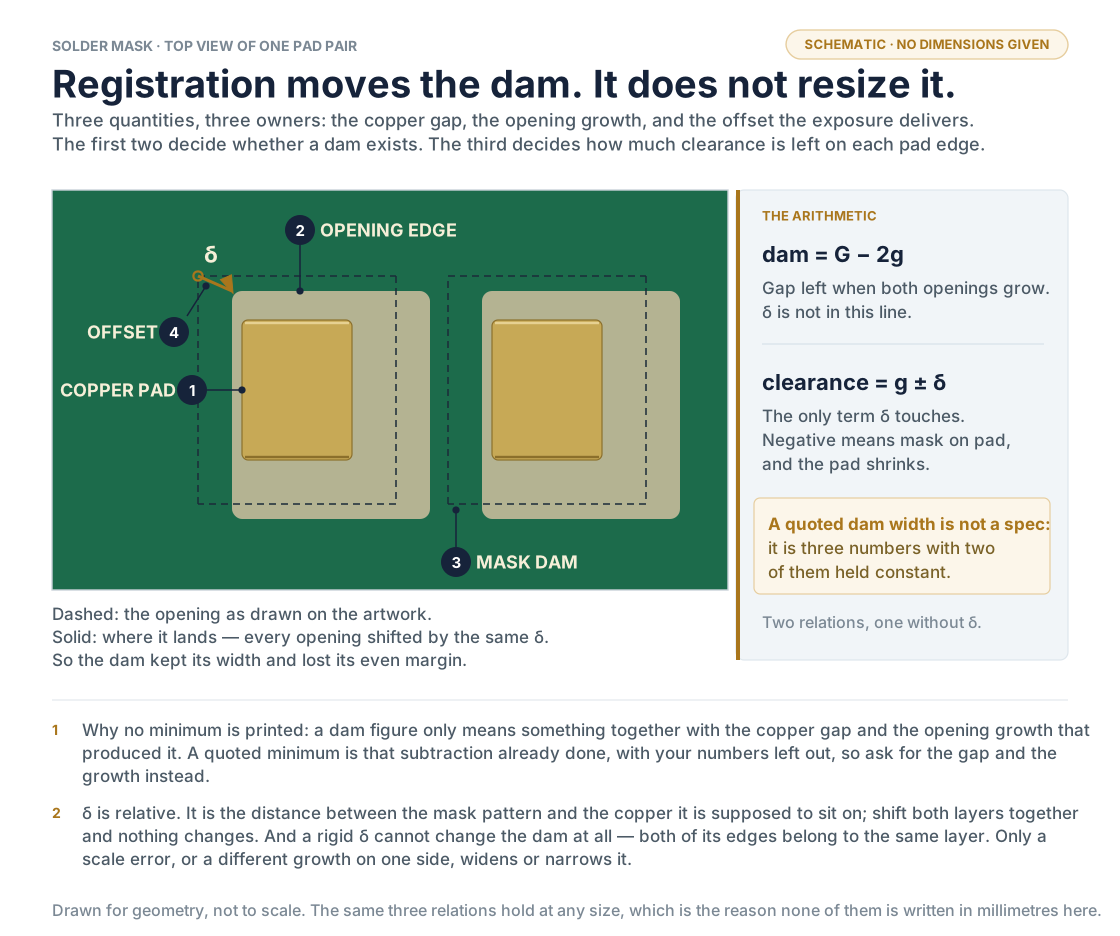
A solder mask dam is the narrow strip of cured mask left between adjacent openings; its manufacturability depends on the material, imaging process, registration and finished feature geometry.
An appealing color becomes a design problem when the selected process cannot maintain the required openings or mask webs. This is not a reason to copy one minimum from a general color chart. Ask the fabricator to review the actual artwork with the proposed ink and process.
| 特集 | Question for the fabricator | What the release record should show |
|---|---|---|
| Minimum web / dam | Can this material and process retain the drawn strip? | Approved minimum and any local exceptions |
| Pad opening | Is the intended relationship to the copper understood? | Accepted mask definition and artwork revision |
| Registration | What alignment capability applies to this construction? | Finished-feature acceptance and inspection method |
| Vias and holes | Which are open, covered, filled or otherwise treated? | A clear via treatment specification |
| Legend near pads | Will marking overlap solderable features? | Coordinated legend and mask review |
The finished feature is what matters. A narrow line present in the CAD file may be modified or omitted by the fabricator if it cannot survive processing. Ask for that exception to be returned for approval, especially near fine-pitch components. Silent artwork edits can change what the assembler expects.
Solder-mask-defined and non-solder-mask-defined pads use different relationships between the mask opening and copper. Follow the component guidance and approved design rather than asking the factory to convert every difficult footprint to one style. Color does not decide the correct pad definition.
Changing color late can mean changing the formulation or imaging conditions, which may justify another DFM check. A green prototype with narrow mask features does not, by itself, prove that a newly quoted black or white process can reproduce them.
This also explains why a published minimum from one manufacturer is not an industry constant. Imaging equipment, copper topography, coating conditions and acceptance differ. Review the manufacturer’s current capability for the exact material and construction, then preserve the answer in the released file package.
Use PCB design rules and manufacturing constraints as the wider checklist. The color choice is one input to the mask review; it does not override pad geometry, electrical spacing requirements or the released drawing.
Electrical Performance and Heat: What Color Does Not Prove
Thermal conductivity describes heat conduction through a material, while emissivity describes thermal radiation from a surface; visible color alone is not a specification for either property.
A color label is not an electrical rating. The complete solder mask can have dielectric, insulation and environmental properties that matter to the product, and different formulations need not share them. The safe statement is not that pigment never matters; it is that the color name alone cannot establish the property.
For ordinary comparisons, do not interpret black as faster, red as higher power or green as inherently lower loss. Where an RF or high-speed design is sensitive to coating above an outer-layer structure, review the relevant material data, thickness and modeled or measured geometry. Do not copy one frequency cutoff from a blog.
| Claim | Why it is insufficient | Better specification |
|---|---|---|
| Black boards conduct heat better | Visible color does not define bulk thermal conductivity | Qualified construction and a verified thermal path |
| Yellow boards are safer in heat | Pigment is not a flame or decomposition certification | Applicable material/construction approval and temperature requirements |
| White always runs cooler | Visible reflectance does not define all spectral or cooling behavior | Measured performance under the actual radiation and cooling conditions |
| All colors are electrically identical | Formulations and coating conditions can differ | Material data and appropriate qualification |
| Dark color gives higher reliability | Appearance does not demonstrate adhesion, cure or workmanship | Controlled process and product-relevant acceptance evidence |
Visible blackness is not a calibrated measure of infrared emissivity. Solar absorption, infrared radiation, conduction into the board and convection to air are different mechanisms. If a surface matters to an optical or thermal system, specify the relevant spectral behavior and validate it under that system’s conditions.
Most board-level heat management decisions involve component power, copper distribution, interconnects, dielectric paths, interfaces and airflow or a heat sink. Recoloring an otherwise inadequate construction is not a substitute for those decisions. Nor does a thermal profile from one assembly prove every material alternative will behave identically.
Reliability has a similar boundary. Proper cure, adhesion, compatibility with subsequent processing and environment, and controlled manufacturing all matter. A generic adjective such as premium cannot replace evidence. Color can be part of a qualified product; it is not a shortcut to qualification.
Color Consistency, Gloss and the Approved Sample
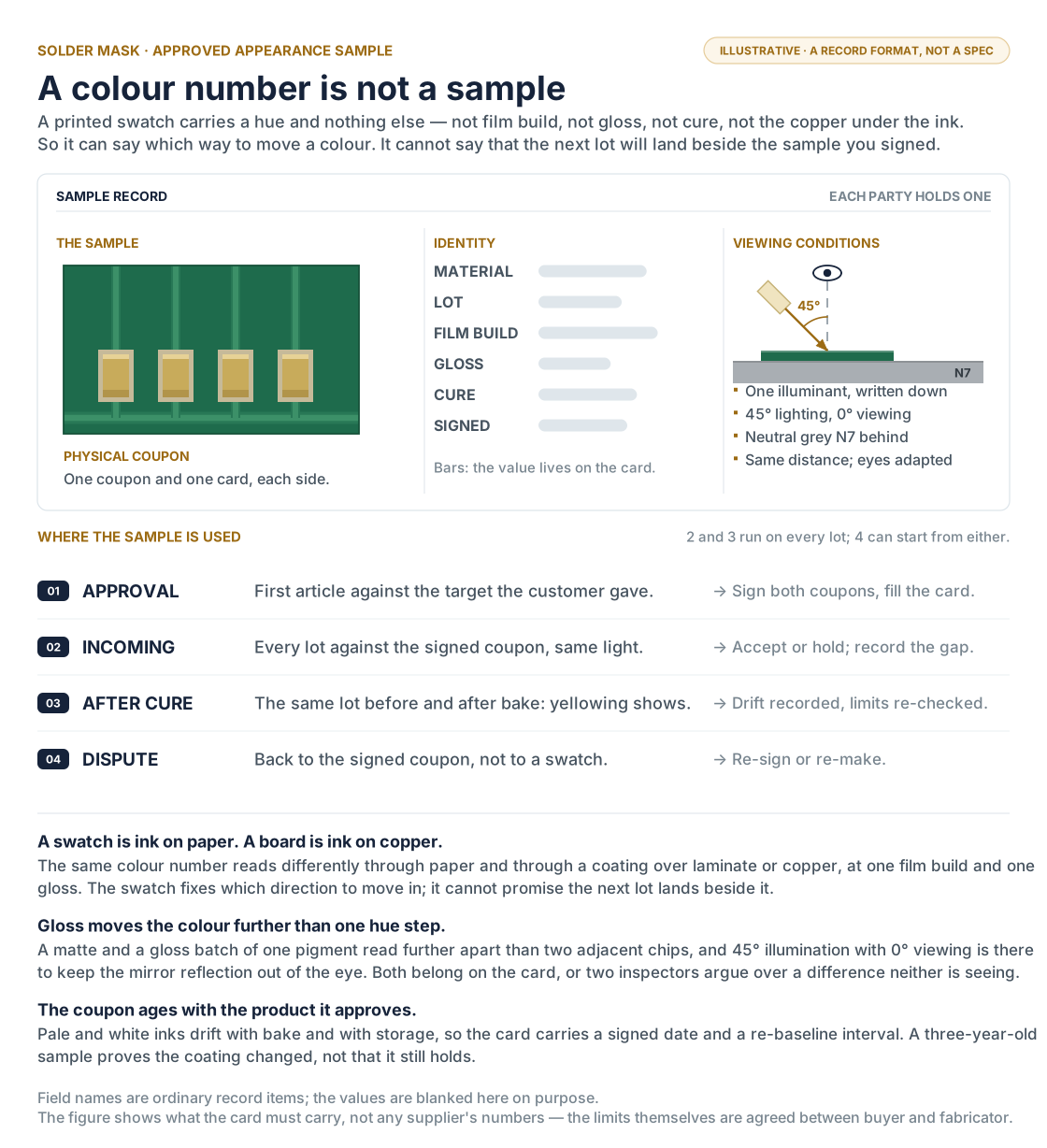
An approved visual sample is a controlled physical reference for the appearance accepted at a stated manufacturing stage under agreed viewing conditions.
Green is not one exact hue, and neither are black or white. Formulation, coating condition, underlying copper pattern, cure and illumination can affect the appearance you see. A photograph adds its own exposure, white balance and display differences.
For a hidden industrial board, a basic color name may be enough. For a visible front panel or branded developer kit, that may be inadequate. State the requirement in proportion to the consequence: exact matching needs more control than simply avoiding a different color family.
| Control item | Practical agreement | What it avoids |
|---|---|---|
| Reference | Identified physical sample or agreed measured reference | Using an uncontrolled web image as the standard |
| Stage | Bare board, assembled board or final product | Approving before the process that changes appearance |
| Viewing | Lighting, viewing geometry and comparison procedure | Arguments caused by different inspection setups |
| Variation | Permitted lot variation and any measured method/limit | Rejecting normal variation without an agreed boundary |
| Change | Material, site or process changes requiring review | Unannounced substitution of a visually different system |
Instrumental color measurement can be useful when both parties agree the method, reference and acceptance limit. A color-space value without measurement conditions is not a complete contract requirement. Do not invent a universal color-difference limit for every PCB product.
Treat gloss or matte appearance separately from hue. Ask whether the quoted product supports the intended look and what it looks like after normal processing. A coating described as matte by one supplier may not match another supplier’s reference.
Keep the sample representative and retrievable. Label its material identity, revision, process stage and approval status; maintain a protected reference rather than a board that has been handled on a desk for months. A purchasing file should make it possible to compare the next lot without relying on a person’s memory.
Price, Lead Time and Substitution: Ask for the Actual Difference
A controlled material substitution is an approved replacement assessed against the original requirements; matching the visible color is only one possible part of that assessment.
The purchasing question is not how much black always costs. It is what changes on this quotation if you request the specified black material instead of the proposed standard option. The answer may involve material availability, a separate coating run, inspection work or no additional charge at all.
| RFQ question | Request a specific answer | Avoid |
|---|---|---|
| Stock option | Material family, color and appearance available now | Assuming every non-green color is special order |
| Cost difference | Separate price for each agreed material option | A universal color surcharge percentage |
| Schedule basis | Procurement and production assumptions | A fixed extra-day rule copied from another factory |
| Minimum / repeat order | Any minimum charge and future availability | Qualifying a one-off material with no repeat plan |
| Alternate policy | Which substitutions require approval and what is rechecked | Accepting any ink described as the same color |
Use the same board and assembly scope when comparing options. If one quote also changes the pad finish, panelization or test, it does not isolate the cost of color. The PCB assembly cost breakdown helps distinguish coating-related choices from unrelated assembly costs.
For repeat production, ask whether the selected ink is part of the normal supply plan. A visually precise custom match can be justified, but its material continuity and alternate rules need attention. If the product requires a fixed formulation, do not let a purchasing substitution quietly become a new qualification exercise after the order is released.
When a color change is approved, tell the assembler what changed. Inspection recipes, visual references, optical testing or profiling review may need attention depending on the product. The PCB assembly process is where some effects become visible; the fabricator’s outgoing approval alone may not close the decision.
A simple change log is often enough to prevent confusion: original material, proposed replacement, affected requirements, evidence, decision owner and effective lot. The level of effort should follow the risk, but the decision should not disappear into an informal email that nobody can find.
A Release Checklist You Can Put Into the RFQ
A solder mask specification identifies the coating and the requirements needed to manufacture and accept it, instead of relying on color as a proxy for performance.
The most useful RFQ is short enough to be read and complete enough to be answered. Separate mandatory requirements from preferences, and ask the supplier to identify exceptions before quotation acceptance. Do not bury the exact material name in a note while accepting an unrestricted equivalent elsewhere.
| Item | What to put in the requirement | How to close the question |
|---|---|---|
| Color and appearance | Color family, matte/gloss where required, permitted options | Supplier confirmation and sample if relevant |
| Material identity | Specific formulation or required characteristics with alternate policy | Data and approved material proposal |
| Artwork capability | Actual openings, webs, registration and via treatments | Product-specific DFM approval |
| Inspection and marking | Relevant visual tasks and readable identifiers | Representative setup / sample review |
| LED / optical needs | Wavelengths, conditions and post-process behavior if required | Agreed measurement and qualification evidence |
| Acceptance stage | Bare, assembled or finished product appearance | Approval at the point that matters |
| Commercial scope | Quantity, repeat demand, delivery and substitution rules | Comparable quotation and controlled release |
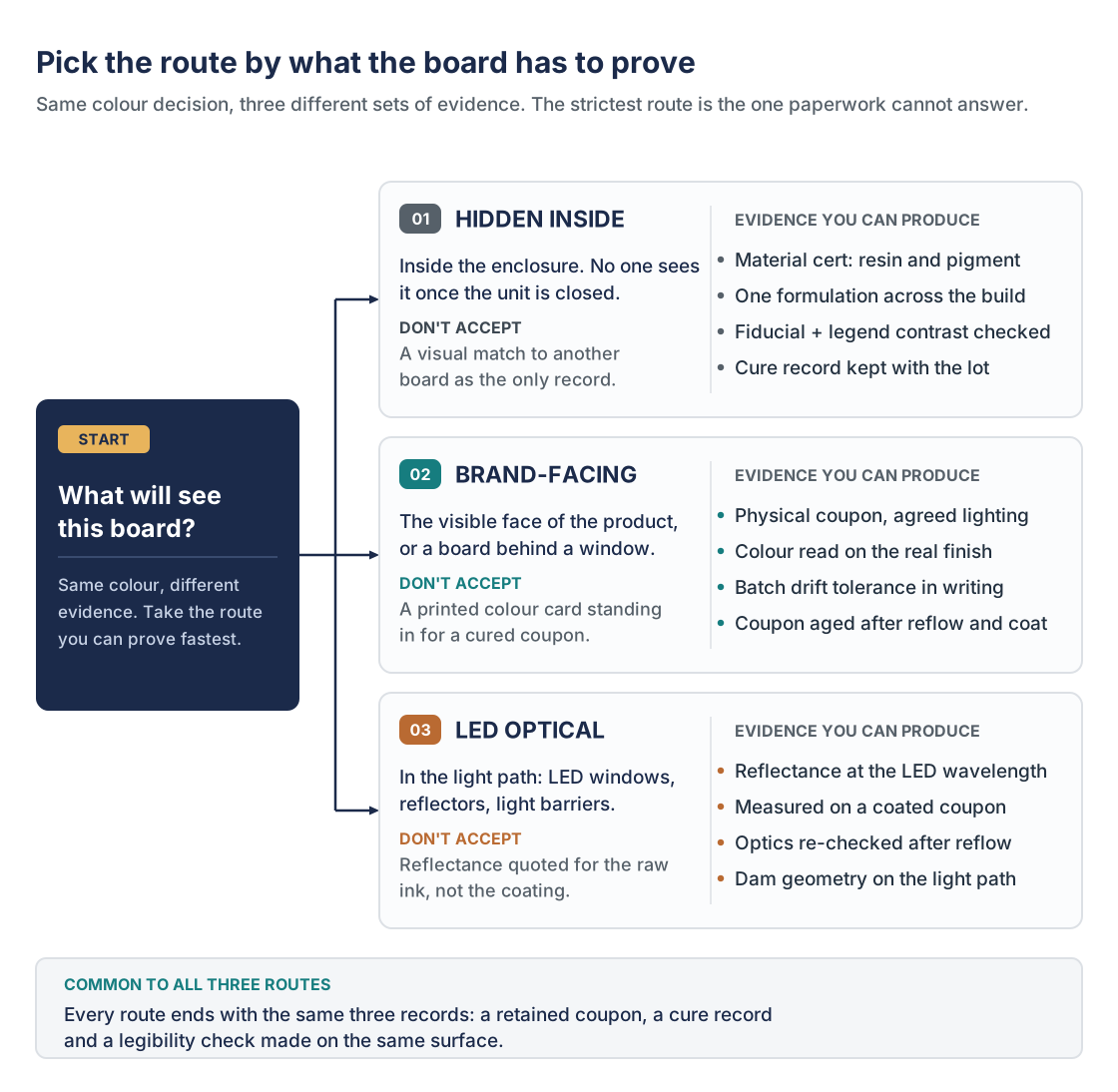
For an ordinary hidden board, you can simply request the manufacturer’s qualified standard green material, subject to the drawing requirements and no unapproved material changes. For a visible board, add the agreed appearance sample. For an LED board, add the optical and environmental requirements. These are different levels of specification, not three separate definitions of quality.
Before volume release, compare a representative build with the proposed acceptance criteria. Check the small features, markings and surface after the intended processing. If the reference sample was made through a different route, identify the difference instead of treating it as proof.
Record both the technical and appearance approvals. A board can look correct while failing a dimensional or coating requirement; it can also meet technical requirements while missing a customer-facing visual target. Classify findings so neither result is mistaken for the other.
When evaluating a manufacturing partner, ask how these decisions are documented and carried into repeat orders. The PCBA manufacturer selection checklist provides a broader evidence-based approach to that conversation.
Send the Requirement, Not Just a Color Name
For a JKRGLO project, send the manufacturing files, board construction, assembly route, quantity and the reason behind the color choice. If the board is visible, include the appearance reference. If it is part of an optical system, describe the measured requirement and acceptance stage.
Ask for confirmation of the available material, DFM implications, sample plan and any change in the quotation or schedule. That is more useful than a generic promise that every color has the same performance.
Ask JKRGLO to review the solder mask color and material requirements before the board is released. Keep confidential files within the agreed disclosure arrangements.
Source note. Material-specific statements should be checked against the selected supplier’s current documentation. Taiyo’s solder mask product descriptions distinguish LED white formulations and other product families; the PSR-4000 LDI product page lists several colors within one family. The comparison tables here are selection guidance, not universal limits or a substitute for product qualification.
PCB Solder Mask Color: Frequently Asked Questions
1. What is the best PCB solder mask color?
The best choice is the qualified material that meets the board’s manufacturing and application requirements. A manufacturer’s standard green option is often a practical starting point. Choose another color when appearance, optical behavior or another defined requirement justifies it, then confirm the actual material and process.
2. Does PCB color affect electrical performance?
The visible color name does not specify electrical performance. The complete coating formulation and geometry can matter to insulation and sensitive structures. Use material data and appropriate validation where the design depends on those properties; do not assume either universal equivalence or a performance ranking by color.
3. Why are so many PCBs green?
Green has broad availability, a long manufacturing history and familiar visual characteristics. A fabricator may have its best-established process with a particular green formulation. That is a practical production advantage, not proof that every green board is more reliable than every other color.
4. Is black PCB solder mask better quality?
No. Black is an appearance choice, not a quality grade. Its suitability depends on the qualified material, finished features, inspection and product requirements. A well-controlled black board can be appropriate, but premium appearance does not demonstrate better electrical or thermal performance.
5. Does black solder mask improve heat dissipation?
Not as a general rule. Visible blackness does not specify bulk thermal conductivity or infrared emissivity. Board cooling also depends on the construction and operating environment. Specify and validate the relevant thermal path or spectral property rather than choosing a color as a heat-management shortcut.
6. Why is white solder mask used on LED boards?
A suitable white material can provide useful light reflectance in the optical system. The selected formulation should be evaluated for relevant wavelengths and color retention after assembly and operating exposure. Generic white ink does not guarantee a particular reflectance or improvement in light output.
7. Will white solder mask turn yellow?
Color stability depends on the formulation, manufacturing route and operating exposure. Some materials are designed for improved color retention. Define the conditions and acceptable result, review current material data, and validate the representative assembly rather than assigning one lifetime to all white coatings.
8. Do black boards always cost more than green boards?
No. Price and schedule depend on the supplier’s stock materials, process, order size and appearance requirements. Request the actual quotation difference for the same board and scope. A universal surcharge percentage is not a reliable purchasing rule.
9. Can I change solder mask color without changing the PCB layout?
Possibly, but the fabricator should review whether the proposed material and process can reproduce the existing features. Also review inspection, appearance and any optical or material requirements. Keeping copper artwork unchanged does not prove the coating change is equivalent.
10. Is matte solder mask the same as a matte metal finish?
No. Matte solder mask describes the coating’s appearance; the exposed-pad surface finish is a separate specification. State both clearly so a supplier does not need to infer whether the requirement concerns the coating, the metal pads or both.
11. Can PCB color identify a hardware revision?
It can support identification, but it should not be the only identifier. Keep a controlled part number and readable revision marking. Different shades, changed suppliers and lighting conditions make a color-only revision instruction unreliable.
12. What should I specify when ordering a custom color PCB?
State the color and appearance, exact material or required characteristics, alternate policy, relevant feature limits and approval stage. Add a controlled sample for appearance-critical work or measured optical requirements for LED applications. Confirm price, lead time and repeat availability before release.
目次
 English English English
 Deutsch
 Français
 Italiano
 Español
 日本語
 한국어 English English English Deutsch Français Italiano Español 日本語 한국어