
Volt Ampere (VA) vs Watts: What’s the Difference & Practical Guide
Introduction liminaire
Réponse rapide : Volt-amperes (VA) measure apparent power in an AC circuit, while watts (W) measure real, usable power. The relationship depends on power factor: Watts = VA × Power Factor. VA is used for sizing transformers, power supplies and wiring, while watts describe actual energy consumption and appear on utility bills. For PCB power design, always size components in VA, not just watts.
Introduction
If you’ve ever sized a power supply or transformer for a PCB assembly and wondered why the rating is in VA instead of watts, you’re not alone. Volt-amperes and watts both describe electrical power, but they measure very different things — and mixing them up is a fast way to undersize components, cause overheating, or trigger premature failures.
This guide breaks down what volt-amperes actually are, how they differ from watts, how to convert between the two, and how to apply them correctly in electronics and PCB design.
What Are Volt-Amperes (VA)?
Formula: VA = V_RMS × A_RMS
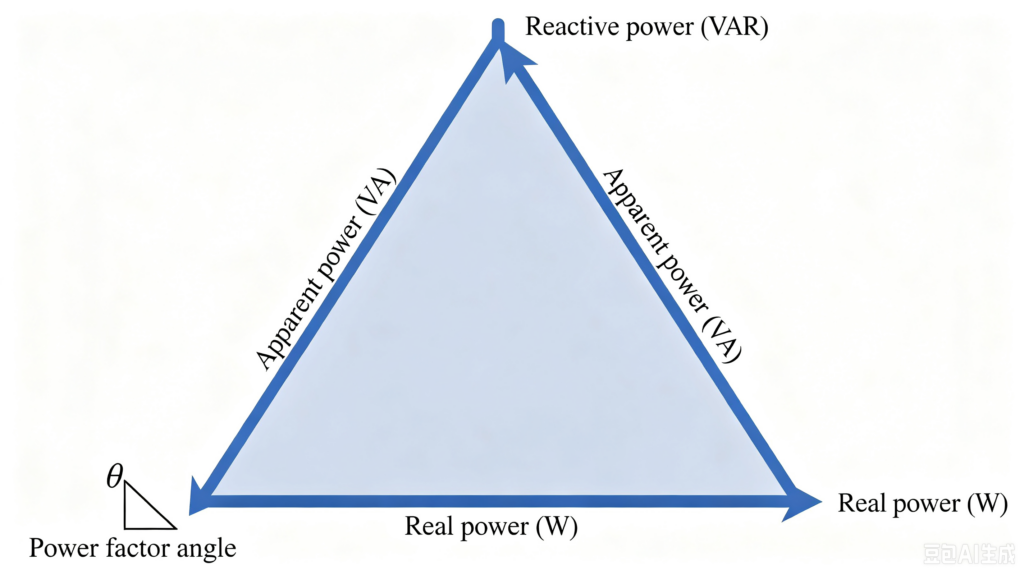
Apparent power includes both the real power that does useful work, and reactive power that moves back and forth between the source and reactive components (capacitors, inductors) without performing any work.
VA is the number you use for sizing electrical hardware: transformers, circuit breakers, wiring, UPS systems, and power supply input ratings. These components have to handle the total current, regardless of whether that current is doing useful work.
What Are Watts (W)?
Watts (W) measure real (active) power — the power that actually performs useful work, generates heat, or runs a circuit.
Formulas:
- DC circuits:
W = V × A - AC circuits:
W = V × A × Power Factor
Watts are what you pay for on your electricity bill. They describe actual energy consumption, component heat dissipation, and usable output power. For PCB design, wattage tells you how much heat your circuit will generate and what your load will draw.
VA vs Watts: Side-by-Side Comparison
| Parameter | Volt-Amperes (VA) | Watts (W) |
|---|---|---|
| Power type | Apparent power | Real / active power |
| Core formula | VA = V × I | W = V × I × PF |
| Accounts for phase shift | No | Yes |
| Primary use case | Sizing transformers, breakers, UPS, wiring | Calculating load, energy use, heat dissipation |
| Found on | Equipment input ratings, transformer labels | Utility bills, output power specs |
| PCB design role | Size power supply input & magnetics | Calculate thermal load & DC power draw |
How to Convert Between VA and Watts
Conversion relies entirely on power factor (PF), a number between 0 and 1 that describes how efficiently a load converts apparent power to real power.
- Watts = VA × Power Factor
- VA = Watts ÷ Power Factor
Quick example: A PCB power supply draws 2 A from a 120 V AC line, with a power factor of 0.75.
- Apparent power:
120 V × 2 A = 240 VA - Real power:
240 VA × 0.75 = 180 W
Key takeaway: The lower the power factor, the bigger the gap between VA and watts. A low-PF load draws more current for the same amount of real power, which is why power factor correction matters for industrial equipment.
Practical Use Cases for PCB & Electronics Design
This is where the difference actually matters for your work:
- Power supply & transformer sizing Always use VA, not watts, when selecting a transformer or AC-DC supply for your PCB assembly. Sizing only for wattage will undersize the primary side and cause overheating or voltage sag.
- PCB trace width planning Trace heating is driven by current, and current is tied to VA. For AC input paths, calculate current from VA, not watts, to specify the correct trace width.
- UPS and backup power UPS systems are rated in kVA. To size a UPS for your equipment, add up the VA ratings of all devices, not just their wattage.
Foire aux questions (FAQ)
Q: Is VA the same as watts?
No. VA measures apparent power, watts measure real power. They are only equal in purely resistive circuits with a power factor of exactly 1.
Q: How many watts is 1 VA?
It depends on power factor. At PF = 1, 1 VA = 1 W. At a typical PF = 0.8, 1 VA = 0.8 W.
Q: Why are power supplies rated in VA?
Because internal components (transformers, fuses, input wiring) must handle the total apparent current, not just the current that does useful work. VA ratings account for full current stress.
À propos de nous
Cela pourrait également vous intéresser…

À propos de l'auteur
Andrew Zhan – Ingénieur R&D chez JKRGLO.com
Fort de plus de 14 ans d'expérience en ingénierie de R&D dans le secteur des circuits imprimés, Andrew Zhan apporte une expertise approfondie en matière d'optimisation de la conception des circuits et de mise en œuvre des principes de conception pour la fabrication (DFM). Il s'attache à transformer des exigences de conception complexes en solutions prêtes pour la production, en favorisant l'innovation technique tant pour la fabrication de prototypes que pour la production en série.
En étroite collaboration avec des équipes pluridisciplinaires et les clients, il veille à une validation rigoureuse de la qualité et à une communication technique fluide tout au long du cycle de vie du projet. Andrew s'engage à fournir des solutions de circuits imprimés fiables et hautement performantes qui dépassent systématiquement les attentes des clients.
Table des matières
Vous avez encore besoin d'aide ? Contactez-nous :
Vous avez besoin d'un devis pour un circuit imprimé (PCB) ou un assemblage de circuit imprimé (PCBA) ?
Étiquette :
ampere volt and watt
PCBA
volt ampere
PCB
what volt ampere