
Volt Ampere (VA) vs Watts: What’s the Difference & Practical Guide
はじめに
簡単な答え: Volt-amperes (VA) measure apparent power in an AC circuit, while watts (W) measure real, usable power. The relationship depends on power factor: Watts = VA × Power Factor. VA is used for sizing transformers, power supplies and wiring, while watts describe actual energy consumption and appear on utility bills. For PCB power design, always size components in VA, not just watts.
はじめに
If you’ve ever sized a power supply or transformer for a プリント基板の組立 and wondered why the rating is in VA instead of watts, you’re not alone. Volt-amperes and watts both describe electrical power, but they measure very different things — and mixing them up is a fast way to undersize components, cause overheating, or trigger premature failures.
This guide breaks down what volt-amperes actually are, how they differ from watts, how to convert between the two, and how to apply them correctly in electronics and PCB design.
What Are Volt-Amperes (VA)?
Formula: VA = V_RMS × A_RMS
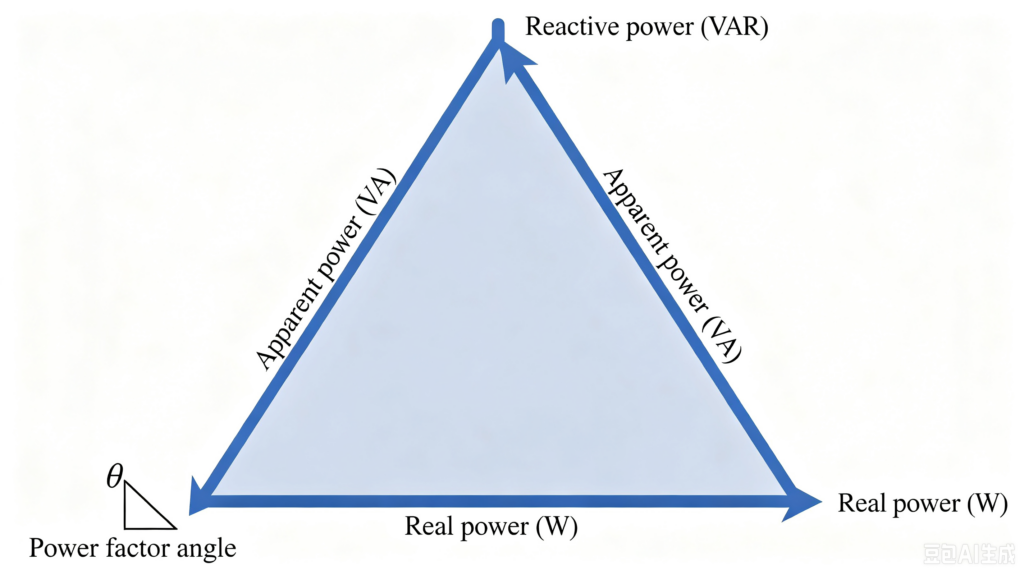
Apparent power includes both the real power that does useful work, and reactive power that moves back and forth between the source and reactive components (capacitors, inductors) without performing any work.
VA is the number you use for sizing electrical hardware: transformers, circuit breakers, wiring, UPS systems, and power supply input ratings. These components have to handle the total current, regardless of whether that current is doing useful work.
What Are Watts (W)?
Watts (W) measure real (active) power — the power that actually performs useful work, generates heat, or runs a circuit.
Formulas:
- DC circuits:
W = V × A - AC circuits:
W = V × A × Power Factor
Watts are what you pay for on your electricity bill. They describe actual energy consumption, component heat dissipation, and usable output power. For PCB design, wattage tells you how much heat your circuit will generate and what your load will draw.
VA vs Watts: Side-by-Side Comparison
| Parameter | Volt-Amperes (VA) | Watts (W) |
|---|---|---|
| Power type | Apparent power | Real / active power |
| Core formula | VA = V × I | W = V × I × PF |
| Accounts for phase shift | いいえ | はい |
| Primary use case | Sizing transformers, breakers, UPS, wiring | Calculating load, energy use, heat dissipation |
| Found on | Equipment input ratings, transformer labels | Utility bills, output power specs |
| PCB design role | Size power supply input & magnetics | Calculate thermal load & DC power draw |
How to Convert Between VA and Watts
Conversion relies entirely on power factor (PF), a number between 0 and 1 that describes how efficiently a load converts apparent power to real power.
- Watts = VA × Power Factor
- VA = Watts ÷ Power Factor
Quick example: A PCB power supply draws 2 A from a 120 V AC line, with a power factor of 0.75.
- Apparent power:
120 V × 2 A = 240 VA - Real power:
240 VA × 0.75 = 180 W
Key takeaway: The lower the power factor, the bigger the gap between VA and watts. A low-PF load draws more current for the same amount of real power, which is why power factor correction matters for industrial equipment.
Practical Use Cases for PCB & Electronics Design
This is where the difference actually matters for your work:
- Power supply & transformer sizing Always use VA, not watts, when selecting a transformer or AC-DC supply for your PCB assembly. Sizing only for wattage will undersize the primary side and cause overheating or voltage sag.
- PCB trace width planning Trace heating is driven by current, and current is tied to VA. For AC input paths, calculate current from VA, not watts, to specify the correct trace width.
- UPS and backup power UPS systems are rated in kVA. To size a UPS for your equipment, add up the VA ratings of all devices, not just their wattage.
よくある質問(FAQ)
Q: Is VA the same as watts?
No. VA measures apparent power, watts measure real power. They are only equal in purely resistive circuits with a power factor of exactly 1.
Q: How many watts is 1 VA?
It depends on power factor. At PF = 1, 1 VA = 1 W. At a typical PF = 0.8, 1 VA = 0.8 W.
Q: Why are power supplies rated in VA?
Because internal components (transformers, fuses, input wiring) must handle the total apparent current, not just the current that does useful work. VA ratings account for full current stress.
当社について
こちらもおすすめ…

著者について
アンドリュー・ザン – JKRGLO.comの研究開発エンジニア
アンドリュー・ザン氏は、PCB業界において14年以上にわたる研究開発(R&D)エンジニアとしての経験を持ち、回路設計の最適化およびDFM(製造適性設計)の実装に関する深い専門知識を有しています。同氏は、複雑な設計要件を量産対応のソリューションへと具現化することに注力し、試作から量産に至るまでの技術革新を推進しています。.
部門横断的なチームやクライアントと緊密に連携し、プロジェクトのライフサイクル全体を通じて、厳格な品質検証と円滑な技術的コミュニケーションを確保しています。アンドリューは、常にお客様の期待を上回る、信頼性が高く高性能なPCBソリューションの提供に尽力しています。.
目次
それでもまだお困りですか?お問い合わせはこちら:
PCBまたはPCBAの見積もりをご希望ですか?
タグ:
ampere volt and watt
PCBA
volt ampere
PCB
what volt ampere