
The 2026 Component Shortage Playbook: BOM Risk, AVL & Buffer Policy
Opening Introduction
The 2026 component shortage is structural rather than cyclical. AI data-center demand has pulled mature-node wafer capacity, memory and high-capacitance MLCCs into allocation, so lead times now routinely run past a quarter and past a year for some MCU and power families. Protecting your BOM and your schedule comes down to six moves: score every line for risk before you quote, qualify a three-tier alternate list while the primary part is still freely available, hold risk-adjusted buffer stock on the ten to twenty lines that can actually stop your line, convert reservations into confirmed purchase orders instead of forecasts, agree substitution rules with your customer and your assembler in advance, and verify every part that enters through a non-authorized channel.
Ask a purchasing team what changed in 2026 and you get some version of the same answer: it is not that parts disappeared. It is that ordinary parts started behaving like scarce ones. The 3.3 V LDO that shipped in two weeks is quoted at thirty. A routine 22 µF capacitor is the line item holding up the kit. The microcontroller that has been on the board since revision A is now marked end-of-life halfway through its production run.
This playbook is for the people who have to keep a build moving: design engineers, procurement leads, and the program managers stuck between them. It is not a market forecast. It is six actions in the order we would take them, with the scoring table, the trigger thresholds and the buffer numbers we use when we screen a customer BOM before quoting.
A structural shortage is one in which demand for constrained manufacturing capacity is not expected to fall back to earlier levels, so lead times do not normalise even after the panic buying ends.
1. Why 2026 is not 2021 again
The 2021 to 2023 shortage was a demand shock. Automotive OEMs double-ordered, almost everything went short at once, and when the double-ordering unwound, availability came back. The 2026 version has a different shape and a much longer tail, because the capacity that would normally absorb a demand spike is already committed somewhere else.
Force one: AI has taken the priority slot on mature nodes. TrendForce reported in June 2026 that AI data-center demand is displacing 8-inch and 12-inch mature-node capacity, the lines that make power management ICs, display drivers, MCUs and power discretes. 8-inch utilisation reached roughly 90% in the second half of the year and wafer prices rose 5 to 20%. Foundries have been unusually direct about what comes next. UMC has said its 2027 adjustments will exceed 2026 levels in both magnitude and scope. Powerchip raised power management and display driver prices 10 to 15% from July 2026, and TSMC is reportedly planning mature-node increases of up to 10% from the start of 2027.
Force two: memory is being reallocated, not expanded. A gigabyte of high-bandwidth memory consumes about four times the wafer capacity of standard DRAM, and TrendForce projects AI demand alone absorbing close to 20% of global DRAM supply in 2026. Samsung, SK Hynix and Micron have moved their main lines to allocation-only contracts weighted toward large AI buyers. Conventional DRAM contract prices rose 13 to 18% quarter on quarter in Q3 2026 and NAND rose 10 to 15%, with UBS revising its DRAM forecast up to 32% for the quarter and pushing the expected tightness into the first half of 2028. DDR4 is the worst case, because it is the part most legacy designs actually use: wafer capacity is moving to DDR5, and Morgan Stanley has flagged a 50% quarter-on-quarter increase for mature DRAM nodes in Q3.
Force three: passives split in two. General commercial MLCCs in common values are available. High-capacitance, high-voltage, small-case and automotive-grade parts are not. TrendForce put standard-case MLCC lead times at 14 to 18 weeks in August 2026 and high-capacitance or high-voltage parts at 15 to 20 weeks, with some Samsung Electro-Mechanics high-capacitance parts quoted near 40 weeks through distribution. Murata’s order-to-backlog ratio reached 1.27, above the 1.25 peak that marked the start of the 2018 shortage. Samsung Electro-Mechanics raised MLCC prices 30% from 1 August 2026 and Taiyo Yuden followed on 1 September.
Component obsolescence and component shortage are different problems that arrive together: obsolescence removes a part permanently, shortage removes it temporarily, and only one of them can be waited out.
| Component family | Lead time now | What is driving it | First move |
|---|---|---|---|
| 32-bit MCUs (Cortex-M class) | 26 to 55+ weeks | Mature-node reallocation; some families marked NRND mid-life | Confirm allocation with a franchised distributor; qualify a pin-compatible alternate during DVT |
| Power management ICs, LDOs, DC-DC | 18 to 52+ weeks | Fab-node concentration; automotive and industrial accounts take priority | Dual-source early; ask for factory loading status, not catalogue stock |
| Power discretes (MOSFETs, SiC) | 30 to 52 weeks at major suppliers | 8-inch line economics; an AI server carries 5 to 10 times the power silicon of a standard server | Check second-source availability before layout freeze |
| DDR4 and legacy DRAM | 20 to 30 weeks and rising | Capacity shifting to DDR5; AI absorbing wafer starts | Run a last-time-buy analysis now; do not design DDR4 into a new program |
| NAND flash and SPI NOR | 10 to 30 weeks | Packaging and test capacity; enterprise SSD priority | Confirm a density migration path before you commit to the exact part |
| High-capacitance MLCC (X7R, 10 µF and above) | 15 to 20 weeks, up to 40 weeks for some parts | Ceramic powder supply; factory allocation to AI grade | Dual footprint pads; specify parameter ranges instead of single part numbers |
| Standard-case commercial MLCC | 14 to 18 weeks | Spillover from high-end allocation | Stay on standard case sizes; keep an AVL across five manufacturers |
| Connectors | 10 to 16 weeks, plus 6 to 10 weeks for custom tooling | Tooling queue | Avoid proprietary footprints unless the enclosure forces it |
| Legacy analog, op-amps, older regulators | 40 to 52+ weeks, some parts already NRND | Mature-node deprioritisation hits these first | Design review now; these show the sharpest extensions in the market |
Table 1. Lead-time ranges reflect what buyers reported through franchised distribution in Q2 and Q3 2026. Confirm against an RFQ for your exact part number and date code, because a catalogue listing is not an allocation.

2. Step one: run a BOM risk screen before your next RFQ
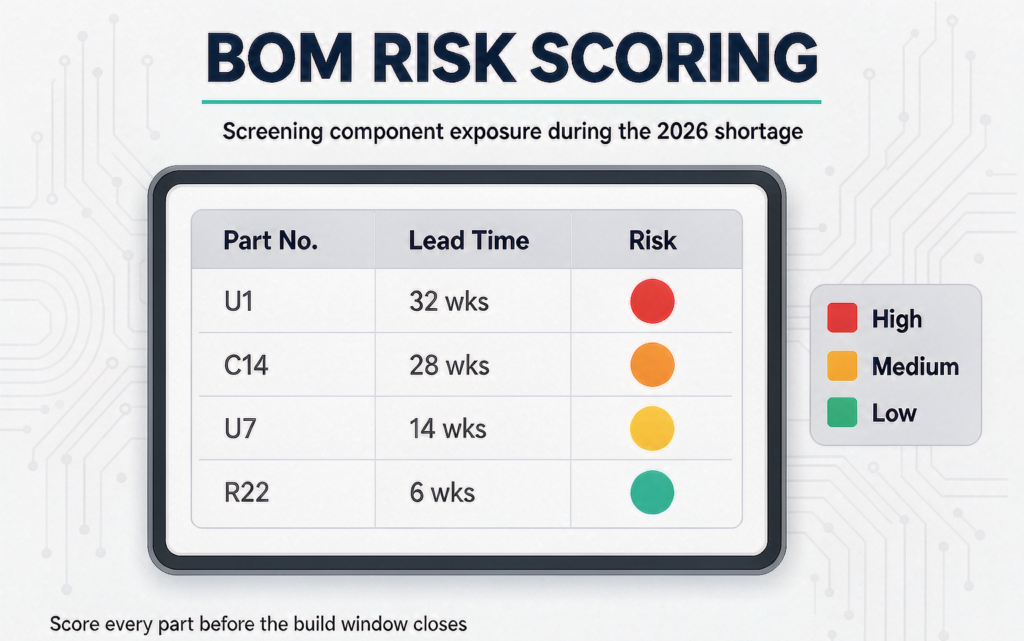
You do not need a platform to start. You need the BOM, current lead times from your distributor, and one afternoon. Score every line on six factors, sort by total, and the exercise reduces a 400-line BOM to the ten to twenty lines that can actually stop a build.
The screening question is not whether a part is available. It is whether it stays available for longer than your planning window. A part with a 20-week lead time, a 12-week production forecast, no qualified alternate and six weeks of inventory is already a production risk, even when the distributor lists it as available to order.
Supply coverage is available inventory divided by average weekly consumption, expressed in weeks of protected production.
In the example above, coverage is six weeks against a twenty-week replenishment cycle, so the real exposure is a fourteen-week gap. That number, not the lead time on its own, is what you take to the redesign conversation.
BOM risk is the probability that a specific line item stops a build, weighted by how much of the schedule that build represents.
| Factor | 0 points | 1 point | 2 points |
|---|---|---|---|
| Lead time against planning window | Under 50% of the window | 50 to 100% of the window | Exceeds the window today |
| Approved source count | Three or more | Two | Sole source |
| Lifecycle status | Active, multi-year outlook | Active but a PCN has landed | NRND, EOL, or inside a last-time-buy window |
| Allocation status | Free stock at an authorised distributor | Partial allocation, quantity limited | Allocation-only, no new commitments accepted |
| Price movement over two quarters | Flat | Up to 15% | Above 15%, or indexed to a commodity |
| Revenue exposure | Under 5% of annual build | 5 to 20% | Over 20%, or a single customer program |
Reading the score: 0 to 3 means monitor quarterly. 4 to 7 means qualify a second source and hold a 60-day buffer. 8 to 12 means build buffer stock and start alternate qualification this month. 13 or above means redesign, or buy ahead now while the traceable channel is still open.
Rescore quarterly. Lead times and allocation status move month to month, and a score you set in January is not an answer in September.
3. Step two: build a three-tier AVL while the primary part is still easy to buy
The worst week to start qualifying a second source is the week your distributor says it can no longer deliver. By then the alternate is usually on allocation too, engineering has no bandwidth, and the customer approval you need has never been discussed. Alternate qualification is a design activity that happens months before it becomes a purchasing activity.
An approved vendor list is the set of alternate part numbers that engineering has already validated for a given BOM line, ranked by how much work each substitution requires.
A drop-in alternate shares the same package, pinout and electrical envelope as the primary part, so it can be substituted without a layout change or a firmware change.
| Tier | What it means | Validation required | Time to switch |
|---|---|---|---|
| Tier 1: drop-in | Same package, same pinout, same electrical envelope | Incoming inspection, LCR or functional spot check on a sample | Days |
| Tier 2: functional equivalent | Same function, different pinout, family or footprint | Datasheet review, electrical and thermal validation, firmware check, EMC re-test if it sits on a clock or supply rail | 4 to 12 weeks |
| Tier 3: redesign | Different package or architecture, or a change that touches the board | Full design verification, layout change, agency re-certification where applicable | 3 to 6 months |
Table 2. The tier a substitute falls into decides whether you can act in days or in months, which is why the tier belongs in the BOM notes and not in someone’s memory.
Five design moves that cost almost nothing at schematic stage:
- Specify parameter ranges instead of a single part number wherever the circuit allows it.
- Keep critical passives on standard case sizes and give them dual-footprint pads, so a case-size substitution needs no board respin.
- Avoid proprietary connectors unless the enclosure forces your hand.
- Do not lock the design to the fastest speed bin. Design for the grade that ships in volume.
- Flag every single-source line at design review, while changing it is still a schematic edit.
4. Step three: set a buffer policy that matches the risk, not the anxiety
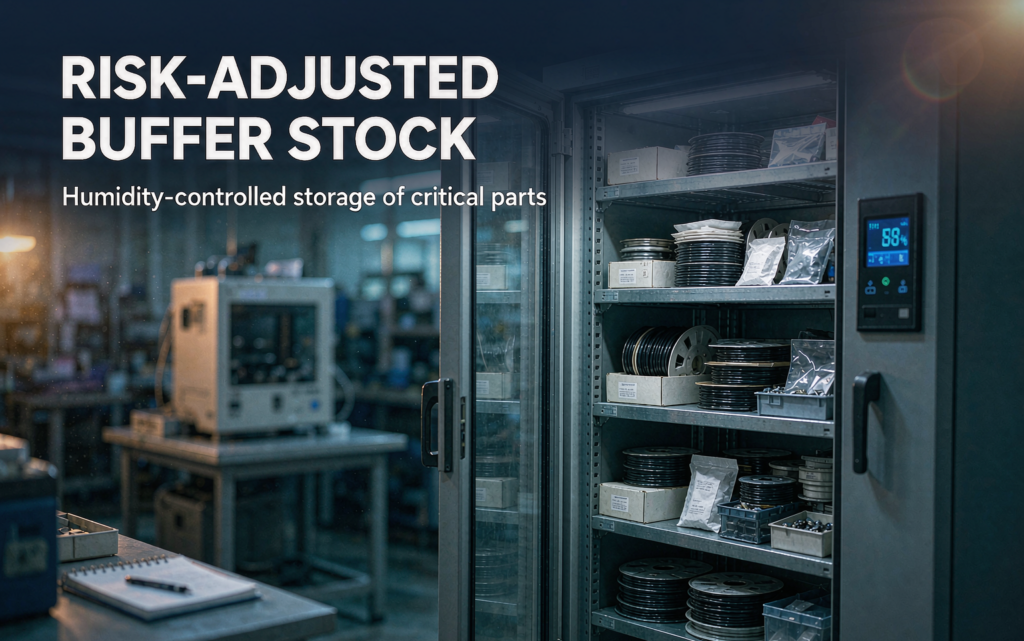
Buffer stock is not one number. It is a policy per risk class, and the arithmetic behind it is simple enough to defend in a budget meeting.
Safety stock is the quantity held specifically to cover the gap between average and worst-case replenishment time, not the quantity held to cover normal demand.
The working formula is maximum lead time minus average lead time, multiplied by average daily usage. A part with a 20-week worst case, a 12-week average and 200 units of daily consumption justifies 560 units of cover, not a round number someone picked from a gut feeling.
| Category | Target coverage | Why that level |
|---|---|---|
| Commodity passives, standard case, multi-source | 4 to 8 weeks | Broadly available. Anything more is working capital sitting in a drawer. |
| Standard logic, non-constrained MCUs | 8 to 12 weeks | Lead times on these move fastest during a demand spike. |
| Constrained or long-lead ICs (PMIC, FPGA, sole-source MCU) | 16 to 26 weeks | Allocation, not price, is the binding constraint here. |
| Memory in active production | 12 to 20 weeks of the exact density and speed grade | A different speed grade is not a real substitute, it is a redesign. |
| Custom mechanicals, first production run | 100% of the first build | Tooling adjustments between runs are normal, and spares prevent a stopped line. |
| Anything with a qualified Tier 1 alternate | Reduce one step | The alternate is doing the buffering, so inventory does not have to. |
Table 3. Coverage targets assume an authorised supply channel and a production forecast you can defend. Adjust the numbers for your own cash position, not for how the news cycle feels.
Two cautions belong in the policy itself. First, buffer stock is not the same thing as risk management: inventory of a part that goes obsolete is not protection, it is a write-off, so check lifecycle status before you buy ahead. Second, the cost comparison is usually obvious once it is on paper. Holding 10,000 units of a part that costs $0.80 ties up $8,000. A single week of stopped production costs far more than that, and that is the number the policy should be built on.
Store what you buy correctly, too. Parts bought on the open market often arrive outside the original moisture barrier bag, and J-STD-033 handling rules are what stop a batch of perfectly genuine components from failing at reflow.
5. Step four: lock supply where allocation is the real constraint
Allocation is a supplier practice of distributing a constrained quantity across customers rather than accepting orders in full, which turns availability into a negotiation instead of a price.
Once a part is on allocation, price stops being the interesting number. What matters is whether your order is recognised at all. Six moves change that:
- Convert reservations into confirmed purchase orders. Allocation systems recognise committed orders, not intentions. A forecast sitting in a spreadsheet buys nothing.
- Offer a committed volume in exchange for a long-term agreement. Even at 5,000 to 20,000 units a year, distributors will usually work with a committed 6 to 12 month view.
- Share a rolling 12-week forecast even when it is imperfect. Scenario visibility generally buys better material commitments than order-by-order purchasing.
- Put a validity date on every quote you issue. Seven days plus an index-linked clause, so a customer cannot confirm a price five weeks after you quoted it and leave you holding the difference.
- Re-check older agreements against current price lists. One major analog supplier raised affected lines 15 to 85%, another 15 to 30%, and a large European vendor raised power switch and power IC prices. A blanket order written before spring 2026 is probably stale, and the increase will surface on the first shipment.
- Handle last-time-buy properly when a PCN lands. Size the final order against the remaining production life of the program, not against this quarter’s usage.
A last-time-buy is the final order a manufacturer accepts before a part reaches end-of-life, and it is usually the only remaining chance to secure traceable stock at a known price.
6. Step five: protect the schedule, not just the BOM
The BOM is a document. The schedule is what your customer actually cares about, and it usually slips for reasons that have nothing to do with a part being unavailable: an RFQ that was incomplete and came back with optimistic numbers, tooling ordered after the components arrived, or a substitution that needed customer approval nobody had defined.
Five habits hold a schedule together in a shortage year:
- Freeze the design before you quote it. Layer count, copper weight and laminate grade move lead time more than any negotiation will, and a stackup change after release costs weeks.
- Send a complete RFQ. Part number for every line, approved alternates, quantity by date, firmware version, test and traceability requirements, and any stock you already own. An RFQ that says “as soon as possible” gets a quote built on hope.
- Start tooling, stencils and test fixtures in parallel with component procurement. These sit on the critical path, and nobody notices until they are late.
- Define substitution rules in writing before you need them. Which changes need customer sign-off, which are yours to make, and what has to be re-tested. Undefined approval is one of the most common causes of a two-week delay that has nothing to do with supply.
- Set trigger thresholds, so the response is a policy instead of a judgement call made under pressure. A threshold removes the meeting where three people disagree about whether this is bad enough to act on.
| When this happens | Do this automatically |
|---|---|
| Lead time crosses 50% of your planning window | Place a buffer order and open alternate qualification |
| A line becomes sole-source | Escalate to design review within one week |
| A supplier issues a PCN or an NRND notice | Run a last-time-buy analysis within 30 days |
| A broker price exceeds twice the book price | Require written engineering approval before the purchase goes ahead |
| A line has been on allocation for two consecutive months | Force a redesign or buy-ahead decision instead of another monitoring cycle |
Table 4. Thresholds are the part of a playbook that actually gets followed, because they replace a debate with a decision.
Schedule protection deserves its own exercise because the cost of failure is not linear. A discrete manufacturing line that loses thirty minutes to material starvation typically burns somewhere between 1,000 and 7,500 euros in contribution margin, and expedited freight to recover a shortage runs three to ten times standard logistics cost. On a just-in-time contract, line-down penalties reach five and six figures per hour. Compare that with the proactive bill: qualifying a second source is a few thousand dollars, and thirty days of safety stock on a low-value part is a rounding error against a single week of stopped output.
The teams that handle this well do one more thing that costs nothing: they ask their contract manufacturer what is moving. A CM sees allocation pressure across hundreds of customers, so it usually knows a part is tightening before it shows up in your inbox. Put it on a standing agenda instead of waiting for bad news.
7. Step six: keep the open market from becoming your biggest risk
Shortages push buyers off authorised channels, and that is not a failure of judgement. It is what happens when the alternative is a stopped line. But a shortage cycle is also exactly when counterfeit and mislabelled parts multiply, because unvetted brokers fill the gap with whatever they can find: devices harvested from scrap boards, date codes remarked to look current, and refurbished parts sold as new.
The number worth remembering comes from ERAI’s 2025 reporting: of the suspect counterfeit parts reported that year, 24% passed electrical testing, and roughly one third were parts still in active production and available through authorised distribution. In other words, counterfeit risk is not confined to obsolete parts, and testing alone is not a screening programme.
Electrical testing alone detects only part of the counterfeit population, which is why authentication programmes combine visual inspection, X-ray, solvent testing and destructive analysis rather than relying on any single method.
| What you are buying | Documentation | Inspection | Electrical check |
|---|---|---|---|
| Passives and standard connectors from an authorised channel | Packing slip, lot code, date code | Visual check, tape and reel seal intact | LCR spot check on a sample |
| Standard logic and op-amps | Certificate of conformance, distributor label | Microscope, then an acetone rub on the marking to expose blacktopping | Curve tracer I/O signature against a known-good sample |
| MCUs, FPGAs, power ICs, memory | Traceability to the original manufacturer at lot level | X-ray, plus decapsulation if markings are suspect | Functional test, firmware load, boundary scan |
| Anything from a broker with no traceability | Treat as suspect until proven otherwise | Full AS6081-aligned programme | Do not release without an evidence-grade test report |
Table 5. Match the verification level to the consequence of a failure, not to the price of the part. A three-dollar microcontroller that stops a hundred-thousand-dollar build deserves more scrutiny than its cost suggests.
If you have to buy outside authorised channels, buy through a distributor that tests in its own laboratory and hands you a report you could show an auditor. Look for AS6081 compliance, testing aligned to AS6171 methods, and inspectors certified to IDEA-ICE-3000. And keep one rule absolute: a purchase order is not an approval. Substitutions need written engineering sign-off, and material from a non-authorised source needs incoming inspection before it goes anywhere near a stencil.
8. What this looks like from the factory side
Most of what goes wrong in a shortage year goes wrong before the first board is built. By the time a line is stopped, the decisions that would have prevented it were made months earlier, during quoting and design review, when nobody felt any pressure at all.
That is the case for treating these six steps as part of your assembly partner’s job rather than your own paperwork. In practice, it means asking a supplier to do specific things, not to promise general things:
- Screen the BOM for long-lead, allocated and end-of-life parts at quote stage, while substitution is still a schematic edit rather than a production crisis.
- Suggest alternates together with the validation each one actually needs, not just a cross-reference number.
- Keep the approved vendor list as a maintained document that survives a change of staff.
- Run incoming inspection on anything that was not bought through an authorised channel, with records tied to the lot and the build.
- Give you an escalation path with a defined response time: which lines are affected, what the projected delay is, and what each option costs, within a day rather than at the end of the month.
- Price the buffer and buy-ahead options into the quote, so you can compare carrying cost against delay risk before you commit.
A useful test when you are evaluating any supplier is to ask what happens on the day a part on your BOM goes on allocation. If the answer is a promise to try their best, that is your answer. If the answer is a process with a response time attached to it, you are talking to the right kind of partner.
9. FAQ
Is there still a component shortage in 2026?
Yes, but it is selective rather than universal, which is what makes it harder to plan for than 2021. High-capacitance and automotive-grade MLCCs, memory, power management ICs, mature-node MCUs and power discretes are constrained. Standard commercial passives, general-purpose logic and common connectors are broadly available. TrendForce flagged the fourth quarter of 2026 as the point at which high-end MLCC tightness either becomes a full shortage or starts to ease, so availability has to be checked part number by part number rather than by category.
Which components are hardest to source right now?
In rough order of how often they stop a build: mature-node 32-bit MCUs, power management ICs and LDOs, DDR4 and legacy DRAM, high-capacitance MLCCs, power discretes, and connectors that need custom tooling. Legacy analog is the category with the sharpest lead-time extension, because mature-node capacity was deprioritised first. Several MCU families have also been marked end-of-life partway through their normal production run, which means the part is not merely hard to get, it is disappearing permanently.
How much buffer stock should I hold?
Enough to cover the gap between your worst case and your average case: maximum lead time minus average lead time, multiplied by average daily usage. In practice that lands at 4 to 8 weeks for commodity passives, 8 to 12 weeks for standard logic, and 16 to 26 weeks for single-source or allocated ICs. Buffer the parts that can stop the line and leave the rest on normal replenishment, because inventory of a part that later goes obsolete is a write-off rather than protection.
Can I swap an MLCC or an MCU without requalifying the board?
It depends which tier the substitute falls into. A same-case MLCC with the same dielectric is normally a Tier 1 drop-in with an LCR spot check, but effective capacitance under DC bias still has to be verified, because a nominally identical 22 µF part can behave very differently once voltage is applied. An MCU swap is a Tier 2 or Tier 3 event: pinout, firmware, peripheral set, timing and boot behaviour all change something, and that work belongs in design verification rather than in a purchase order note.
When will the shortage ease?
Forecasts converge on 2027 at the earliest, and not uniformly. UBS expects DRAM tightness to persist into the first half of 2028, with 2027 demand growing around 36% against supply growth near 19%. On mature nodes, relief is generally pushed to 2028 because moving a device from 8-inch to 12-inch production takes 18 to 30 months of redesign, process tuning and customer qualification. Plan for tight supply through 2027 and treat any improvement as upside rather than as a plan.
Is it safe to buy from a broker when authorised channels are dry?
It can be, if the distributor tests in its own laboratory and gives you an evidence-grade report you could produce during an audit. It is not safe to buy from an unvetted marketplace listing on the assumption that stock equals authenticity. Roughly a quarter of reported suspect counterfeits in 2025 passed basic electrical testing, so “we tested it” is not the same claim as “it is traceable to the original manufacturer”.
The part that actually protects the schedule
The teams that come through 2026 with their delivery dates intact will not be the ones holding the largest inventory. They will be the ones who knew which twelve lines could hurt them, qualified the alternates before they needed them, put a number on the buffer instead of a feeling, and had a documented answer ready for the week a supplier called.
Most of that work takes an afternoon and costs nothing but attention, which is exactly why it gets postponed. The parts on allocation do not care about your roadmap, so the sequencing has to be yours.
Want a second opinion on your BOM before you release it? Send it to our engineering team and we will flag the long-lead, allocated and end-of-life lines, and tell you which alternates need qualification work and how much.
See our PCB assembly and turnkey component sourcing service or send your BOM for a risk review.
Market conditions and figures in this article are current as of September 2026, and are drawn from published research and reporting by TrendForce, UBS, Morgan Stanley, ERAI, AERI and manufacturer price announcements. Component lead times, allocation status and pricing change quickly. Confirm the current position for your exact part number and date code with an authorised distributor or your assembly partner before you commit to a build schedule.
About US
You may also be interested in…

About the Author
Andrew Zhan – R&D Engineer at JKRGLO.com
With over 14 years of R&D engineering experience in the PCB industry, Andrew Zhan brings deep expertise in circuit design optimization and DFM implementation. He focuses on translating complex design requirements into production-ready solutions, driving technical innovation for both prototype and mass production.
Working closely with cross-functional teams and clients, he ensures rigorous quality validation and seamless technical communication across the full project lifecycle. Andrew is committed to delivering reliable, high-performance PCB solutions that consistently exceed customer expectations.
Table of Contents
Still, need help? Contact Us:
Need a PCB or PCBA quote?
Tag:
best pcb manufacturers
PCBA
PCB
component lead times 2026
MLCC lead time