
PCB Manufacturing Tariffs in 2026: The Real Duty Stack for China-Origin Boards
Opening Introduction
Quick answer
As of September 2026, a China-origin printed circuit board pays 12.5% or 37.5% in US import duty, and the deciding factor is whether the board qualifies for the Section 301 exclusion for two-layer and four-layer rigid FR4 circuits. Qualifying boards skip the 25% Section 301 product duty and pay only the 12.5% forced-labor tier introduced on July 24, 2026. Everything else — six layers and above, flex and rigid-flex, non-FR4 substrates, and most assembled boards — has paid 37.5% all year. The exclusion expires at 11:59 p.m. ET on November 9, 2026, which is the most consequential date on a PCB buyer’s calendar right now. The IEEPA tariffs that dominated 2025 were struck down by the Supreme Court on February 20, 2026, and roughly $165 billion in collected duties has been flowing back to importers since April.
Tariff talk changed shape in 2026. Last year it was a headline number — 145%, then 30%, then whatever the news said that week. This year it is a technical conversation about exclusion numbers, tariff classifications, and a single deadline in November. If you buy boards, that shift matters, because two shipments of the identical board can carry 25 percentage points of difference in duty depending on paperwork and layer count.
We build and quote boards for US buyers every week, so we see how these rules land on real purchase orders. Below is the duty stack as it actually stands, checked against USTR, CBP, and court filings as of September 2026 — plus what we see from the factory floor.
1. What a China-origin PCB pays right now
There is no single answer to “what is the tariff on PCBs from China,” because duty is now a function of two variables: the layer count and construction of the board, and whether the specific exclusion covering it is still alive. Here is the whole picture for China-origin product, as of September 2026.
| Board type (China origin) | Section 301 product duty | Forced-labor tier (since July 24, 2026) | Effective duty |
|---|---|---|---|
| 2-layer rigid FR4, exclusion claimed (HTS 8534.00.0040) | 0% (excluded) | 12.5% | 12.5% |
| 4-layer rigid FR4, exclusion claimed (HTS 8534.00.0020) | 0% (excluded) | 12.5% | 12.5% |
| 6+ layers, HDI, flex, rigid-flex, non-FR4 substrates | 25% | 12.5% | 37.5% |
| Assembled boards (PCBA) — generally outside the board exclusion | 25% (varies by classification) | 12.5% | ~37.5% |
| China-origin ICs and semiconductors (8541 / 8542) | 50% | 12.5% | 62.5% |
Duty applies to the customs value of the goods, and the figures above exclude freight, the merchandise processing fee, and brokerage. Two things are worth noticing. First, a two-layer board and a six-layer board from the same factory, shipped the same week, can carry a 25-point difference in duty — not because of price or quality, but because of which tariff line and which exclusion they fall under. Second, the 12.5% tier is not a PCB measure at all. It applies to Chinese goods generally.
2. How the 2026 stack was rebuilt
The rules changed more in the first seven months of 2026 than in the previous three years combined. Five events did most of the work.
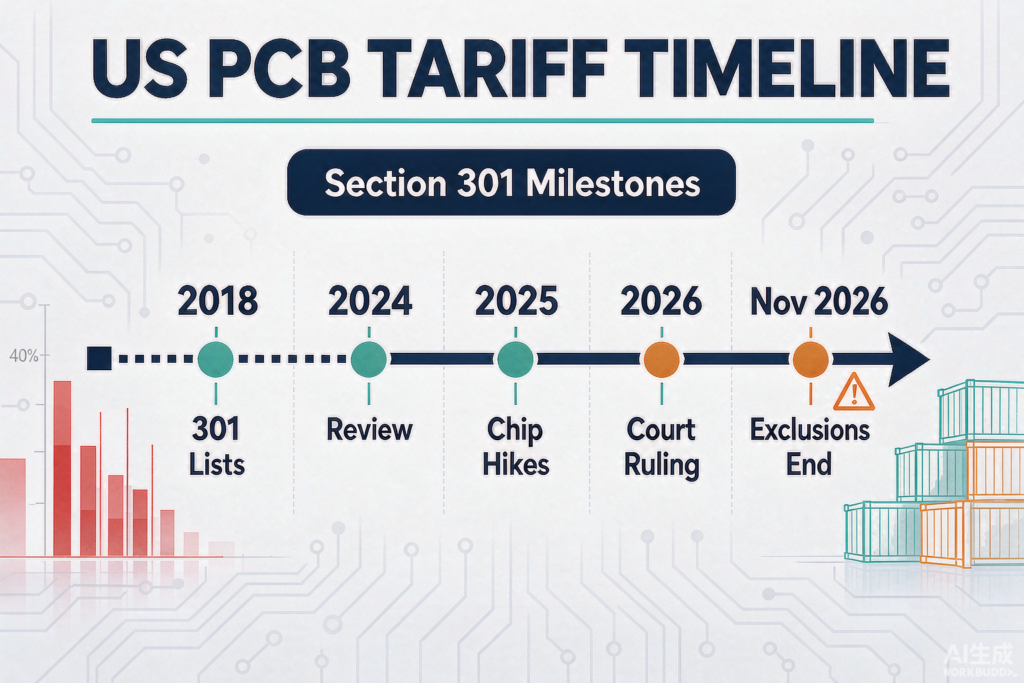
| Date | What happened | What it means for a PCB buyer |
|---|---|---|
| Feb 20, 2026 | The Supreme Court ruled 6-3 that IEEPA does not authorize the President to impose tariffs, voiding the fentanyl and reciprocal duties | No IEEPA layer on your entries, and refunds became claimable |
| Feb 24-25, 2026 | A 10% temporary surcharge under Section 122 of the Trade Act of 1974 took effect globally, capped at 150 days | A flat 10% replaced the voided tariffs while a durable mechanism was written |
| Mar 4 to Apr 20, 2026 | The Court of International Trade ordered refunds; CBP opened the CAPE portal and began paying them out | About $166 billion owed to roughly 330,000 importers; close to $100 billion refunded by August |
| Jun 24, 2026 | De minimis was suspended for all origins, not just China | Samples, spares, and small orders now need a customs entry and pay duty |
| Jul 24, 2026 | Section 122 expired at its statutory limit, and a two-tier Section 301 forced-labor tariff took effect the same day | China moved to the 12.5% tier; roughly 45 other economies sit at 10% |
| Nov 9, 2026, 11:59 p.m. ET | 178 Section 301 exclusions expire, including the one covering two-layer and four-layer rigid boards | China 2-layer and 4-layer boards move from 12.5% to 37.5% unless USTR extends |
| Nov 27, 2026 | China’s suspension of its gallium and germanium export controls toward the US runs out | A component availability risk rather than a duty change, but it hits the same programs |
One pattern is worth internalizing: every time a tariff mechanism has been struck down or has expired, a replacement has appeared within hours, not months. Planning around a window of zero tariffs has not worked for two years running.
3. The five layers that decide your duty
PCB manufacturing tariffs are the import duties a buyer pays when a bare board or an assembled board crosses a national border, calculated on the customs value of the goods rather than on the total shown on the purchase order. That value-driven logic is why freight and insurance do not appear in the duty line, and why the same board can cost two buyers different amounts depending on how it was declared.
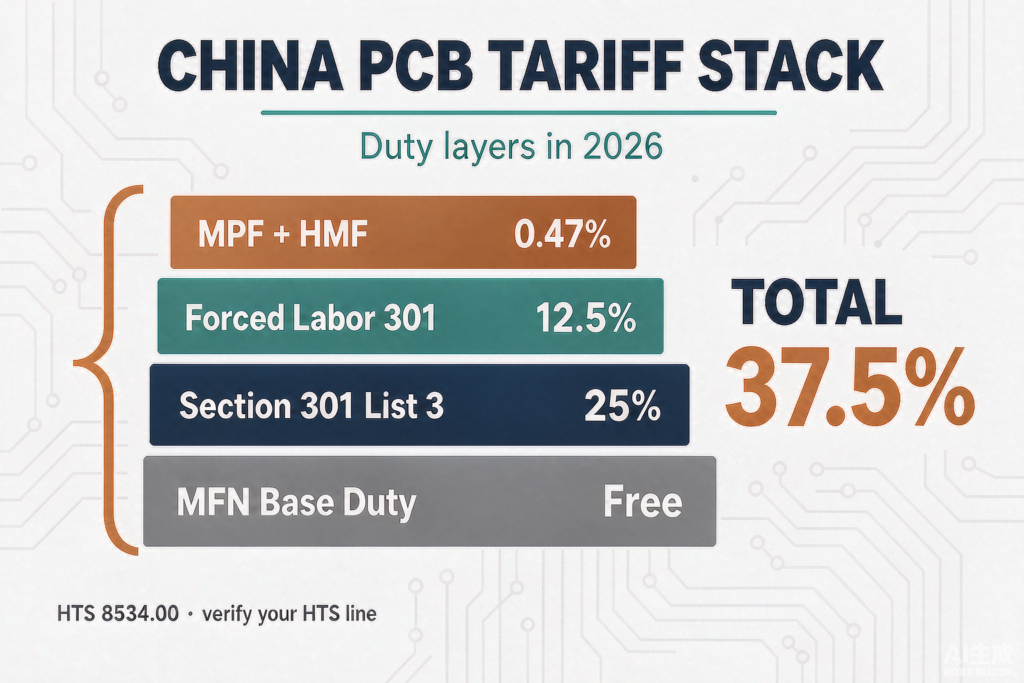
| Layer | Rate | Who and what it applies to |
|---|---|---|
| MFN base duty | Free for HTS 8534.00 | All origins. A zero base rate does not mean a zero landed rate — every other layer still applies |
| Section 301 product duty | 25% | China and Hong Kong origin PCBs, unless a published exclusion covers the product |
| Section 301 forced-labor tier | 12.5% China, 10% ~45 other economies | Effective July 24, 2026, replacing the Section 122 surcharge across roughly sixty economies |
| Merchandise processing fee (MPF) | 0.3464% of entered value, with a statutory minimum | Formal entries. On small shipments the minimum dominates the percentage |
| Harbor maintenance fee (HMF) | 0.125% | Ocean freight only, which is why air and sea quotes diverge slightly |
A Section 301 exclusion is a product-specific exemption published in the Federal Register that removes a listed item from a Section 301 duty, usually for a fixed window and only for goods that match the published description exactly. Exclusions are the reason the effective rate on some boards is a third of the rate on others.
4. The 2-layer and 4-layer exclusion, and what happens on November 9
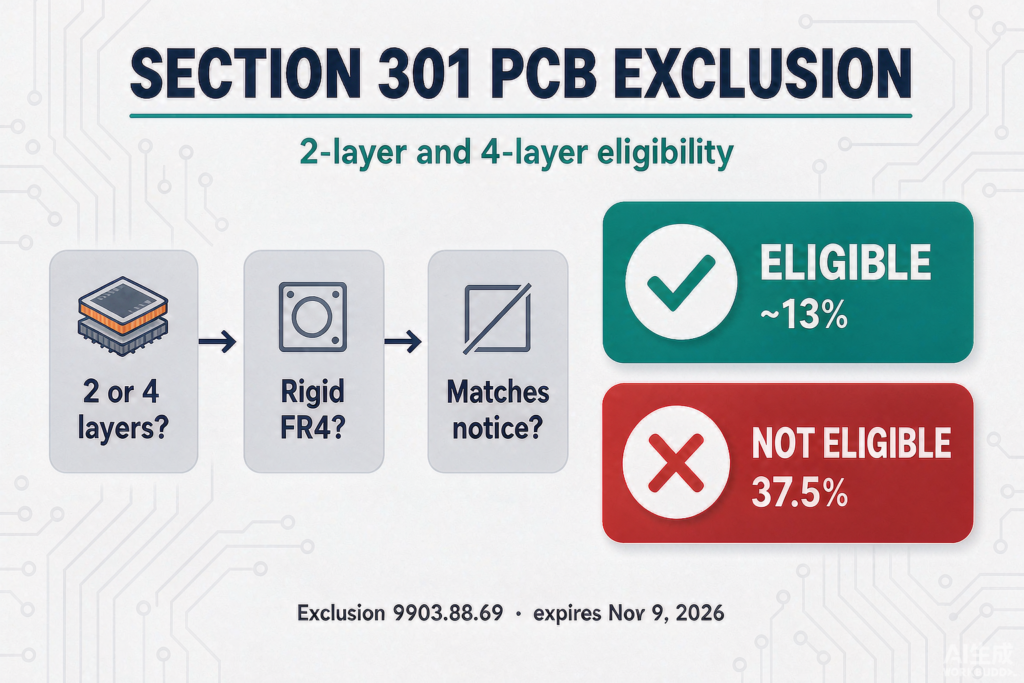
The exclusion that keeps most simple boards affordable is filed under HTS 9903.88.69. It does not cover “printed circuit boards” in general — it covers a narrow description, and boards that miss any part of that description have been paying the full 37.5% all year without their buyers necessarily realizing it.
| Qualifies today | Does not qualify |
|---|---|
| Rigid boards only | Flex, rigid-flex, and any flexible construction |
| Two layers of copper on a glass-reinforced substrate (standard FR-4), or four layers on the same substrate | Six or more layers, HDI, and any count above four |
| Bare, unpopulated boards | Assembled boards with components mounted |
| Glass-reinforced base material | Metal-core, aluminum, ceramic, and other specialty substrates |
HTS 8534.00 is the US tariff heading for bare printed circuits — boards with no components mounted — and the heading itself carries no base duty; what a buyer actually pays comes from the trade-remedy layers applied on top of it.
The exclusion expires at 11:59 p.m. Eastern on November 9, 2026. Unless USTR extends it, the first entries filed on November 10 pay the full rate. On a 1,000-piece order of four-layer boards at $3.00 FOB, that is the difference between $375 and $1,125 in duty.
| Now (exclusion in force) | From November 10, 2026 | |
|---|---|---|
| Effective duty rate | 12.5% | 37.5% |
| Duty on a $3,000 shipment | $375 | $1,125 |
| Cost per board before freight | $3.38 | $4.13 |
| Change | — | +22% per board |
5. HTS classification: the lever most buyers never check
Classification decides which layers apply. It is also the one variable where a buyer can create real savings — or real liability — without changing suppliers.
| Heading | What it covers | Practical note |
|---|---|---|
| 8534.00 | Bare printed circuits — rigid, flex, rigid-flex, unpopulated | MFN free; the 25% and 12.5% layers are what you actually pay |
| 8473.30 | Assemblies that are parts of computers and data processing machines | Narrower than most importers assume, and it does not cover boards that do a different job |
| 8517.62 and 8517.79 | Assemblies for communication apparatus | Carved out of the 2026 forced-labor action by its annex, which catches people by surprise in both directions |
| 8537.10 | Boards fitted with switching or control apparatus, under 1,000 V | Common for industrial controllers and machine panels |
| 8542.31 and 8542.39 | Integrated circuits, including some modules that function as ICs | China-origin parts here carry the 50% semiconductor rate |
USMCA rules of origin determine whether goods assembled in Mexico or Canada enter the United States duty-free, and they rest on where the qualifying manufacturing processes happen rather than simply where the last assembly step took place. Classification and origin are the two places where documentation, not negotiation, sets your rate.
Two habits pay for themselves. First, classify by function and write the reasoning down before the first shipment, so the answer does not change with whoever is filling out the paperwork that month. Second, if the value is meaningful or the heading is arguable, request a binding ruling through CBP’s eRulings system. It is free, it takes about a month, and it converts a judgment call into a document you can hand an auditor years later. Reclassification after the fact does not just cost the duty — it can cost interest and penalties, and it applies retroactively to every entry you filed the same way.
6. Landed cost: four scenarios on the same order
Landed cost is the total a buyer pays to get goods into a warehouse — unit price plus freight, insurance, duty, customs fees, and inland delivery — and it is the only number worth comparing between suppliers in different countries. Here is an illustrative 1,000-piece, four-layer order across four sourcing routes. Freight, MPF, and brokerage are excluded so the duty effect is visible on its own.
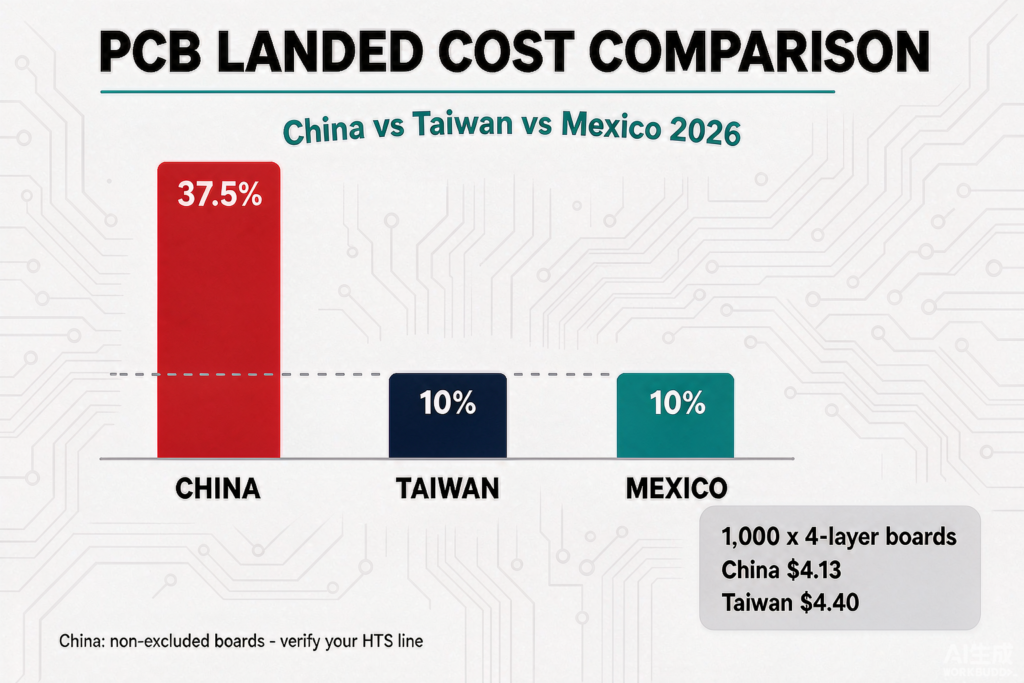
| Source | Unit FOB | Duty rate | Duty per board | Cost per board |
|---|---|---|---|---|
| China, exclusion claimed, before November 9 | $3.00 | 12.5% | $0.38 | $3.38 |
| China, after November 9 if the exclusion lapses | $3.00 | 37.5% | $1.13 | $4.13 |
| Malaysia | $4.20 | 10% | $0.42 | $4.62 |
| Taiwan | $4.50 | 10% | $0.45 | $4.95 |
| Mexico, USMCA-qualifying | $5.50 | 0% | $0.00 | $5.50 |
Read the first two rows together and the November deadline stops being an abstraction. The China board stays the cheapest option on this order either way, but the cushion against Malaysia shrinks from $1.24 per board to $0.49. For a program with thin margins, that is the difference between a comfortable decision and a hard conversation.
Now run the same math on a six-layer board, where China pays 37.5% no matter what. A $6.00 board lands at $8.25. The same board quoted at $6.80 from Taiwan lands at $7.48 — cheaper, even though the unit price is higher. That is the case where duty genuinely changes a sourcing decision, and it is the case that gets missed when buyers compare quotes on unit price alone.
7. Samples and prototypes after the de minimis change
De minimis was the rule that let commercial shipments valued at $800 or less enter the United States without duty; it has been suspended for all origins since June 24, 2026, so every commercial shipment now needs a customs entry. China-origin goods lost the exemption earlier, which is why some teams already adjusted and others are about to.
The change hits engineering budgets harder than it hits production, because fixed costs do not scale down. A $200 sample box now needs a classified entry, the MPF minimum, and either a broker or in-house filing capability. Add a broker fee in the usual $35 to $75 range and the effective rate on that sample can exceed the duty rate on a full container.
Three things make it manageable. Consolidate: a single shipment covering multiple suppliers costs one entry instead of five. Document: prototype goods with no commercial value may qualify for duty-free entry under 19 CFR 10.151, but only with proper documentation, and labeling a commercial order as a sample is how importers earn penalties. And ask your supplier for paperwork in advance — invoices that state the HTS code, the value, and the origin correctly save a week of back and forth with a broker.
8. Seven mitigation moves that hold up under audit
None of these require an aggressive position on the rules, which is the point. Strategies that depend on a creative reading of a Federal Register notice tend to survive until the first audit.
- Classify by function and document it. Write the HTS code, the reasoning, and the date into the part file before the first shipment. When a new buyer or broker takes over the account, the answer stays the same.
- Verify every exclusion against the published description. Layer count, rigidity, base material, and whether components are mounted all matter. A supplier saying “our boards are covered” is not verification.
- Do the pre-November stockpiling math. If you build in volume on two-layer and four-layer FR4, compare the cost of carrying inventory for a few months against a 25-point duty increase. Inventory carrying cost is usually the cheaper side of that trade — but only for volumes you are confident about.
- Consolidate shipments. Fixed entry costs do not care about shipment size. Five small shipments cost roughly five times what one consolidated shipment costs.
- Use duty drawback if you re-export. If goods you import are later exported, or destroyed under supervision, drawback can recover the large majority of the duty paid. It is the single most underused mechanism among mid-size importers.
- Consider a Foreign Trade Zone for inverted-tariff situations. When the finished product carries a lower duty rate than its imported inputs, an FTZ lets you pay the finished rate instead of the component rate. It is real, legal, and requires setup work.
- Treat USMCA qualification as a manufacturing question, not a shipping question. Origin rules follow the product-specific rule for the classification, and recent rulings have focused on where the substantive processes happen. A final assembly step does not automatically create origin, and Mexico’s own 2026 tariff reform raised costs on non-FTA inputs, so the arithmetic needs to be run rather than assumed.
One thing to skip: relabeling a product to land in a better tariff line without changing the product. That is not tariff engineering, and the penalty exposure runs well past the duty saved.
9. What we see from the factory floor
Tariff analysis is usually written from the buyer’s side of the ocean. Since we sit on the manufacturing side, here is what has actually changed in the orders coming across our desks — the practical version of everything above.
- Buyers ask for tariff documentation upfront. HTS codes on invoices, layer counts confirmed in writing, and explicit statements about base material have gone from occasional to routine. Teams that got burned by a reclassification are asking before the order instead of after.
- Layer count is now a supply chain decision. Where a design could reasonably be built on four layers or six, the tariff difference sometimes decides it. That conversation did not exist two years ago.
- Orders concentrated before the deadline. Programs that know they depend on the 2-layer and 4-layer exclusion are moving volume earlier rather than betting on an extension.
- Sourcing split by board type rather than by supplier loyalty. Complex multilayer and flex work still comes to China in large numbers because the process depth is here, while simple high-volume boards are the volume most likely to be diverted.
- Quoting got longer. A useful quote now includes the classification assumption, the exclusion position, and the date the rate was checked. A quote that only shows a unit price is not answering the question buyers are asking in 2026.
FAQ
What is the tariff rate on PCBs from China in 2026?
It depends on the board. Two-layer and four-layer rigid FR4 bare boards that qualify under Section 301 exclusion 9903.88.69 pay 12.5%, the forced-labor tier that took effect on July 24, 2026. Boards with six or more layers, flex and rigid-flex circuits, non-FR4 substrates, and most assembled boards pay 37.5% — 25% Section 301 plus the 12.5% tier.
What happens on November 9, 2026?
178 Section 301 exclusions expire at 11:59 p.m. Eastern, including the exclusion covering two-layer and four-layer rigid boards. Unless USTR extends them, entries filed from November 10 pay 37.5% instead of 12.5% on those boards.
Do bare PCBs and assembled PCBAs pay the same duty?
No. The 2-layer and 4-layer exclusion applies to bare, unpopulated boards with a glass-reinforced base. Once components are mounted, the assembly normally falls under a different classification and does not benefit from the board exclusion, so PCBAs generally sit at the full 37.5% for China-origin product unless another exemption applies.
Can I still import a prototype duty-free under the $800 rule?
Not as a commercial shipment. De minimis has been suspended for all origins since June 24, 2026, so even a small sample order needs a customs entry, an HTS classification, and payment of applicable duty and fees. Goods with no commercial value may qualify for duty-free entry under 19 CFR 10.151, but that requires documentation and cannot be used for orders destined for resale.
Is it cheaper to assemble boards in Mexico to avoid the tariffs?
Only if the finished goods actually qualify under USMCA rules of origin. Qualification follows the product-specific rule for the classification, and it looks at where the substantive manufacturing processes happen rather than the last assembly step. Mexico also raised duties on many non-FTA inputs in its 2026 reform, so a Mexico route has to be costed with real rules-of-origin work rather than assumed at zero duty.
Should we still source PCBs from China in 2026?
For complex multilayer, HDI, and flex work, usually yes — the process depth and turnaround are difficult to match, and duty is only one line in the landed cost. For simple two-layer and four-layer FR4, run the arithmetic per part number: China remains competitive on price before November 9, and the margin narrows afterward. The honest answer is that the right decision differs by board type, which is why per-part-number comparisons beat per-supplier comparisons.
The practical takeaway: know your board’s classification, know which exclusion it sits under, and put a date on the rate you were quoted. Buyers who do those three things are the ones who are not surprised on November 10. If you need a quote that states the classification assumption, the exclusion position, and the date the rate was verified, our engineering team will put it in writing with the quotation.
Rates and deadlines in this article were verified against USTR, CBP, and USITC sources as of September 2026 and can change with subsequent trade actions. This is general information, not customs or legal advice — confirm the rate for your specific HTS code with a licensed customs broker or CBP before you commit to an order.
About US
You may also be interested in…

About the Author
Andrew Zhan – R&D Engineer at JKRGLO.com
With over 14 years of R&D engineering experience in the PCB industry, Andrew Zhan brings deep expertise in circuit design optimization and DFM implementation. He focuses on translating complex design requirements into production-ready solutions, driving technical innovation for both prototype and mass production.
Working closely with cross-functional teams and clients, he ensures rigorous quality validation and seamless technical communication across the full project lifecycle. Andrew is committed to delivering reliable, high-performance PCB solutions that consistently exceed customer expectations.
Table of Contents
Still, need help? Contact Us:
Need a PCB or PCBA quote?
Tag:
best pcb manufacturers
PCBA
PCB