
How to Choose a PCBA Manufacturer: Five Audits Before You Commit
Introduction liminaire
How to Choose a PCBA Manufacturer: Five Audits Before You Commit
Réponse rapide
To choose a PCBA manufacturer, match the factory to your board, verify its material and process records, agree on inspection and electrical test coverage, and qualify a representative pilot build before releasing production. Compare quotations only after the scope, approved parts, testing and delivery assumptions are the same.
A PCBA manufacturer is a supplier that mounts and solders electronic components onto fabricated printed circuit boards and performs the assembly-related services agreed in the purchase specification.
Supplier qualification is the documented decision that a specific manufacturing site can meet a defined product, quality and delivery requirement. A certificate, equipment list or attractive sample is evidence to examine, not qualification by itself.
A quotation tells you what a supplier is prepared to charge. It rarely tells you what happens when a component becomes unavailable, a test fails, or the production schedule moves. Those are the moments that separate a capable assembly partner from a factory that was simply available.
The useful question is not whether a supplier owns a fast placement machine. It is whether the proposed site can build your revision, with your approved materials, at the agreed rate, and show what happened to each lot. That is a narrower question, and a much easier one to audit.
This guide follows that decision from the first RFQ to production release. The five shop-floor audits sit inside a wider buying process: define the job, test the evidence, compare the commercial scope, then qualify the build. For the underlying manufacturing sequence, see how PCB assembly works.
Start With the Product, Not the Supplier Brochure
A manufacturing requirements package is the controlled set of design files, build quantities, acceptance rules and delivery expectations used to evaluate and quote an assembly project.
Before contacting factories, write down the requirements that would make a supplier unsuitable. These may be technical, such as access to hidden-joint inspection, or operational, such as traceable programming records and repeat deliveries. Separate genuine requirements from preferences. An oven brand is usually a preference; a validated thermal process for your assembly is a requirement.
Use the same revision package for every candidate. Include the bare-board data, BOM, placement data, assembly drawings, firmware requirements and a clear description of testing. Mark anything that is not final. A supplier cannot quote an undefined test program accurately, and an estimate based on missing files should not be compared with a firm, fully scoped quotation.
| Requirement | Specify before the RFQ | Evidence to request |
|---|---|---|
| Product and quantity | Build stage, order size, repeat demand and product environment | Comparable work and a proposed manufacturing route |
| Assembly complexity | Small packages, hidden joints, heavy connectors, mixed SMT/THT | Product-specific process and inspection proposal |
| Materials | Approved manufacturer parts, alternates, supply ownership | BOM exceptions and source plan |
| Quality and testing | Applicable criteria, electrical limits, records and release authority | Inspection/test plan and sample records |
| Delivery | Material-ready date, shipment schedule and destination | A milestone plan with named assumptions |
| Data and changes | Revision baseline, confidentiality and approval contacts | Document-control and engineering-change workflow |
State the volume profile rather than just a large annual number. Releasing one thousand boards once is not the same planning problem as releasing small lots every week. Ask who will manage reschedules, line changeovers and component commitments. A factory can have ample installed capacity and still be a poor match for your ordering pattern.
If the product requires regulatory documentation, list the actual deliverables. Do not write a broad request for every certification you have seen on another factory website. The relevant question is which requirements apply to this product, site and supply arrangement, and who is responsible for meeting each one.
Check the Manufacturing Site and the Business Model
Manufacturing-site qualification assesses the location and processes that will actually build an order, rather than treating a supplier group or sales office as one interchangeable factory.
Ask which legal entity will quote, which entity will invoice, and which site will manufacture. Then map the work that leaves that site: bare-board fabrication, coating, programming, environmental testing or final assembly. Outsourcing is not automatically a weakness. Unclear ownership is.
An assembly supplier may source bare boards from a qualified PCB fabricator and still control the finished assembly well. What matters is whether subcontractors are approved, specifications flow down, incoming results are checked, and changes require notification. Ask who can retrieve the original process records when a defect appears.
A strong prototype supplier may not be the best repeat-production supplier. Prototype work rewards rapid engineering decisions and flexibility; repeat production needs predictable materials, controlled changeovers, test maintenance and capacity allocation. Your preferred partner should explain how the job moves between those stages without relying on one engineer remembering every exception.
| Supply model | Supplier normally manages | Buyer still needs to settle |
|---|---|---|
| Turnkey assembly | Bare boards, component procurement and assembly within the agreed scope | Approved sources, substitutions, test scope and excess material |
| Consigned assembly | Assembly of customer-supplied boards or parts | Incoming condition, shortages, attrition and replacement responsibility |
| Hybrid supply | A stated mix of customer-owned and supplier-purchased materials | Ownership and shortage rules for every material category |
These are scope descriptions, not quality rankings. Turnkey PCB assembly can reduce purchasing coordination, but only when the approved BOM and sourcing rules are clear. Consignment gives you more procurement control, while leaving more inventory and kit-readiness work with your team.
Keep a simple shortlist. Candidates that cannot meet a critical product requirement should not reach the price comparison stage. There is little value in negotiating a lower unit price with a supplier that cannot provide the records needed for product release.
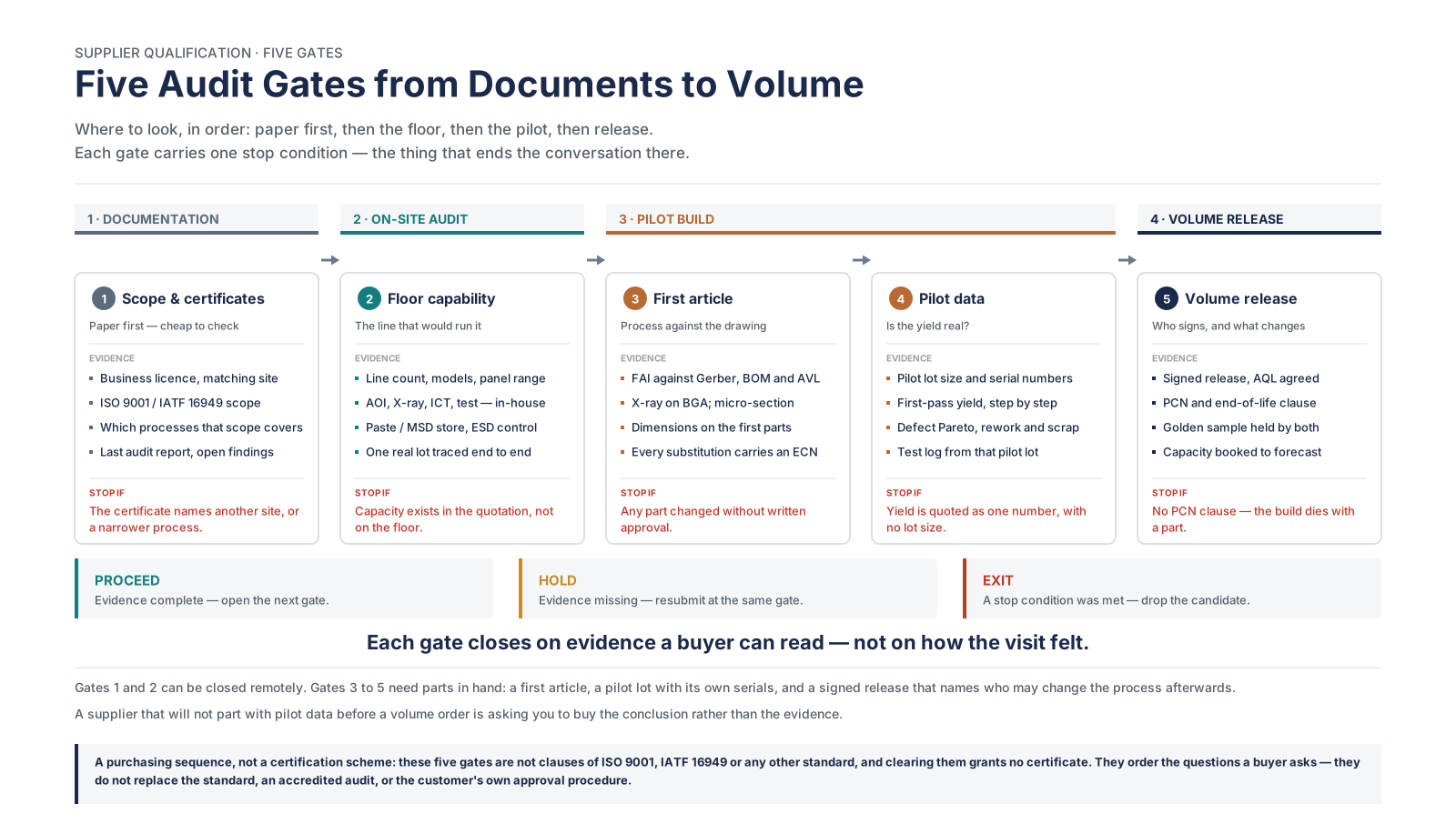
The Five Quality Audits That Make a Shortlist Useful
A PCBA supplier audit is a structured examination of a factory’s controls and records to determine whether the factory can repeatedly meet a specific assembly requirement.
A factory tour is useful when it follows a job, not a sales route. Choose a recent completed lot with the supplier’s agreement, trace its materials into production, and follow its inspection and test results to shipment. Protect other customers’ information: redacted records can demonstrate a control without disclosing a design or commercial identity.
| Audit | Ask the factory to show | A weak answer | A useful decision |
|---|---|---|---|
| 1. Solder-paste printing | Paste history, SPI recipe, actual results and reaction records | A photograph of an SPI machine | Can the factory detect and contain a printing drift? |
| 2. Materials and traceability | One lot from purchasing and receipt to finished assemblies | A generic certificate without a lot connection | Are approved parts and material history recoverable? |
| 3. Thermal control | A representative profile, its approval and change history | A standard oven recipe for every board | Is the process validated for the actual assembly? |
| 4. Inspection and test | Coverage matrix, limits, failed-unit handling and retest records | AOI described as complete functional verification | Does the plan address your important failure modes? |
| 5. First article and change control | Released baseline, first-article results and a completed change | The latest file is whichever one arrived by email | Can the correct revision reach the line without ambiguity? |
Ask for a normal record and an exception record. A normal record shows what the process is supposed to produce; a failure, hold or engineering change shows whether the system still works when events stop being routine. Do not reward a supplier simply because its example contains no defects.
Give each finding an owner and a closure condition. A missing signature, a test coverage gap and an unapproved component substitution are not equivalent. Record the consequence for your product and whether the issue blocks a pilot, blocks shipment, or can be followed up during normal supplier development.
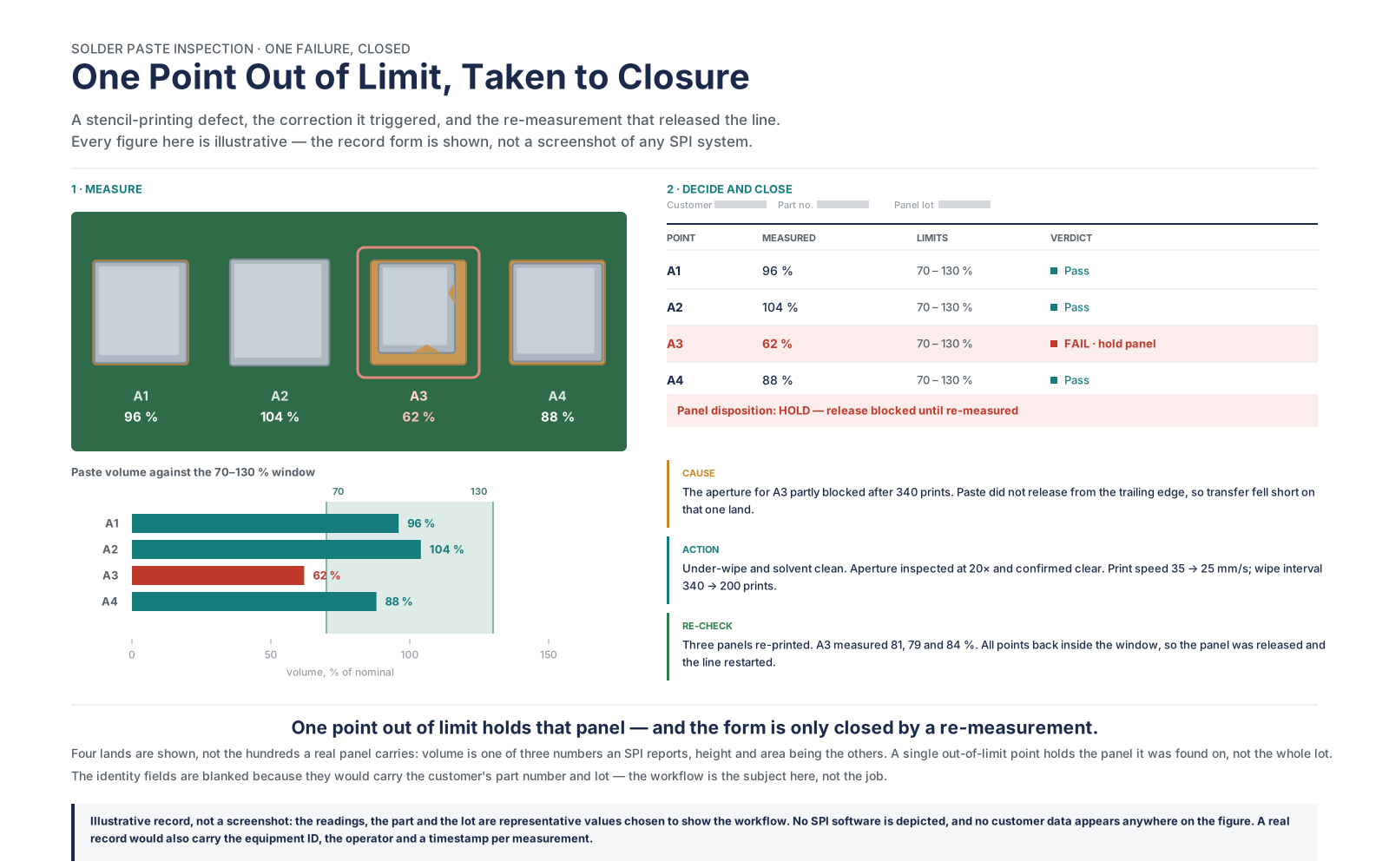
Audit 1: Follow Solder Paste From Storage to the SPI Result
Solder paste inspection, or SPI, measures printed paste deposits before component placement so that printing errors can be identified before the assembly enters reflow.
Start with the paste container and the work order. Can the operator identify the material lot, expiry, storage condition, preparation status and applicable handling instructions? Storage temperature, preparation time and stencil life must follow the actual paste supplier’s instructions and the validated process. They are not universal numbers that can be copied between products.
Then inspect a live recipe or a redacted record for a comparable board. Check the selected pads, measurement limits, program revision and how the recipe was approved. Three-dimensional SPI can measure deposit height and volume as well as area; owning that capability does not prove the limits are appropriate or the calls are reviewed.
Ask what happens when the result is out of control. Does the board stop? Who decides whether to clean the stencil, correct alignment, investigate a blocked aperture or change another process condition? Ask for the last recorded intervention and what happened to affected boards. A dashboard without a reaction plan is only a display.
Be careful with automated printer feedback. Closed-loop adjustment can be helpful, but the supplier should explain which parameter changes automatically, which changes require approval, and how an incorrect measurement is prevented from driving an incorrect correction. Do not require a generic plus-or-minus percentage as an acceptance rule for every pad geometry.
For small apertures or mixed component sizes, ask whether the factory reviews trends by feature type instead of accepting a board-wide average. A good overall paste-volume result can hide one difficult footprint. The question is whether the measurement resolves the feature that matters to your assembly.
There is no need to repeat an unsupported claim that a fixed percentage of all SMT defects comes from printing. Printing deserves scrutiny because its errors can affect joint formation downstream. The evidence is in the recipe, records and response. Our solder paste inspection guide explains the measurement stage in more detail.
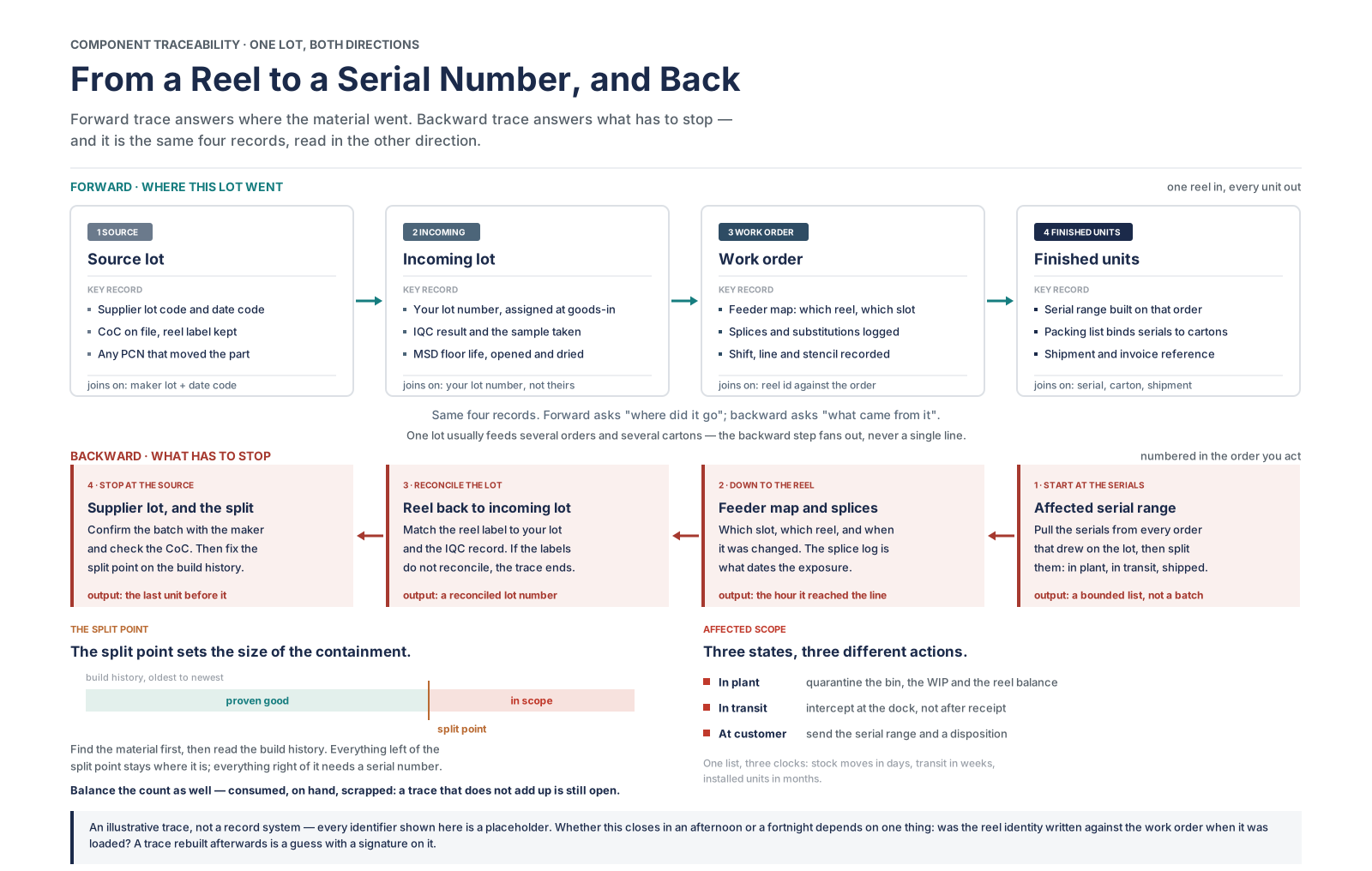
Audit 2: Trace an Actual Component Lot, Not a Sample Barcode
Component traceability is the ability to link a fitted component to its recorded identity, material lot and use in a production lot or assembly, at the granularity agreed for the product.
Ask the purchasing team to walk through the source hierarchy. Original component manufacturers and authorized distributors provide a different evidence trail from independent brokers. Where a shortage requires an exception, the buyer should approve the source and verification plan before the order is placed, not after the parts arrive.
An incoming visual check cannot prove every semiconductor authentic. Package markings, documentation review, X-ray, electrical testing or other methods each answer different questions and have limits. The appropriate plan depends on the part, provenance and product risk. Ask who is qualified to interpret the results and when an external specialist is used.
Take one part number from a finished job and work backward. Can the supplier identify the purchase, receipt, supplier lot, incoming disposition, storage history and issue to the build? Then reverse the exercise: if one incoming lot is suspect, which work orders or finished units would be contained? That second question often exposes a gap that a polished serial-number lookup misses.
| Control | A practical evidence sample | Question to resolve |
|---|---|---|
| Source approval | Purchase record linked to approved supplier and part | Who can authorize an exception? |
| Material identity | Manufacturer part number, lot/date information and receipt | How are mixed or relabeled lots prevented? |
| Moisture-sensitive handling | Storage and exposure records, with applicable instructions | How is exceeded floor life detected and dispositioned? |
| Use in production | Issue record tied to job, reel or serial range as required | What level of traceability is actually provided? |
| Containment | A forward trace from a selected material lot | Can affected inventory and shipped units be identified? |
Do not assume every project needs individual component-to-board serialization. Some products require fine-grained records; others can be controlled at batch level. Define the required granularity, retention period and retrieval method in the contract. A promise of full traceability means little until both sides agree on those three details.
Include customer-supplied parts in the same discussion. Who records a damaged moisture barrier bag? Who approves a replacement when the supplied kit is short? A consigned part still becomes part of your finished product. For the authenticity question specifically, see counterfeit component detection and sourcing controls.
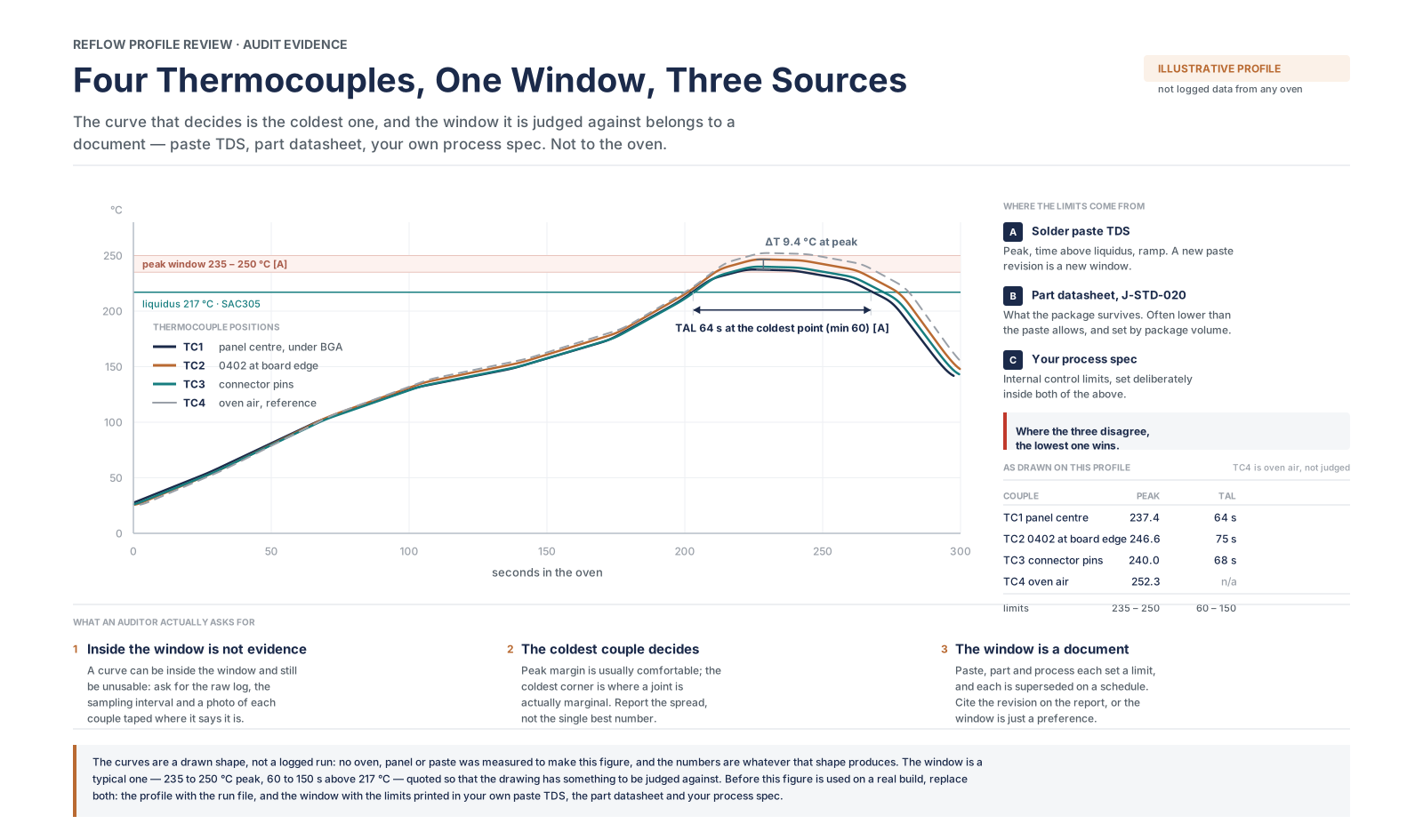
Audit 3: Ask Who Owns the Thermal Profile
A reflow thermal profile is a measured time-temperature history of an assembly passing through the soldering process; it is used to assess the process against material and component limits.
Ask for a profile from a board with comparable thermal demands, then ask how your board will be profiled during introduction. The factory should explain thermocouple locations, measurement equipment, applicable limits, acceptance and ownership. High-mass connectors, large copper regions and sensitive packages may need different measurement attention.
Do not select a supplier by counting oven zones alone. More zones may offer control flexibility, but product suitability depends on the achieved profile, available process window, loading, conveyor settings and repeatability. A machine specification is not a substitute for a measured assembly result.
Review what triggers a new profile or an engineering review. Board construction, panel arrangement, solder paste, component mass and process loading can change the thermal behavior. Ask the factory to show an actual example where a change was assessed, rather than telling you that the recipe has never needed adjustment.
Nitrogen can support wetting and oxidation control in suitable processes. It is not automatically mandatory for all lead-free assemblies, nor a guarantee that voids disappear. If it is part of the proposed process, ask what condition is controlled, how it is monitored and how the cost appears in the quote.
A profiling assembly is a production-development tool, not simply a sacrificed board. Agree how representative hardware will be obtained, who pays for it, how sensors are attached and how the profile is kept useful over time. The important point is that the measurement represents the assembly you intend to buy.
Finally, connect profiling to defect response. If the factory adjusts the process after a soldering defect, ask how the change is approved and whether already-built units require review. Otherwise a corrected recipe can coexist with an unexplained earlier lot. That is a release problem, not just a soldering problem.
Audit 4: Separate Inspection Coverage From Electrical Test Coverage
Test coverage is the defined set of defects or product functions that an inspection or test method can evaluate under stated conditions; coverage is not the same as the number of machines in a factory.
Ask the supplier to list your important failure modes and show which process addresses each one. A missing resistor, a hidden solder defect and incorrect firmware are different problems. No single inspection station proves that an assembly will operate correctly in its intended application.
| Method | Useful evidence | What must not be assumed |
|---|---|---|
| SPI | Deposit measurements and reaction records before placement | Paste acceptance proves the completed joint is good |
| AOI | Validated optical recipe, review records and defect examples | Visible appearance verifies hidden joints or function |
| X-ray / CT | Inspection views, interpretation and applicable criteria | Every hidden defect is detectable in every geometry |
| ICT / flying probe | Accessible nodes, programmed tests and measured results | Unprobed circuits or untested operating states are covered |
| Functional test | Controlled firmware, loads, limits and result log | A brief power-on check validates all product requirements |
| Environmental screening | Agreed conditions, purpose and failure disposition | Screening substitutes for design qualification or useful life evidence |
For BGA or other hidden joints, discuss why the proposed X-ray method is suitable. Two-dimensional projection and three-dimensional reconstruction provide different information. The appropriate method depends on overlap, geometry, resolution and the defect being investigated. CT is not a universal requirement for every assembly.
Require the inspection criterion to identify the package type, applicable document, measurement method and customer-specific limits. Do not accept a blanket statement that IPC requires less than ten or fifteen percent volumetric voiding for all BGA and thermal-pad joints. An area estimate from a projection image is not automatically a volume measurement.
A detailed 3D X-ray inspection discussion can help frame questions, but the purchase specification and approved criteria must govern release. Where a numerical threshold is critical, confirm the actual standard clause or component guidance rather than relying on a blog summary.
Electrical testing needs equal attention. Ask how fixtures are maintained, limits protected, firmware revisions recorded and failed units kept out of shipment. Challenge the retest rule: can an operator repeatedly run a failing board until it passes, or does the system retain the first result and require an authorized disposition?
Define who develops the test, who owns the fixture and how a test change is validated. These responsibilities affect both quote comparison and future transfer to another supplier. For an overview of available methods, see PCBA testing.
Audit 5: Make First Article Approval and Revision Control Visible
First article inspection is the documented verification of an initial assembly or agreed sample against the released requirements before further production proceeds under the approved plan.
First article approval should establish more than component presence. Check the board revision, fitted parts, polarity, approved deviations, programming identity, inspection results and electrical checks required by the product. A visually correct assembly with the wrong firmware remains the wrong product.
The sample size and timing should follow the project plan. There is no universal rule that exactly one board, inspected by a particular automated station, qualifies every product. Ask what must be approved before the line continues and who is allowed to give that approval.
| Change | Records that should move together | Release question |
|---|---|---|
| Component replacement | Approved BOM/alternate decision, procurement and feeder setup | Was the replacement approved before use? |
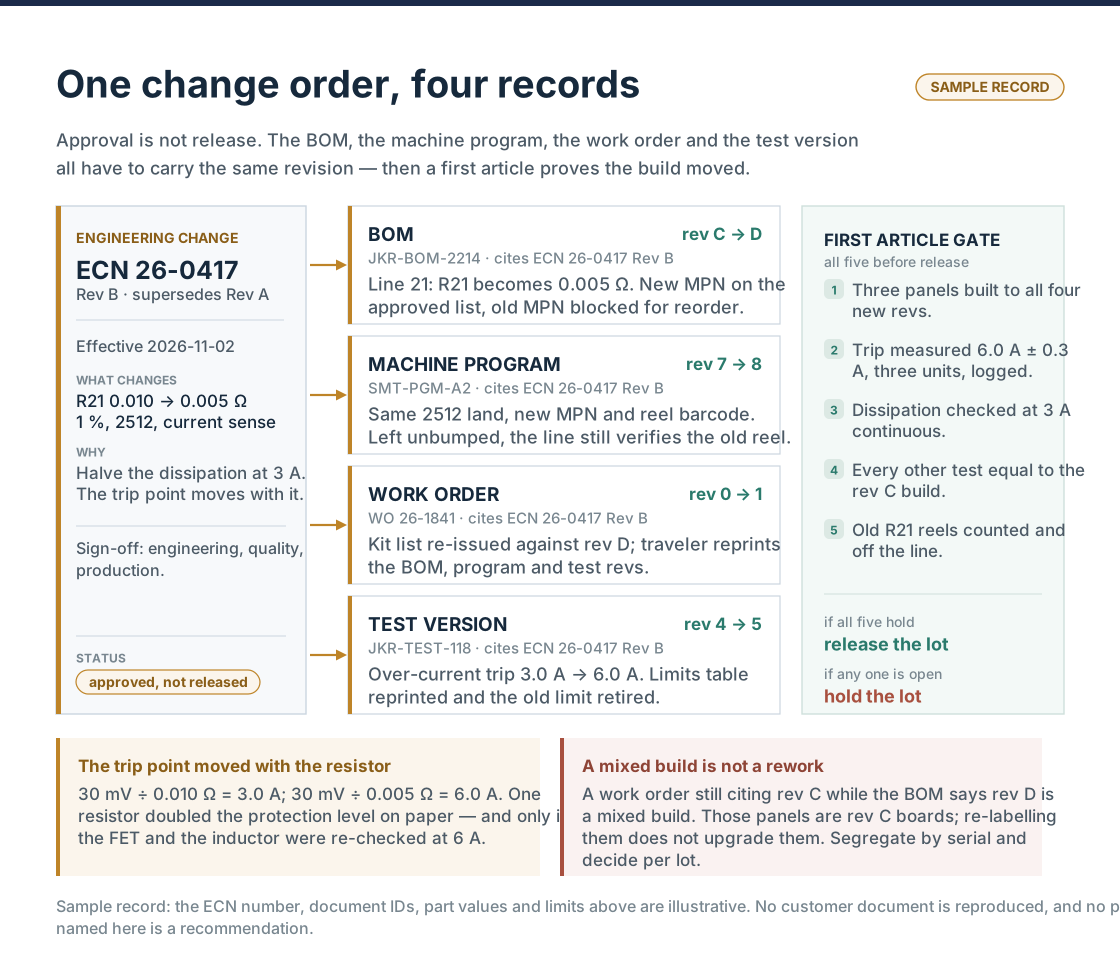
| PCB revision | Fabrication data, drawing, placement data and inspection recipe | Can old stock be used, reworked or must it be segregated? |
| Firmware update | Controlled image, programming settings and test limits | How is the programmed version verified and logged? |
| Test change | Coverage rationale, software/fixture revision and validation | Can results before and after the change be distinguished? |
| Process or site change | Risk review, instructions, qualification and notification | Does the buyer need to approve before shipment? |
Trace one completed engineering change through the system. The practical sequence is authorization, effectivity, document release, implementation, verification and record retention. Ask how the factory handles boards already in work, parts already purchased and finished units awaiting shipment. These are effectivity decisions, not email housekeeping.
A manufacturing execution system can enforce holds and revisions, but software branding is not the audit result. A well-controlled manual process may be acceptable for a suitable project; an automated system with unrestricted overrides may not be. Look at permissions, exceptions and evidence that obsolete instructions cannot quietly return to the line.
Agree on a stop rule for uncertainty. If the BOM and assembly drawing disagree, the right response is an engineering question with a recorded answer. It should not depend on an operator choosing whichever interpretation keeps the line moving.
Read Certificates and Standards for What They Actually Say
A quality management system certificate evaluates an organization’s management system within a stated scope; it is not a certificate that every assembly or finished product meets all applicable requirements.
Read the certificate PDF, not a badge on a website. Confirm the legal name, site address, scope, validity and certification body. Check whether the relevant work is included. If the proposed manufacturing site differs from the one shown, ask how the site is covered before treating the certificate as qualification evidence.
| Document or requirement | What it addresses | What to specify or verify |
|---|---|---|
| ISO 9001 | Système de gestion de la qualité | Scope, site, validity and implementation evidence |
| ISO 13485 / IATF 16949 where applicable | Sector-specific quality management requirements | Applicability to the supply chain and actual certified scope |
| IPC-A-610 | Post-assembly acceptability criteria | Agreed revision, applicable class and customer additions |
| J-STD-001 | Soldering materials and process requirements | Contractually applicable requirements and process evidence |
| IPC-7095 / IPC-7093 as relevant | Guidance for different package/assembly categories | Package relevance; do not invent one universal void limit |
| Product and material compliance | Requirements such as destination-specific restrictions | Actual declarations, test evidence and responsibility by product |
IPC-A-610 and J-STD-001 serve different purposes. IPC describes A-610 as a post-assembly acceptance standard and J-STD-001 as addressing soldering processes and materials. Neither should be used as a shortcut for an agreed electrical test specification.
Also distinguish a company certificate, a personnel credential and a product claim. An inspector’s training record does not certify the entire manufacturing site. A declaration about supplied materials does not automatically establish every regulatory requirement for the finished equipment.
If your product needs a particular acceptance class, put it in the procurement documents with the applicable revision and any additions. Do not assume a manufacturer’s claim of Class 3 capability makes every quotation, process and test result Class 3 by default. Technical exceptions should be resolved before they become production assumptions.
Normalize the Quote Before Comparing Unit Prices
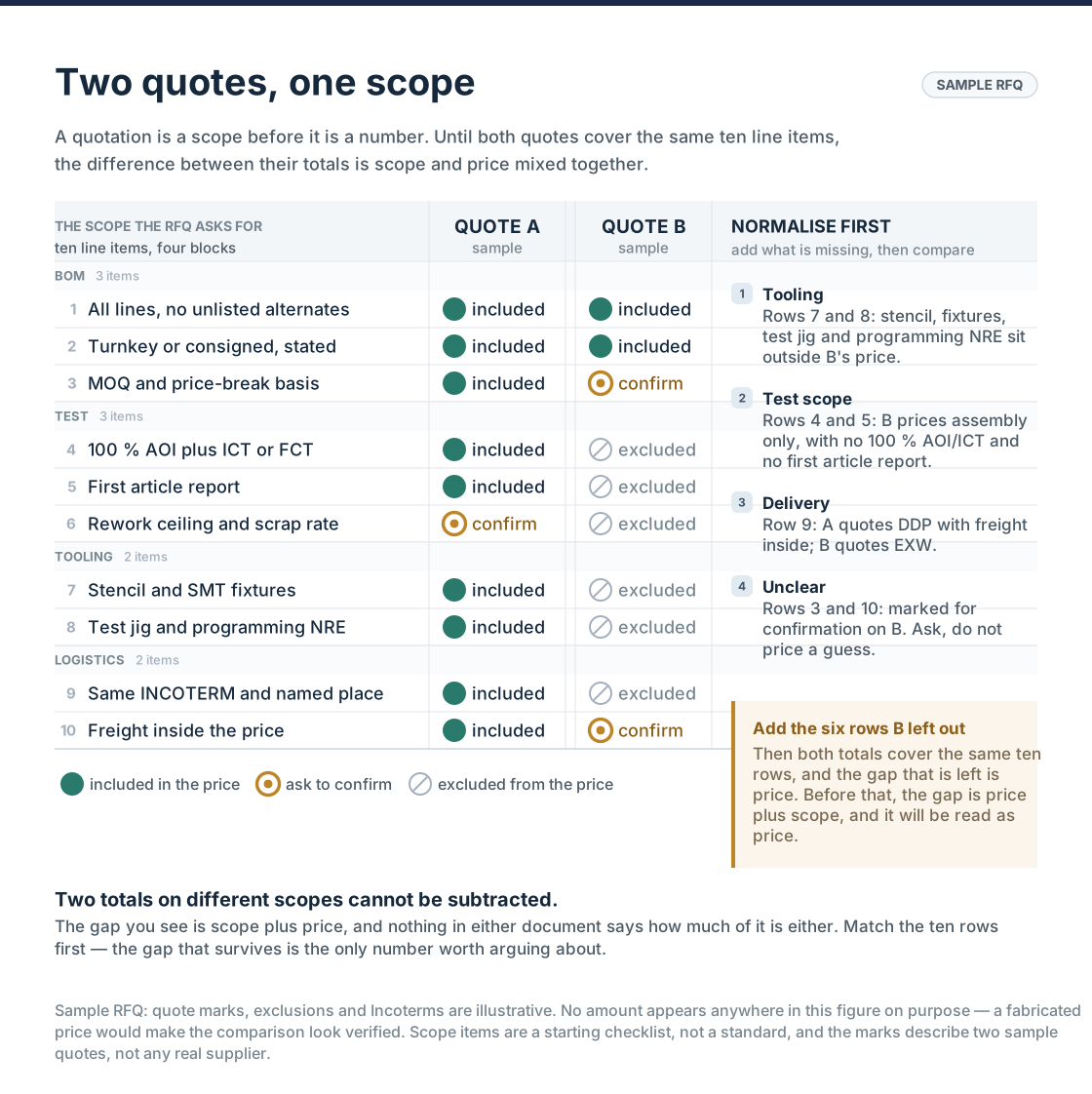
Total landed procurement cost is the agreed purchase cost plus the additional costs needed to receive usable assemblies at the destination, including applicable logistics, duties and separately charged services.
Price comparisons fail when one quote includes functional testing, programming and material handling while another covers placement and soldering only. Ask every supplier to identify inclusions, exclusions and assumptions on the same comparison sheet. Then compare the delivered scope rather than the largest or smallest number in the email.
| Cost or term | Clarify in the quotation | Common comparison error |
|---|---|---|
| BOM and procurement | Exact manufacturer parts, sources, alternates and pricing validity | Comparing different fitted components as one BOM |
| Tooling and NRE | Stencil, fixtures, programming development, maintenance and ownership | Treating one-time charges as if they recur per shipment |
| Inspection and test | Coverage, sampling, records, fixture and test time | Assuming a generic quality check includes functional testing |
| Material commitments | MOQ, reels, excess, attrition and non-cancellable items | Comparing consumed parts with the full procurement commitment |
| Delivery and logistics | Material-ready milestone, shipment term and named place | Comparing ex-factory and delivered quotes without adjustment |
| Changes and failures | Rework approval, retest, returns and deviation handling | Leaving responsibility to be negotiated after a failure |
For repeated orders, ask what changes with volume and what does not. A fixture cost can be amortized; an expensive test cycle still takes time on every unit. A lower assembly rate can be offset by excess inventory or repeated engineering charges. A useful PCB assembly cost breakdown separates these cost drivers.
Do not ask a supplier to promise a fixed lead time without a material basis. Distinguish quotation turnaround, component procurement, build time, test readiness and transport. A forecast date should state what must be approved or available for the schedule to hold.
Put shortages and substitutions in writing. A form-fit-function claim can be a starting point for review, but it is not permission to fit an unapproved alternate. Decide who pays for existing stock, how a substitution is validated and what happens to the schedule while approval is pending.
The quality agreement should define containment, return authorization, failure analysis and corrective action. Liability and warranty wording need commercial and legal review for the transaction; a blog checklist cannot settle them. What it can do is stop those subjects being omitted until a shipment is already disputed.
Qualify a Pilot Build Against Written Release Gates
A pilot build is a controlled production exercise used to verify that the intended materials, process, documentation and test system work together before routine volume release.
A prototype proves that something can be built. A representative pilot examines whether the intended production route can build it under controlled conditions. Where practical, use the proposed site, normal staff, production programs, approved sources and actual test method. Record any difference so it does not disappear from the qualification decision.
Choose pilot quantities and repetition according to risk, process novelty and the evidence you need. There is no universal pilot quantity or mandatory number of successful lots for every PCBA. A complex safety-relevant assembly needs a different plan from a low-risk board using an established process.
| Release gate | Evidence | If the gate is not met |
|---|---|---|
| Baseline ready | Released design package, BOM, approved deviations and test plan | Hold the build until conflicting requirements are resolved |
| Materials and setup ready | Approved sources, traceability, instructions and verified programs | Contain questionable materials or setup conditions |
| First article approved | Documented findings and authorized disposition | Correct the issue and repeat relevant checks |
| Pilot results acceptable | Yield definitions, defects, inspection/test logs and actions | Investigate, correct and gather the evidence needed for approval |
| Production release | Closed critical findings, capacity plan and named release authority | Do not turn a conditional pilot into an unqualified production release |
Keep first-pass yield separate from final yield. First-pass yield counts units that pass the defined process or test on the first attempt; final yield may include successfully repaired or retested units. Both can be useful, but mixing them makes two suppliers appear comparable when they are measuring different things.
Require the denominator and the observation point. A percentage from a handful of boards says little about long-term performance, and a placement-level metric is not interchangeable with a board-level metric. Ask for counts, defect categories and the disposition history behind the percentage.
A pilot defect is not automatically a supplier rejection. A supplier that contains the issue, identifies a defensible cause and verifies an effective correction may be preferable to one that supplies a perfect-looking sample with no supporting records. The release decision depends on the evidence, not how uncomfortable the review meeting feels.
Close the loop on packaging and shipment. Confirm ESD protection, any moisture controls, labels and identification needed to receive the boards correctly. PCBA shipping and packaging requirements should be part of release, not a note added after the build.
Make the Award Decision, Then Keep the Evidence Current
Supplier approval is a conditional authorization to purchase a defined scope from a defined source; it should be reviewed when the product, process, site or supplier performance changes.
Use a scorecard only after non-negotiable requirements are met. A weighted average can hide a failed traceability requirement behind good delivery and an attractive price. Treat product-critical gaps as release conditions, not points that can be compensated by a tidy reception area.
| Decision level | Example | Action |
|---|---|---|
| Stop / unresolved critical risk | Unapproved substitutions, unverifiable build site, uncontrolled release baseline | Do not award the affected scope until resolved |
| Conditional approval | A defined documentation or process gap with agreed containment | Assign an owner, evidence requirement and closure date |
| Qualified for stated scope | Pilot and audit evidence meet agreed requirements | Release within the approved product and site scope |
| Ongoing review | Performance change, repeat defect, process transfer or major revision | Reassess the relevant part of qualification |
If using scores, label the weights as your purchasing policy. Do not present an invented pass mark as an industry standard. Different programs can reasonably prioritize field reliability, engineering responsiveness, capacity flexibility or cost differently, provided critical quality requirements remain gates.
Ask what delivery performance means before collecting it. A supplier measuring against the latest revised promise date may look better than one measuring against the originally confirmed shipment date. The same problem appears when one team excludes material shortages and the other includes them.
After award, review a small, stable set of measures: agreed-date delivery, first-pass and final results under defined rules, escaped defects, open corrective actions and unapproved changes. Keep the underlying counts. Low order volumes can make percentages swing dramatically without indicating a stable trend.
Business continuity belongs in the review as well. Ask what happens if a critical fixture, test computer, key component or production line becomes unavailable. A backup plan is useful only if the alternate route can meet the same approved requirements. Moving the work to a different site without review can invalidate the assumptions behind your original approval.
Bring the Same Questions to JKRGLO
A useful first discussion is a review of the job, not a general request for the lowest price. Share the current design package, expected volumes, sourcing constraints and release requirements. Ask which work would be performed at the proposed site, what evidence is available and what remains to be confirmed before a quotation becomes a production commitment.
For a JKRGLO project, request a product-specific capability review covering the BOM, assembly route, inspection and test responsibilities, and any open manufacturing questions. Treat company information as a starting point and verify the requirements that matter to your order.
Send the BOM, manufacturing files and test requirements to JKRGLO and ask for a clearly scoped engineering and quotation review. Do not include confidential customer data unless the disclosure arrangements are in place.
FAQ: Choosing a PCBA Manufacturer
1. What is the difference between a PCB manufacturer and a PCBA manufacturer?
A PCB manufacturer fabricates the bare board. A PCBA manufacturer assembles components onto that board and provides the agreed related services. Some companies provide both through their own operations or approved partners. Ask which site performs each step and who controls quality and changes.
2. How do I choose a PCBA manufacturer for repeat production?
Start with the actual product and order pattern, eliminate capability mismatches, audit material and process controls, normalize the quotations and qualify a representative pilot. Repeat production also needs agreed material commitments, controlled test records, revision handling and a realistic capacity plan.
3. What should I send with a PCBA RFQ?
Send the released board data, BOM, placement data, assembly drawings, quantities, schedule and applicable quality requirements. Include firmware and test requirements where relevant, plus approved alternates and material ownership. Identify incomplete information so the quotation can state its assumptions.
4. Is ISO 9001 enough to approve a PCBA supplier?
No. ISO 9001 concerns the quality management system within the certified scope. Supplier approval also needs evidence of product capability, actual process control, inspection and test coverage, and acceptable qualification results. Sector-specific requirements may add further obligations.
5. Does IPC Class 3 capability mean every board is supplied to Class 3?
No. The applicable acceptance class, revision and customer-specific requirements must be agreed for the order. A capability claim alone does not define the production scope, electrical test, process controls or release documentation included in a quotation.
6. Does a good PCBA factory need 3D X-ray for every board?
No. Inspection should address the package geometry and failure modes. Some assemblies can be inspected adequately without CT; others need methods that resolve overlapping or hidden features. Agree the method and acceptance criteria rather than using one machine type as a universal qualification rule.
7. What are the five most useful PCBA quality audits?
Review solder-paste printing and SPI response, component sourcing and traceability, thermal profiling, inspection and electrical test coverage, and first article plus engineering-change control. For each area, examine a real record and an exception record, not only a procedure.
8. Can a remote factory audit replace an on-site audit?
A structured remote review can screen documents, demonstrate workflows and sample records. Its limits include camera selection, access and difficulty following material movement independently. Use the method that provides enough evidence for the product risk; remote access is not automatically equivalent to an on-site assessment.
9. How many boards should a pilot build include?
There is no single quantity suitable for every assembly. Set the pilot plan according to process novelty, component and package risk, expected production conditions and the evidence needed for release. Record sample size and limits rather than claiming a small successful batch proves long-term yield.
10. Should I choose the cheapest PCBA quotation?
Only after confirming that the quotations use the same approved components, tooling, inspection, testing and delivery scope. Compare material commitments and recurring costs as well as unit price. A cheap quote with missing test coverage is not the same purchase at a lower price.
11. Who should own the test fixture and production data?
Ownership, maintenance, access and transfer rights should be written into the commercial agreement. Clarify which files, test programs, logs and fixtures are customer-owned, how they can be retrieved and what charges apply. Do not assume that paying a tooling line item settles every ownership question.
12. When should a buyer walk away from a PCBA supplier?
Stop when a product-critical requirement remains unresolved, such as unauthorized substitutions, an unverifiable manufacturing site, uncontrolled revisions or inadequate release evidence. Ordinary improvement findings can be managed, but they should not conceal a gap that prevents responsible product acceptance.
Reference notes. IPC distinguishes IPC-A-610 acceptability and J-STD-001 process requirements. Package guidance is summarized on the IPC advanced electronic packaging page. For the management-system distinction, see ISO’s explanation of ISO 9001. These public summaries do not replace the contractually applicable standards, specifications or regulatory review. Audit questions and decision gates in this article are practical purchasing guidance, not a prescribed certification scheme.

À propos de l'auteur
Andrew Zhan – Ingénieur R&D chez JKRGLO.com
Fort de plus de 14 ans d'expérience en ingénierie de R&D dans le secteur des circuits imprimés, Andrew Zhan apporte une expertise approfondie en matière d'optimisation de la conception des circuits et de mise en œuvre des principes de conception pour la fabrication (DFM). Il s'attache à transformer des exigences de conception complexes en solutions prêtes pour la production, en favorisant l'innovation technique tant pour la fabrication de prototypes que pour la production en série.
En étroite collaboration avec des équipes pluridisciplinaires et les clients, il veille à une validation rigoureuse de la qualité et à une communication technique fluide tout au long du cycle de vie du projet. Andrew s'engage à fournir des solutions de circuits imprimés fiables et hautement performantes qui dépassent systématiquement les attentes des clients.
Table des matières
Vous avez encore besoin d'aide ? Contactez-nous :
Vous avez besoin d'un devis pour un circuit imprimé (PCB) ou un assemblage de circuit imprimé (PCBA) ?
 English English English
 Deutsch
 Français
 Italiano
 Español
 日本語
 한국어 English English English Deutsch Français Italiano Español 日本語 한국어