
5G Ultra Wideband vs. Nationwide 5G: Speed Differences, Spectrum Bands, and Real-World Coverage
Introduction liminaire
Quick Answer:5G Ultra Wideband (UWB) is a high-frequency, ultra-fast tier of 5G that delivers gigabit-level download speeds (often exceeding 1Gbps) with near-zero latency, but it operates over limited physical distances. In contrast, Nationwide 5G uses low-band frequencies to provide broad, coast-to-coast geographic coverage and strong wall-penetration capabilities, though its speeds (50Mbps to 250Mbps) are only slightly faster than late-stage 4G LTE network connections.
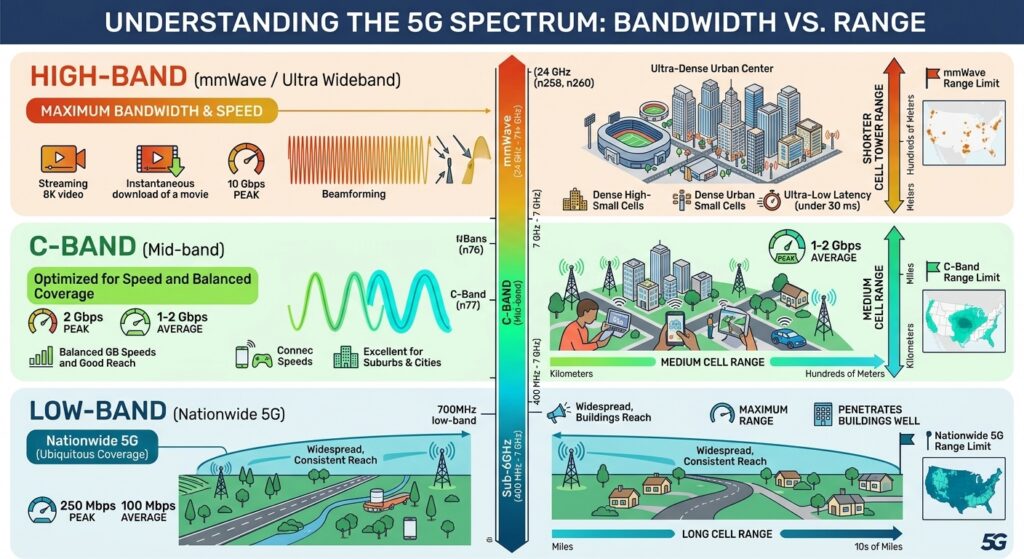
The Core Technical Split: High-Band mmWave vs. Low-Band Sub-6GHz
| Band Category | Frequency Range | 5G Type | Key Characteristics |
|---|---|---|---|
| Low-Band | <1 GHz | Nationwide 5G |
|
| Mid-Band | 2.5 GHz – 3.7 GHz | 5G UWB (C-Band) |
|
| High-Band | 24 GHz+ | 5G UWB (mmWave) |
|
1. Nationwide 5G (Low-Band / Sub-6GHz)
Nationwide 5G relies on low-frequency spectrum bands (typically under 1GHz or Sub-6GHz) shared or overlaid onto existing 4G LTE infrastructure using Dynamic Spectrum Sharing (DSS).
- Frequency Range: 600MHz to 2.5GHz
Propagation: Radio waves travel several miles from a single cell tower and pass through concrete walls, foliage, and window glass easily.
User Experience: Highly reliable mobile signal icon, but speeds feel incrementally faster than a stable 4G connection.
2. 5G Ultra Wideband (Mid-Band C-Band & High-Band mmWave)
5G Ultra Wideband (a term popularized heavily by carriers like Verizon, but representing high-capacity 5G architectures globally) combines C-Band spectrum (3.7GHz-3.98GHz) with millimeter wave (mmWave) bands (24GHz-39GHz).
Frequency Range: 3.7GHz up to 39GHz.
Propagation: High attenuation. mmWave signals can be blocked by buildings, glass windows, heavy rainfall, or even human hands covering phone antennas.
User Experience: Instantaneous 4K / 8K video streaming, rapid multi-gigabyte file downloads, and low latency essential for real-time edge computing.

Head-to-Head Performance Comparison
| Feature / Metric | 5G Nationwide | 5G Ultra Wideband (C-Band) | 5G Ultra Wideband (mmWave) |
|---|---|---|---|
| Typical Download Speed | 50-200 Mbps | 300-600 Mbps | 1.0-3.0+Gbps |
| Average Latency | 30 - 50 ms | 15 - 25 ms | < 10 ms |
| Signal Distance / Cell Range | Multi-mile radius per tower | 1 - 3 miles per tower | Several hundred feet per small cell |
| Indoor Obstacle Penetration | Excellent | Modéré | Poor (Requires direct line-of-sight) |
| Deployment Location | Rural, highways, suburbs | Suburbs, commercial districts | Airports, sports stadiums, urban hubs |
Hardware and PCB Design Implications for 5G Devices
Enabling both 5G Nationwide and 5G Ultra Wideband inside a single handheld or IoT hardware design introduces severe Printed Circuit Board (PCB) routing challenges.
| Component | Connection / Technology |
|---|---|
| Sub-6GHz Baseband IC | Standard Microstrip Traces |
| mmWave Transceiver IC | AiP (Antenna-in-Package) |
| Phase Array Modules | — |
Antenna-in-Package (AiP) Integration: mmWave frequencies cannot tolerate long copper PCB trace lengths without excessive signal attenuation. RF engineers must use AiP modules, placing phased-array antennas directly onto the IC package.
Ultra-Low Loss Substrates: Standard FR-4 dielectric materials exhibit high signal absorption at $28\text{GHz}+$. High-frequency 5G PCBs require specialized high-speed substrates such as Rogers (RO4000 series) or Liquid Crystal Polymer (LCP) materials.
Thermal Dissipation Planes: Processing multi-gigabit data streams generates substantial local thermal stress on RF transceivers. Board designs require dense arrays of thermal vias leading directly to copper ground planes or heat spreaders.
Foire aux questions (FAQ)
Why does my phone switch between 5G and 5G UW?
Your mobile device dynamically switches network modes based on proximity to cell towers and signal quality. When you enter an area covered by C-Band or mmWave small cells, the phone automatically connects to 5G Ultra Wideband to deliver maximum bandwidth. When moving indoors or out of line-of-sight, it falls back to 5G Nationwide or 4G LTE to preserve connection stability.
Does 5G Ultra Wideband drain the phone battery faster?
Yes. Transmitting and receiving high-frequency millimeter wave signals requires more processing power from modem chipsets and RF front-end amplifiers. When actively downloading large files over mmWave Ultra Wideband, power draw increases compared to standard low-band 5G.
Is 5G Ultra Wideband available in rural areas?
Generally, no. Due to the limited signal range of high-frequency spectrums, installing millions of mmWave small cells across rural environments is not cost-effective. Rural areas rely primarily on 5G Nationwide (Sub-6GHz) and low-band towers to maintain wide geographic coverage.
À propos de nous
Cela pourrait également vous intéresser…

À propos de l'auteur
Andrew Zhan – Ingénieur R&D chez JKRGLO.com
Fort de plus de 14 ans d'expérience en ingénierie de R&D dans le secteur des circuits imprimés, Andrew Zhan apporte une expertise approfondie en matière d'optimisation de la conception des circuits et de mise en œuvre des principes de conception pour la fabrication (DFM). Il s'attache à transformer des exigences de conception complexes en solutions prêtes pour la production, en favorisant l'innovation technique tant pour la fabrication de prototypes que pour la production en série.
En étroite collaboration avec des équipes pluridisciplinaires et les clients, il veille à une validation rigoureuse de la qualité et à une communication technique fluide tout au long du cycle de vie du projet. Andrew s'engage à fournir des solutions de circuits imprimés fiables et hautement performantes qui dépassent systématiquement les attentes des clients.
Table des matières
Vous avez encore besoin d'aide ? Contactez-nous :
Vous avez besoin d'un devis pour un circuit imprimé (PCB) ou un assemblage de circuit imprimé (PCBA) ?
Étiquette :
what is 5g ultra wideband
PCBA
5g ultra wideband