
Non‑Recurring Engineering (NRE): What It Means for Your PCB Quote
Opening Introduction
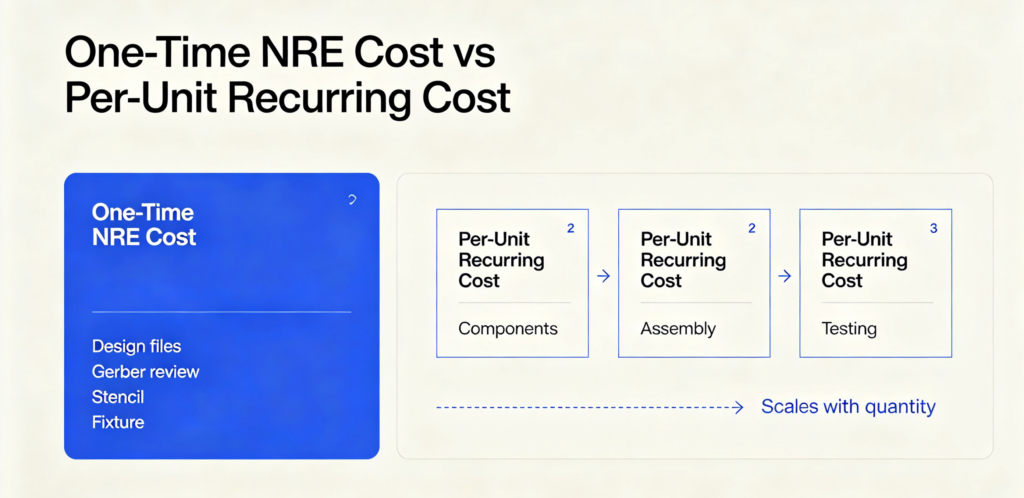
Quick answer: What does NRE stand for? NRE is short for Non‑Recurring Engineering. These are one‑time setup and engineering charges to prepare your unique PCB design for manufacturing and assembly; they do not repeat for every unit you order.
What Is Included in PCB‑Related NRE Costs
- DFM review and Gerber file processing
- Pick‑and‑place machine programming
- Solder stencil fabrication
- Electrical test bed / fixture building
- Reflow and inspection program setup
- First‑article validation workBittele El…
It is critical to understand: NRE is separate from your per‑unit board cost. You pay it once, while unit costs multiply by your order quantity.
Main Factors That Drive Your NRE Expense
Three primary variables move your NRE number up or down: board physical size, layer count, and project complexity. Order strategy also plays a big role.
Below is a quick reference table summarizing how design choices impact NRE:
| Factor | Effect on NRE Cost | Practical Tip |
|---|---|---|
| PCB physical dimensions | Larger boards increase stencil and test-bed work → higher NRE | Keep board footprint as compact as real-world constraints allow |
| Number of PCB layers | More layers mean extra CAM processing and tooling work | Only use multi-layer stacks when your design absolutely requires them |
| Design complexity (fine pitch, special requirements) | Tighter tolerances, blind/buried vias raise engineering labor | Stick to standard design rules for prototype builds |
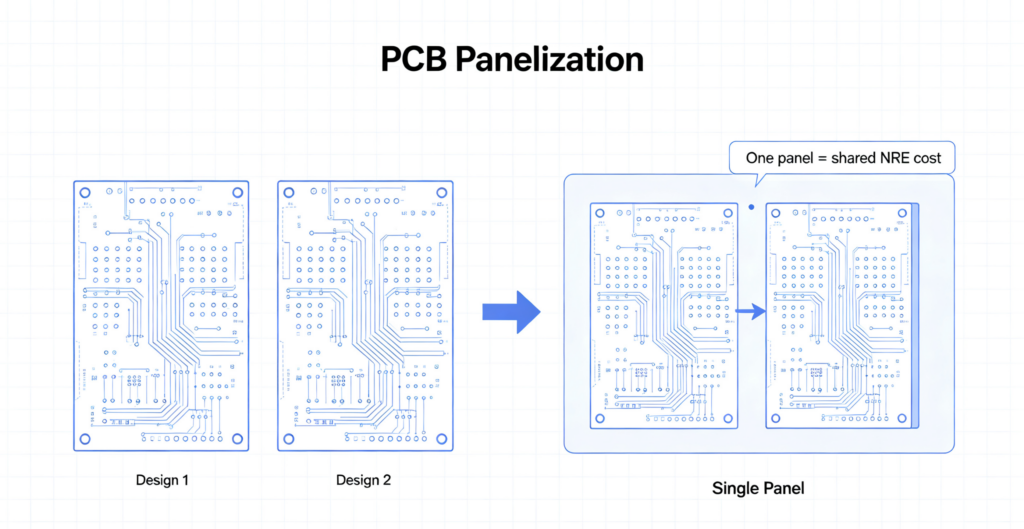
| Order panelization | Multiple designs combined to one panel = single NRE charge | Merge small independent jobs into one panel when feasible |
Even if NRE cannot be eliminated entirely, small design tweaks can keep it from ballooning out of control.
Actionable Ways To Lower Your NRE Charges
Some level of NRE will always exist for new custom hardware. Manufacturers must build stencils, write machine code and validate your files. Still, you have real options to cut expenses.
- Optimize your PCB layout Keep dimensions compact and hold layer count minimal. Avoid unnecessary exotic specifications unless your end‑product demands them. This directly cuts tooling and engineering hours.
- Use panelization for multiple small projects Suppose you have two separate projects, each for 50 boards. Ordering them separately triggers two full NRE bills. If you combine both onto one production panel, you pay only one set of NRE fees. This trick works great for prototypes and small‑batch jobs.
- Re‑use existing tooling on repeat orders Most PCB assemblers will safely store your solder stencils and programming files after your first production run. When you re‑order the exact same design, full NRE is waived. You will still see a smaller setup and test‑time fee, but you get a large discount. Even minor component changes can often reuse much of the original work, so always ask your vendor what can be carried over from prior buildsBittele El….
Frequently Asked Questions (FAQ)
Q: What does NRE stand for in PCB manufacturing?
A: NRE stands for Non‑Recurring Engineering. It covers one‑time engineering, programming and tooling work needed to get your unique PCB design ready for assembly. It is not a per‑board charge.
Q: Is NRE refundable if I cancel my order?
A: Typically no. Once tooling like solder stencils is manufactured or machine programming is finished, that labor and material is already spent, so NRE is usually non‑refundable. Clarify cancellation terms with your manufacturer up‑front.
Q: Will I pay full NRE again for my second production run?
A: Not if your design stays unchanged. When stencils and program files are retained by the factory, you avoid most original NRE costs; only minimal assembly setup and test time fees apply. If you release a major design revision, new partial or full NRE will apply.
About US
You may also be interested in…

About the Author
Andrew Zhan – R&D Engineer at JKRGLO.com
With over 14 years of R&D engineering experience in the PCB industry, Andrew Zhan brings deep expertise in circuit design optimization and DFM implementation. He focuses on translating complex design requirements into production-ready solutions, driving technical innovation for both prototype and mass production.
Working closely with cross-functional teams and clients, he ensures rigorous quality validation and seamless technical communication across the full project lifecycle. Andrew is committed to delivering reliable, high-performance PCB solutions that consistently exceed customer expectations.
Table of Contents
Still, need help? Contact Us:
Need a PCB or PCBA quote?
Tag:
what does nre stand for in manufacturing
PCBA
nre meaning
PCB